Insurance Policy Management Systems: 2026 Guide
Compare the best insurance policy management systems for 2026. Discover key features, pricing, and tools to streamline your workflows and boost efficiency.
Written by AI for Insurance
Insurance policy administration systems have become a $3.6 billion to $10.5 billion global market in 2025, with published forecasts ranging from 8.2% to 12.3% annual growth, depending on market definition. That scale makes selecting a policy management platform a strategic enterprise decision, not a back-office software purchase.
The reason is structural. The policy administration system is the operational record for policies, billing, endorsements, renewals, and servicing. If its architecture limits product changes, integrations, auditability, or data quality, the constraint reaches underwriting, distribution, claims, compliance, and customer service.
Most buying guides still compare feature lists. After evaluating policy administration capabilities across complex insurance environments, I'd use a different test: Can the platform change without custom-code dependence, expose reliable data and controls for AI, and support a sequenced modernization program without disrupting live servicing?
Table of Contents
- Why Policy Administration Systems Now Drive Insurance Strategy
- Cloud-Native Architecture vs Legacy Monoliths, The Real Differentiator
- Policy Lifecycle Coverage, What Configuration Means in Practice
- AI Augmentation in Policy Management, When to Embed and When to Orchestrate
- Vendor Selection Criteria, KPIs That Matter More Than Feature Lists
- Modernization Sequencing, Phasing Replacements Without Losing Agility
- Building Your Policy Management System Evaluation Playbook
Why Policy Administration Systems Now Drive Insurance Strategy
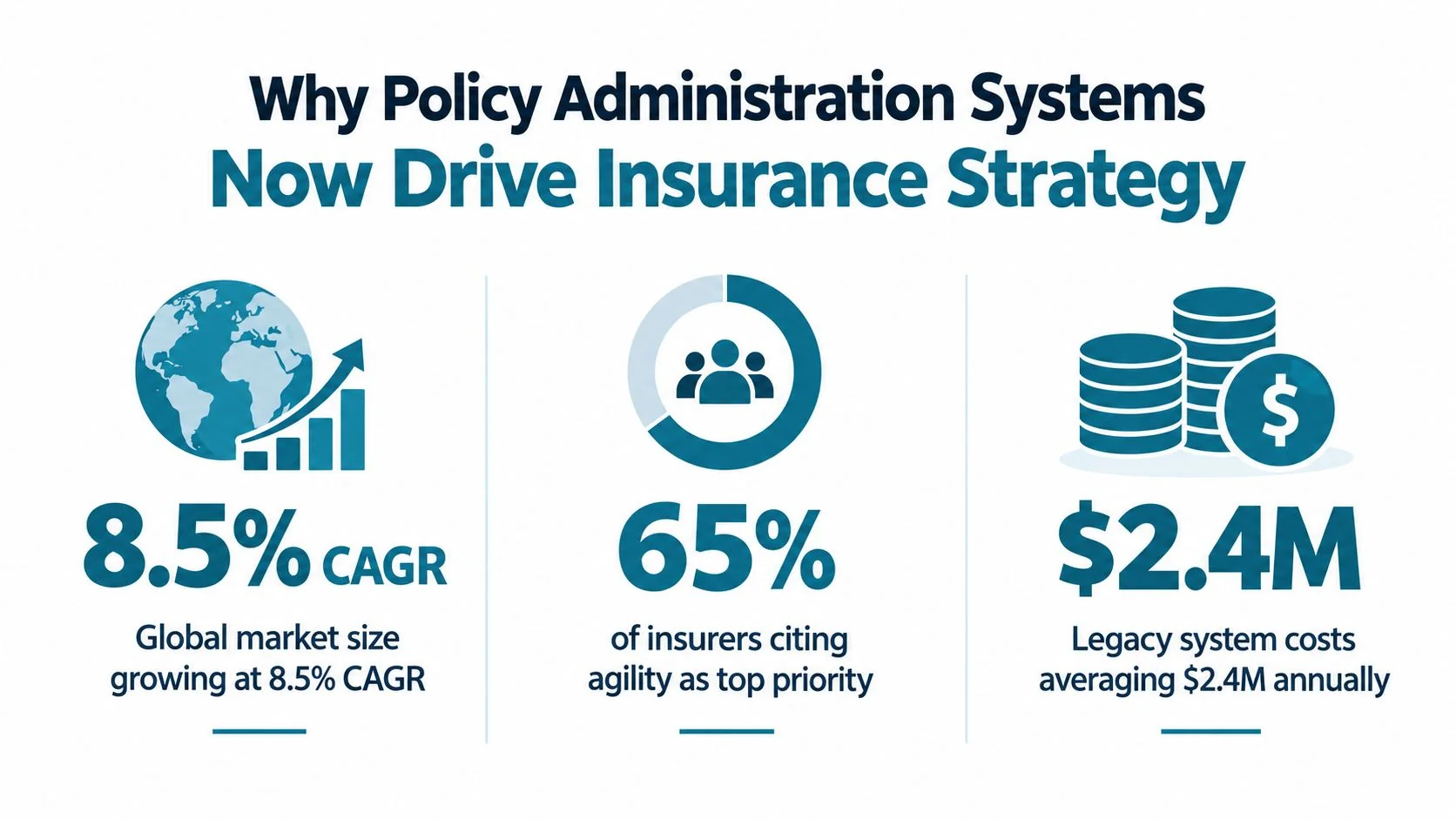
The market's expansion signals a change in how insurers view policy administration. One estimate places insurance policy administration systems software at $3.6 billion in 2025, rising to $4.04 billion in 2026, with a projected 12.3% year-over-year growth rate and a forecast of $6.37 billion by 2030 at a 12.1% CAGR. A broader estimate values the category at $10.5 billion in 2025 and projects $21.4 billion by 2034 at an 8.2% CAGR. These estimates use different market boundaries, but both point to the same conclusion, policy administration has become a major enterprise software category. The market estimates and growth projections are detailed by The Business Research Company.
Why the system of record matters
A PAS doesn't merely store policy documents. It coordinates the lifecycle that connects quote, underwriting, issuance, billing, endorsements, renewal, cancellation, and servicing. That makes its data and workflow decisions relevant to actuarial analysis, claims handling, regulatory reporting, customer communications, and distribution.
The investment is being driven by several pressures:
- Legacy modernization: Insurers are replacing or surrounding platforms that make product changes and integrations slow.
- Product complexity: New coverages, riders, pricing structures, and jurisdictional requirements increase configuration demands.
- Digital distribution: Customers and intermediaries expect policy servicing across multiple channels.
- Compliance control: Insurers need traceable rules, approvals, records, and data lineage.
- AI adoption: AI initiatives require stable data contracts, observable workflows, and auditable execution.
The strategic implication is easy to miss. A system that issues policies efficiently but makes a new product expensive to configure can restrict underwriting agility. A platform with impressive digital interfaces but weak audit trails can create compliance exposure. A PAS must therefore be assessed as part of the insurer's operating model, not as an isolated application.
The 2026 buying environment
The modernization cohort is also changing. Recent industry coverage indicates that many large and midsize insurers have already completed core replacements, while smaller and specialty carriers are becoming a more prominent group of buyers. Those organizations often face tighter resource constraints, more heterogeneous portfolios, and greater dependence on external integrations.
A European survey cited by BearingPoint identified the availability of IT resources to maintain and modernize platforms as a pressing challenge, scoring 7.4 out of 10. The modernization trend analysis discusses that resource constraint and related implementation pressures.
Strategic test: Choose the platform that preserves underwriting change while reducing operational dependence on scarce legacy skills.
Cloud-Native Architecture vs Legacy Monoliths, The Real Differentiator
A feature checklist can tell you whether a platform supports endorsements or renewals. It can't tell you whether changing an endorsement requires a vendor release, a code deployment, or a business-user configuration. That distinction is where architecture becomes an operating-cost and agility issue.
Compare the seams, not the screens
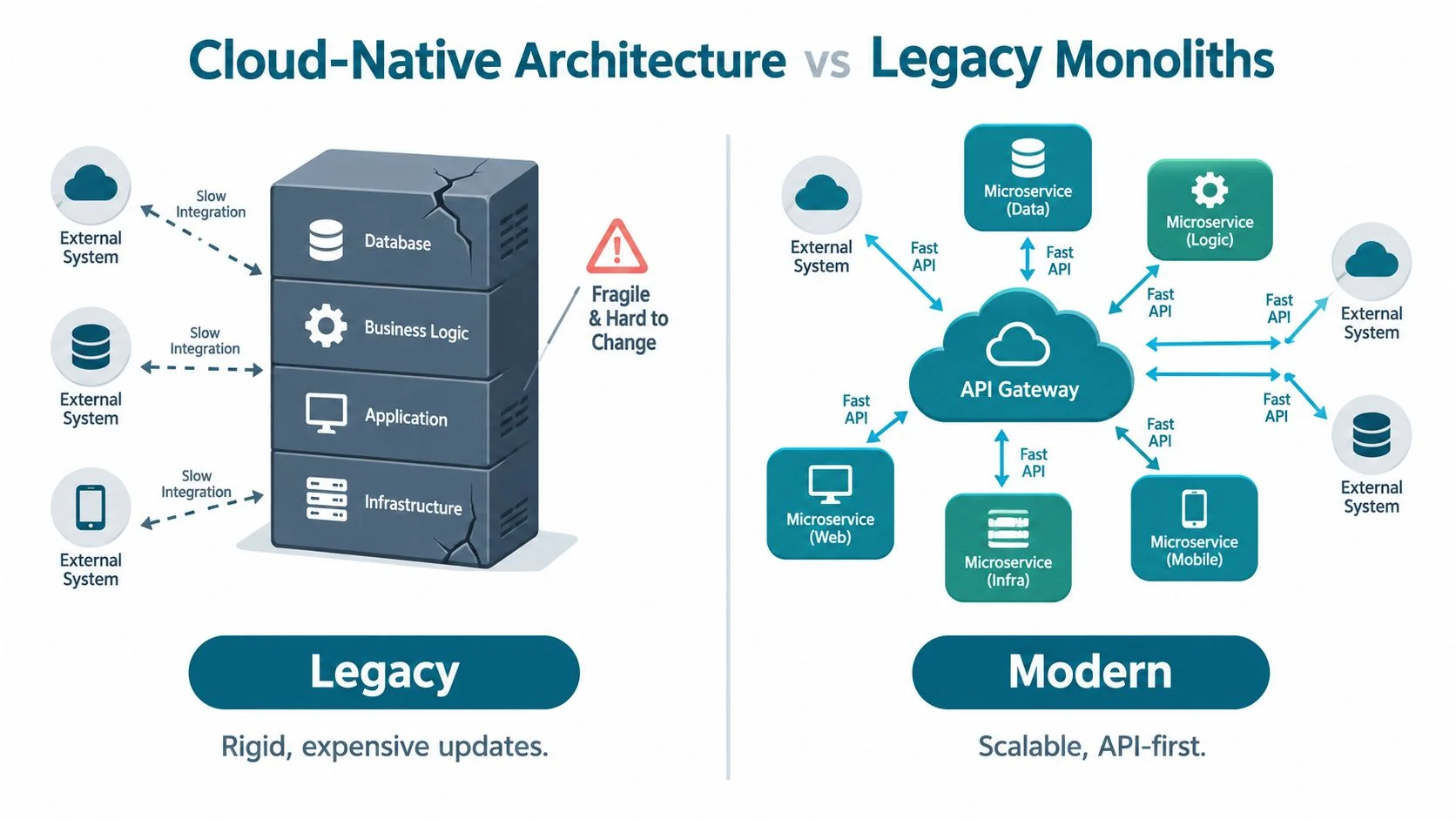
A modular, cloud-native PAS should separate capabilities without creating disconnected data silos. Policy, rating, billing, document generation, workflow, and identity services should communicate through stable interfaces. That doesn't mean every insurer needs a collection of microservices. It means the architecture must allow a capability to evolve without forcing the entire policy engine to change with it.
| Evaluation dimension | Rigid legacy design | Modular modern design |
|---|---|---|
| Product change | Often dependent on custom development | Configuration and rules can handle many changes |
| Integration | Point-to-point interfaces and brittle dependencies | Documented APIs and reusable service contracts |
| Workflow | Hard-coded process paths | Orchestrated, configurable journeys |
| Auditability | Broad transaction logs may lack field detail | Field-level history, user attribution, and RBAC |
| Recovery | Commitments may be unclear or infrastructure-dependent | Defined RTO and RPO obligations |
| Channel expansion | New channels can require duplicated logic | Shared services support multiple channels |
Architecture claims need evidence. Ask the vendor to demonstrate a product change from definition through rating, documentation, approval, and issuance. Then ask which parts were configured, which required code, who performed the work, and how the change was tested and rolled back.
Integration depth is a control
Modern insurance policy management systems should support documented APIs, common insurance data exchanges such as ACORD XML and AL3, field-level audit trails, role-based access control, configurable rules, and explicit disaster-recovery RTO and RPO commitments. These requirements aren't decorative technical preferences. They determine whether the platform can exchange data, prove who changed what, and recover predictably.
The integration assessment should include inbound and outbound data, error handling, replay capability, versioning, authentication, and monitoring. A successful demonstration isn't a live data feed that works once. It's an observable process showing what happens when a record is incomplete, duplicated, rejected, or changed after downstream transmission.
For a practical view of how digital insurance platforms fit into a broader architecture, see this overview of digital insurance platforms. The key buying principle remains simple: a modern interface doesn't compensate for an inflexible core.
Policy Lifecycle Coverage, What Configuration Means in Practice
“Configurable” remains one of the least reliable terms in a PAS presentation. It may describe a business rule that an authorized user can change, or source-code changes handled by developers through a controlled release process. Those options have different effects on product speed, governance, and operating cost.
A configurable platform lets authorized business and product teams adjust meaningful lifecycle elements without rebuilding the system. Typical examples include fields, eligibility rules, rating variables, referral thresholds, forms, correspondence, approval paths, and effective-date logic. The evaluation question is who can make each change, what controls apply, and how quickly the change reaches production.
Test the complete lifecycle as one flow
Assess coverage through a connected transaction rather than isolated module demonstrations. The baseline should include:
- Quote and submission: Capture risk data, validate completeness, and route exceptions.
- Underwriting: Apply rules, referrals, authority limits, and manual review.
- Issuance: Generate policy records, documents, billing instructions, and downstream events.
- Servicing: Process endorsements, cancellations, reinstatements, inquiries, and corrections.
- Renewal: Reassess terms, apply new rules, generate notices, and record decisions.
- Claims integration: Exchange the policy and coverage data required by claims operations.
Line-of-business testing exposes gaps that a generic demonstration can hide. For P&C, examine changing exposures, locations, vehicles, schedules, endorsements, and mid-term adjustments. For life and annuity products, test benefit structures, riders, policy values, payment patterns, beneficiary changes, and long-duration servicing. Celent's 2026 North American individual life review profiles 22 PAS products used or marketed for individual life, pension, and annuity products, showing how strongly PAS capabilities specialize by line of business. Celent's review describes the surveyed life PAS ecosystem.
Test change control, not presentation polish
Give every vendor identical business scenarios. Introduce a coverage rider, alter a renewal term, add a referral condition, or modify an endorsement approval path. Require evidence of the user interface, rule version, effective date, test result, document output, audit record, approval, and rollback method.
A platform may cover the full lifecycle while still sending every meaningful change to a technical queue. That dependency links product strategy to development capacity and makes operational cost difficult to predict. It can also discourage useful product changes because teams cannot assess delivery effort with confidence.
Document processing needs its own test. For unstructured applications, schedules, and supporting records, determine whether the PAS can extract and validate information or integrate with a specialist layer. This discussion of OCR and deep learning in insurance matters because capture quality before issuance affects downstream policy accuracy, not only intake speed.
Configuration test: If a product owner cannot explain, test, approve, and reverse a rule change without opening a development ticket, the platform offers limited configuration rather than operational control.
AI Augmentation in Policy Management, When to Embed and When to Orchestrate
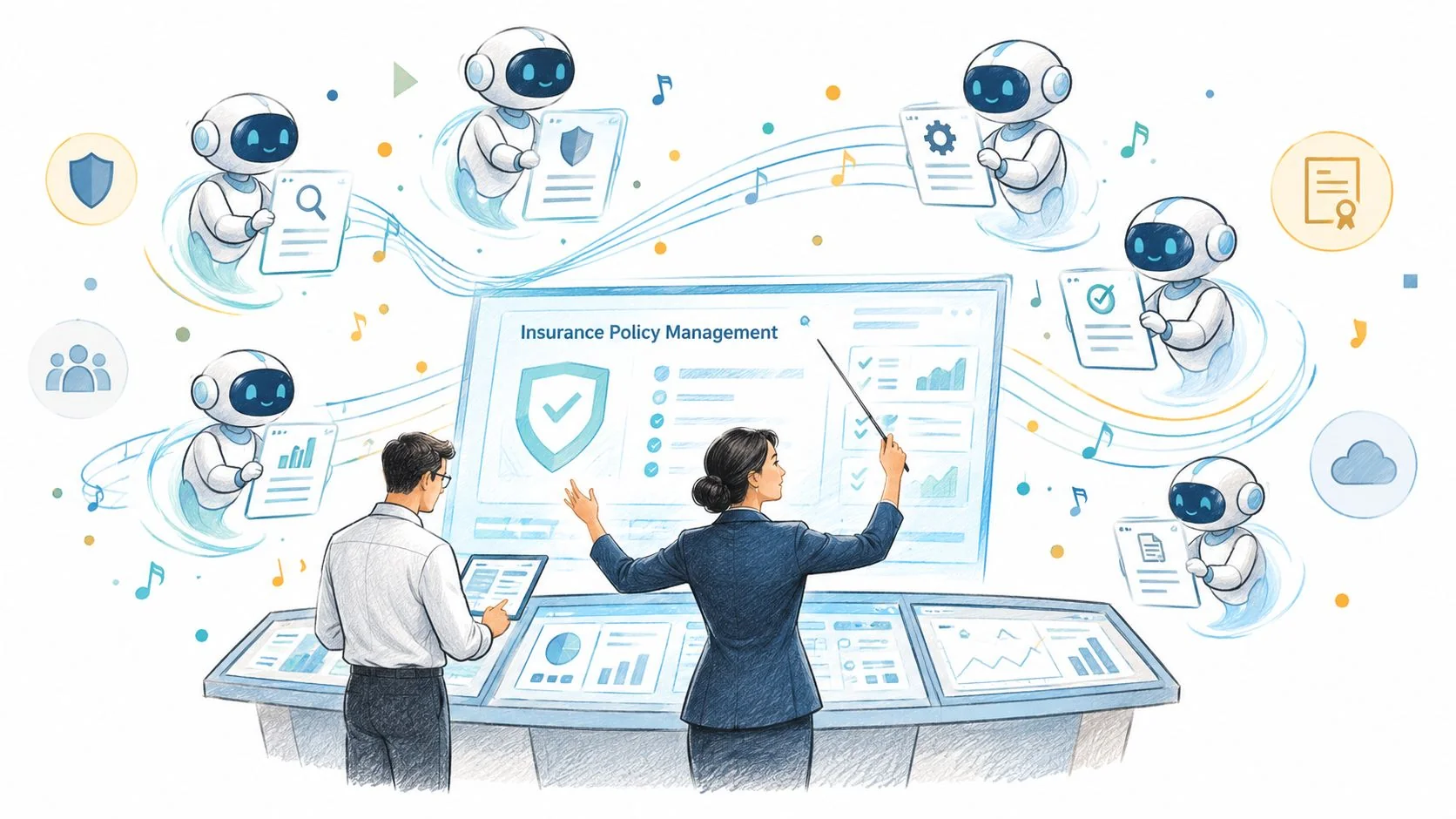
AI should sit inside the policy layer when it requires authoritative policy context, controlled decisions, and an auditable transaction. It should operate outside the core when the task is exploratory, probabilistic, or better handled through orchestration, analytics, document interpretation, or decision support.
This boundary matters because an assistant cannot correct weak foundations. If policy data is inconsistent, rules are opaque, and event histories are incomplete, the insurer may receive useful recommendations without being able to explain the inputs, decision path, or resulting action.
Put deterministic controls before AI
Embedded AI is easier to govern when the PAS provides:
- Stable data contracts: AI services receive consistent definitions for policy, coverage, party, transaction, and status data.
- Deterministic rules: Regulatory, eligibility, authority, and calculation requirements remain explicit rather than hidden inside a model.
- Observability: Teams can inspect inputs, outputs, confidence, exceptions, overrides, and downstream actions.
- Human controls: Authorized users can review, approve, reject, and document decisions.
- Compliance automation: Workflows can support obligations associated with GDPR, NAIC AI guidance, and the EU AI Act.
A practical division of responsibility is clear. AI can classify documents, suggest missing information, summarize policy changes, identify anomalies, and prioritize service queues. Binding authority, coverage eligibility, premium calculation, and adverse decisions should remain governed by explicit rules and approval controls unless the insurer has a documented model-risk framework for that use case.
Test production readiness, not pilot theater
Recent insurance coverage describes broad generative AI investment while reporting that many insurers struggle to scale beyond pilots because architecture and governance are not ready. FICO cites the 2025 Global Insurance Outlook from EY as stating that 99% of insurers are investing in or planning generative AI, while many remain unable to scale it. The PAS modernization perspective discusses the relationship between AI investment, architecture, and governance.
Treat “embedded AI” as an implementation claim that requires transaction-level evidence. Ask where the model runs, which policy data it accesses, how prompts or features are versioned, what happens at low confidence, and whether an auditor can reconstruct the decision afterward.
AI for Insurance provides a searchable way to review documented insurance AI implementations, including use cases and measurable outcomes where disclosed. Use its case studies to test vendor claims against evidence, then validate the same workflow with your own data, controls, and operating constraints.
Vendor Selection Criteria, KPIs That Matter More Than Feature Lists
A strong PAS selection process does not start with a feature matrix. It starts with operating pain that can be measured, traced to policy workflows, and improved within a defined time horizon. Demos tend to reward breadth. Production environments reward low exception rates, faster servicing, cleaner data, and recoverable operations.
That shift matters because many PAS evaluations still overvalue visible functionality and undervalue architecture behavior under load, change, and error conditions. The better question is not whether a platform supports endorsements, renewals, or underwriting referrals. It is whether those transactions can be configured, changed, audited, and recovered without creating manual work elsewhere. For a broader view of how policy software supports these measures, see this guide to software for insurance companies.
The KPI set should therefore test three decision-critical dimensions that feature lists often miss: modularity, AI readiness, and modernization fit.
| KPI | What it reveals | Evidence to request |
|---|---|---|
| First-pass issuance yield | Whether product rules, data defaults, and integrations work without rework | Transaction sample, exception taxonomy, and root-cause breakdown |
| Endorsement cycle time | Whether servicing changes become completed policy updates without queue buildup | Timestamped workflow demonstration across straight-through and exception cases |
| Policy data accuracy rate | Whether the PAS remains the trusted record across billing, claims, and CRM | Reconciliation method, field-level audit history, and correction workflow |
| Exception queue aging | Whether operational debt is accumulating in referrals, rejects, and unresolved tasks | Queue dashboard, aging bands, escalation rules, and staffing assumptions |
| Change lead time for product updates | Whether configuration changes can be delivered without custom code bottlenecks | Admin-led change demonstration, approval path, and deployment steps |
| Recovery performance against stated RTO and RPO | Whether the platform can support continuity after failure, rollback, or bad release | Recovery test evidence, data-restore process, and failed-job handling |
| Servicing cost per policy in force | Whether the operating model improves after implementation rather than shifting labor off-system | Cost model, labor assumptions, transaction scope, and baseline period |
Some KPIs matter more by line of business. A P&C carrier with frequent filing changes should weight product-change lead time, endorsement handling, and exception aging heavily. A life insurer usually has more exposure to long-duration data integrity, servicing history, and controlled benefit changes. A specialty carrier often gets more value from coexistence metrics, especially where delegated authority, broker workflows, or external rating dependencies remain in place.
The scoring model should separate capability, proof, and delivery risk.
A vendor gets capability credit for supporting a function. Proof credit should only follow a demonstration using your products, rules, and exception conditions. Delivery risk should reduce the score when outcomes depend on custom code, scarce implementation skills, fragile integrations, or future-phase promises.
This structure exposes a pattern buyers often miss. Two platforms can score similarly on features while producing very different operating results. The difference usually shows up in how configuration is isolated from code, how transaction failures are surfaced and corrected, and how easily the insurer can change one part of the stack without retesting everything else. That is the practical expression of architecture modularity, and it has a larger effect on total cost and delivery speed than an extra set of workflow screens.
Ask for evidence in a controlled format:
- A workflow using your product rules, approvals, and exception paths
- An integration test that includes rejected, corrected, and replayed messages
- A product or rate change completed by a business administrator, with promotion controls
- An audit reconstruction from quote to bind to mid-term policy change
- A recovery exercise covering failed batch, rollback, and restoration against stated service objectives
AI claims belong in the same evidence model. If a vendor positions AI as part of policy operations, test whether it improves a measurable KPI such as queue aging, servicing time, or data accuracy, and whether the result depends on deterministic rules, external orchestration, or manual review. Buyers should score that separately from generic automation claims.
A polished demo proves very little. The stronger vendor is the one that can show stable transaction handling, controlled change, and measurable improvement under real operating conditions.
Modernization Sequencing, Phasing Replacements Without Losing Agility
Replacement programs usually lose momentum in the middle, not at launch. The pattern is familiar across policy administration projects. New business may move first, but endorsements, renewals, billing dependencies, document triggers, and historical lookups stay tied to the legacy estate much longer than the original plan assumed.
That is why sequencing matters more than target-state diagrams. A technically stronger platform can still produce worse operating results if the migration path creates split servicing, duplicate data correction, or unclear accountability for transaction failures. Teams end up running two operating models at once, and the cost of coordination starts to erase the expected gain.
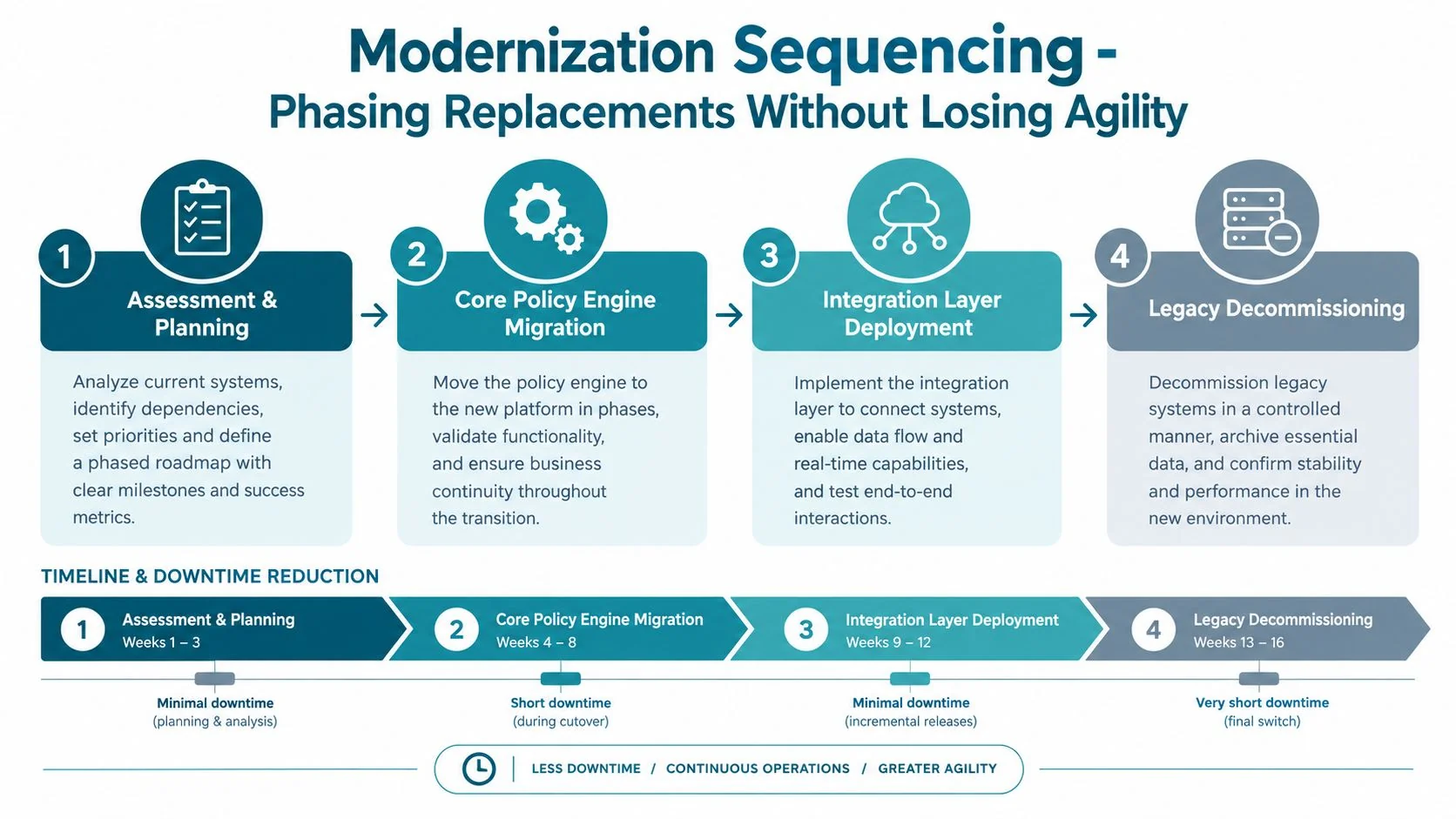
A better framing is to treat modernization as a sequence of control decisions.
First, define the unit of replacement. That should usually be a product line, distribution channel, or transaction family with bounded integrations and a clear service model. Replacing everything that touches policy at once looks decisive, but it often expands the testing surface faster than the insurer can manage.
Next, separate future-state design from cutover design. Many insurers spend too much time debating end-state architecture and too little time specifying how a policy created in one system will be endorsed, renewed, cancelled, audited, and reported during transition. Those transition rules determine whether the program preserves agility or freezes it.
Then decide where standardization helps and where it destroys useful variation. Status handling, audit capture, identity checks, correspondence triggers, and approval evidence usually benefit from consistency. Product rules, underwriting tolerances, and channel-specific workflows often need more room. That distinction is easy to miss in checklist-based evaluations, but it shapes both implementation speed and post-launch change capacity.
A four-part sequence works better than a single cutover event:
- Stabilize the operating model: map policy states, manual interventions, exception queues, handoffs, and record-of-truth ownership before any migration wave starts.
- Migrate a bounded book of business: move one product or transaction set where success can be measured through service levels, reconciliation rates, and change throughput.
- Build reusable transaction services: establish APIs, event handling, monitoring, and recovery processes for billing, claims, documents, identity, and reporting as shared capabilities rather than one-off project integrations.
- Retire legacy components selectively: decommission only after historical access, financial reconciliation, audit reconstruction, and rollback procedures have been proven under live conditions.
The order is deliberate. If the insurer migrates the core policy engine before it has clear transaction ownership and data contracts, the new platform inherits the old coordination problem in a different form. If it builds shared services too early, before migration scope is constrained, the integration layer becomes a holding area for unresolved business rules.
This is also where architecture modularity and AI readiness become practical selection criteria rather than abstract design preferences. Modular platforms let carriers phase products and servicing functions independently, which reduces the amount of retesting required in each wave. AI features matter only if they can operate inside that phased model with observable inputs, deterministic controls where needed, and clear handoff points when confidence is low. Bolt-on automation that depends on unstable data or hidden decision logic usually adds another migration dependency instead of reducing work.
The verified case studies in the AI for Insurance database are useful here because they show outcomes by implementation path, not just by product claim. The stronger examples tend to share the same pattern: narrow initial scope, explicit coexistence rules, measurable service KPIs, and staged expansion after transaction quality is proven.
One principle holds across nearly every successful replacement. Keep the ability to service in-force business stable while changing how future business is administered. Programs that protect that boundary usually keep optionality. Programs that blur it often lose both speed and control.
Building Your Policy Management System Evaluation Playbook
A useful evaluation playbook turns architecture principles into decision gates. It should force business, operations, actuarial, compliance, and technology stakeholders to inspect the same evidence.
| Decision phase | Questions to answer | Evidence required |
|---|---|---|
| Requirements | Which workflows create cost, delay, or control risk? | Process map and KPI baseline |
| Architecture | Can capabilities evolve independently? | API catalogue, data model, recovery commitments |
| Lifecycle | Which changes can authorized users configure? | Scenario-based demonstration |
| AI readiness | Are data, rules, and actions observable? | Model controls, audit records, exception paths |
| Validation | Does the platform work with your products and interfaces? | Proof of concept and integration test |
| Implementation | Can live servicing continue during transition? | Migration plan, reconciliation design, ownership model |
Use stakeholders as evaluators
Underwriters should test referral logic and product change. Servicing leaders should test endorsements, corrections, renewals, and exception queues. Actuaries should examine rating inputs, versioning, and effective dates. Claims leaders should validate coverage data exchange. IT and security teams should review interfaces, access control, observability, resilience, and operational support.
Avoid three predictable mistakes:
- Choosing breadth over depth: A long feature list doesn't prove that workflows are integrated.
- Treating configuration as a slogan: Require a business-user change demonstration.
- Underestimating transition work: Data mapping, reconciliation, coexistence, and ownership often determine delivery risk.
The final recommendation should identify the smallest credible modernization scope, the capabilities that must be proven before commitment, and the measures that will determine whether expansion is justified. That approach produces a platform decision tied to operating outcomes rather than presentation quality.
Map your current policy lifecycle, select the KPIs that expose rework and exception burden, and run the same product-change and integration scenarios against every shortlisted platform. Before signing, require evidence that the system can support live servicing, auditable rules, stable data contracts, and a phased migration plan. That is how insurers turn insurance policy management systems from a replacement project into a durable operating advantage.
