Computer Vision with Machine Learning: Claims Automation
Discover how computer vision with machine learning transforms insurance through damage assessment, document processing, and claims automation.
Written by AI for Insurance

Most advice about computer vision with machine learning starts in the wrong place. It talks about benchmark accuracy, model families, and shiny demos, then acts surprised when a claims workflow collapses under bad lighting, crooked phone angles, low-end cameras, and messy customer uploads. In insurance, the hard part isn't proving that a model can recognize images in a controlled setting, it's making sure it still works when the photo comes from a wet driveway, a dim garage, or a rushed adjuster on the road.
That's why the critical question isn't which architecture is strongest, it's which failures your model can survive before they turn into operational losses. The field got here because large benchmark datasets made image recognition scalable, with ImageNet holding over 14 million labeled images and COCO offering more than 330,000 images with pixel-level annotations across 80 categories (benchmark dataset overview). But those lab conditions don't resemble insurance intake, where the business outcome depends on what happens after a customer uploads one imperfect photo, not after a curated test set is scored.
Table of Contents
- Why Benchmark Accuracy Misleads Insurance Teams
- How Computer Vision Pipelines Work for Insurance Tasks
- Choosing the Right Model for Claims and Underwriting
- Data Quality and the Labeling Bottleneck
- When Models Break in Production Insurance Environments
- Evaluation Frameworks That Predict Real-World Performance
- Building a Pragmatic Deployment Strategy
Why Benchmark Accuracy Misleads Insurance Teams
A high benchmark score can still mislead an insurance team. It proves the model handled a clean test set, not that it can survive the visual mess of real claims work. Insurance images are unforgiving because the same loss can arrive through different phones, different inspectors, different weather, and different habits. A model that looks strong in validation can still make poor decisions once it leaves the lab.
Why the benchmark mindset fails
The benchmark mindset assumes the main problem is model selection. In practice, the harder problem is distribution shift, meaning the inputs in production don't resemble the training data closely enough for the model to stay reliable. The more useful question is whether the model can survive the kinds of shift that show up in claims operations, and whether your team can detect failure before it becomes a claims issue.
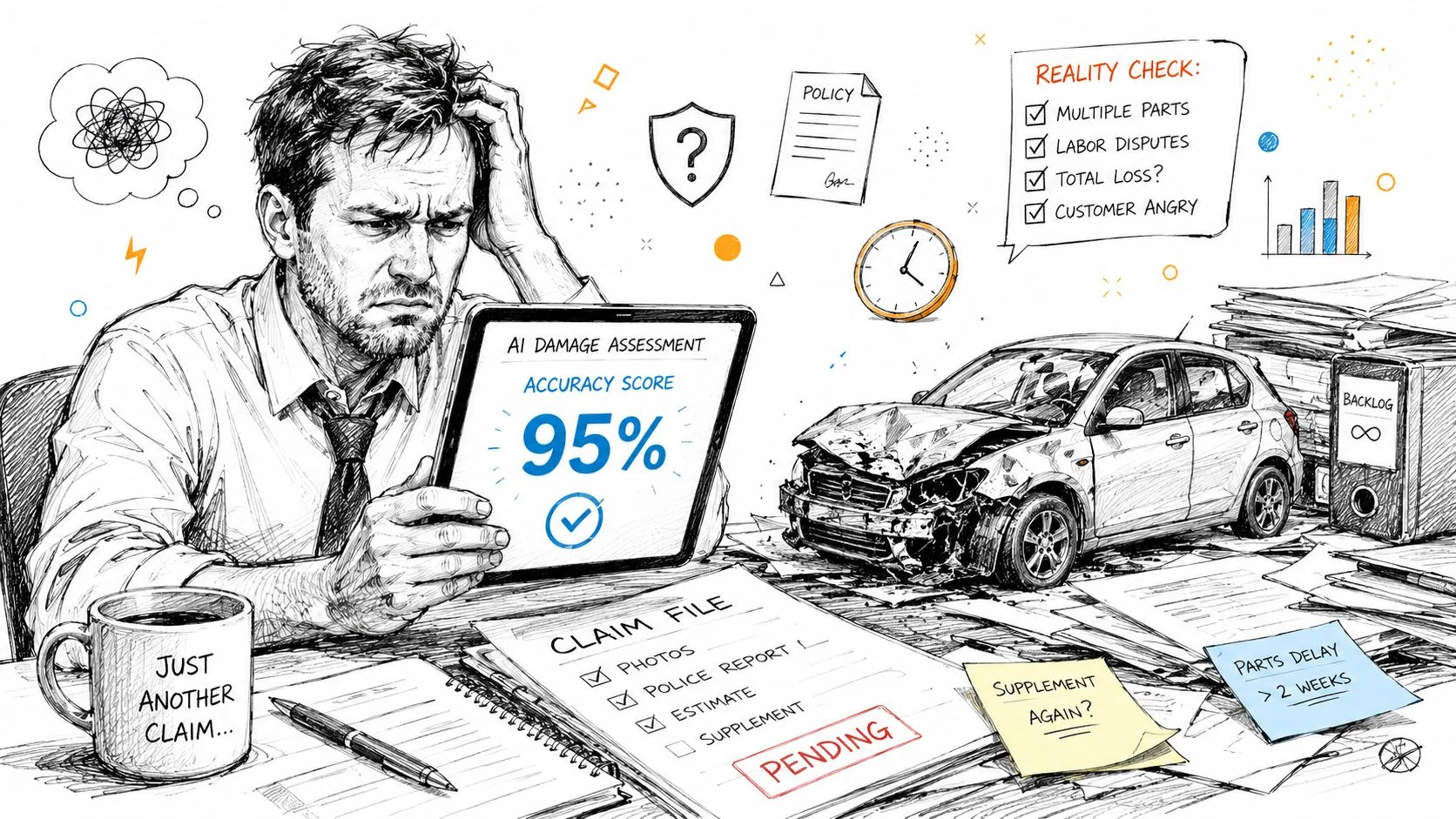
Insurance teams also deal with a harsher definition of error than academic benchmarks do. A false positive in a controlled test might be a minor metric penalty, but in a live workflow it can trigger a bad triage decision, send a claim down the wrong path, or force manual review where automation should have helped. Production reliability matters more than leaderboard performance, because operational mistakes create rework, delay payouts, and erode trust.
Practical rule: if the training set doesn't reflect the ugliness of real submissions, the test score is mostly a confidence estimate for the lab, not for the business.
The market reality shows how quickly this technology has moved beyond research. One industry analysis puts the global AI computer-vision market at $14 billion in 2023 and projects $51 billion by 2030, with a reported 19.5% CAGR. The scale is real, but scale doesn't remove the operational question. It makes it more urgent.
For insurers, the implication is simple. Don't ask whether a vision model is “accurate enough” in abstract terms. Ask whether it can keep its footing when image quality drops, when damage is partially occluded, or when a customer submits a photo that doesn't match the conditions used during development. The same standard applies to older claims archives with sparse or missing labels. The practical question is whether you can use those unlabeled claims as a monitoring set, a weak supervision pool, or a source of hard negatives without pretending they are clean ground truth. The system should be judged on how it behaves in that setting, not on a benchmark score that only looks good in isolation.
One insurer-style deployment pattern is already clear in practice. The AI for Insurance auto-authorisation case study shows why automation value comes from routing and estimation decisions, not from a headline accuracy number. That is the difference between a model that looks good in a demo and a model that survives claims volume.
How Computer Vision Pipelines Work for Insurance Tasks
Computer vision with machine learning only becomes useful in insurance when the pipeline is tied to a decision. The system is not just an image model. It is an end-to-end workflow that begins with image intake, moves through preprocessing and model selection, and ends with a business output such as triage, localization, or extraction. Industry overviews of computer vision pipelines usually break that workflow into tasks like image classification, object detection, segmentation, tracking, pose estimation, and OCR. For insurance teams, the useful question is not whether the model can recognize an image in general, but which step supports the claim or underwriting decision that follows.
From image intake to task-specific output
In claims, customer uploads usually start with classification. That stage can separate irrelevant photos from plausible damage images, or route a submission into the right handling lane. If the workflow needs more than triage, object detection can localize damaged parts, such as a bumper, windshield, or roof section, while segmentation can isolate the damaged area for finer severity estimation.
The same logic applies to underwriting and inspection. A property photo may need OCR if the workflow includes document fields, but OCR should not be the first model choice by default. The model should follow the required output, not the other way around. If the business only needs a yes or no on whether a document is legible, a broad classifier may be enough. If it needs exact field extraction, then structured text handling becomes more important. The practical trade-off is straightforward, broader models are easier to route with, while tighter extraction pipelines usually cost more to label and maintain.
The main operational mistake is using one model family for every task because it feels cleaner architecturally. That usually creates hidden costs in annotation, latency, and maintenance. A lightweight classifier can be the right answer for high-volume routing, while a denser localization model is better when the downstream step depends on knowing exactly where the damage is.
Why foundational datasets matter
The reason this field became scalable is that benchmark datasets made evaluation repeatable. ImageNet's over 14 million labeled images, COCO's more than 330,000 annotated images, and MNIST's 70,000 handwritten digits split into 60,000 training and 10,000 test examples show how the discipline moved from simple recognition to richer visual understanding. Insurance teams do not use those datasets directly, but they inherit the lesson, shared standards matter because they let teams compare approaches under consistent conditions.
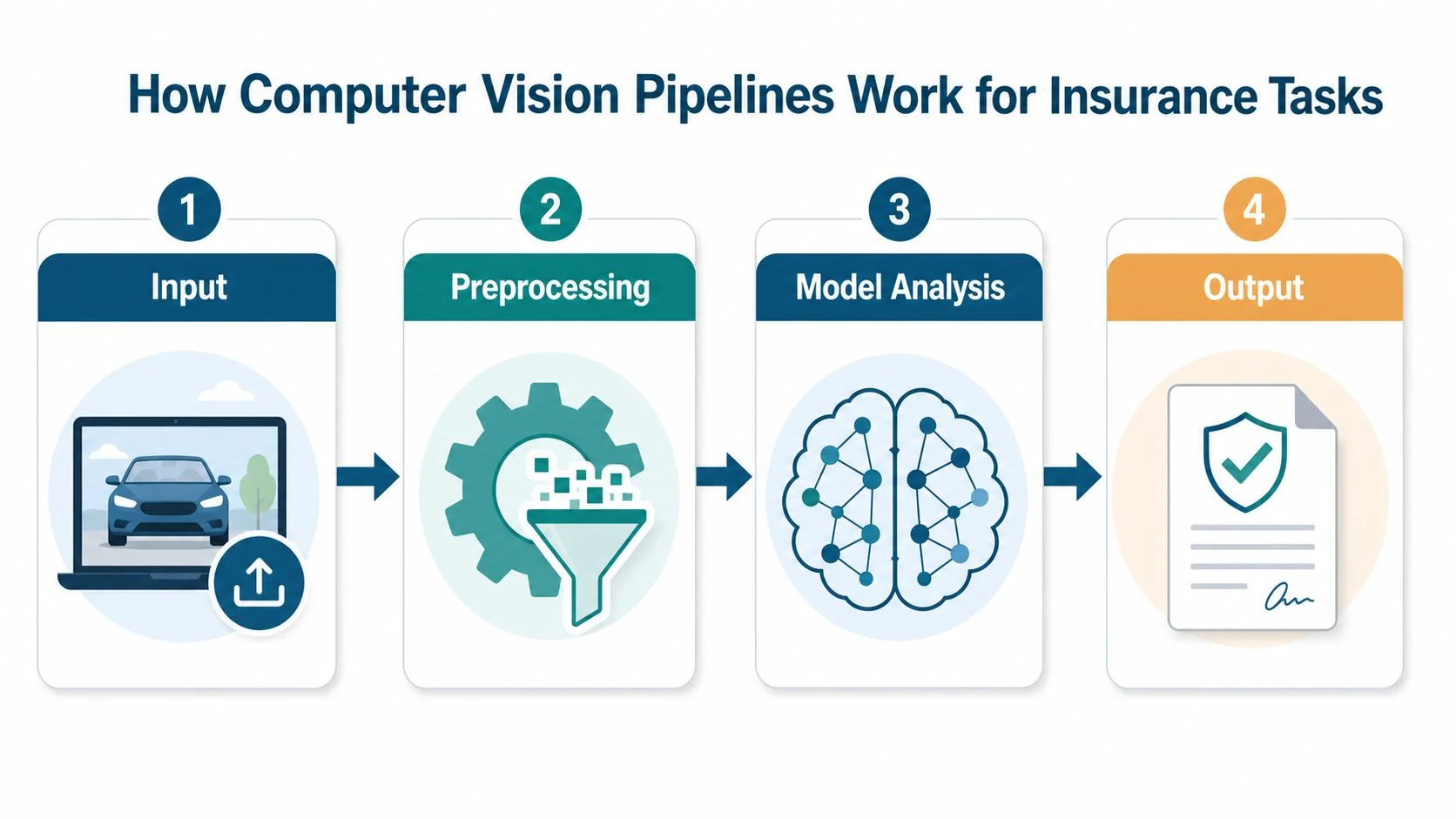
In practice, the pipeline should be built around the claims or underwriting decision you are trying to automate. Start with the output, then choose the model stage that supports it. If the output is unclear, the model choice will be unclear too. That is where computer vision technology overview for insurance is useful, because it frames the workflow around operational steps instead of model names.
<iframe width="100%" style="aspect-ratio: 16 / 9;" src="https://www.youtube.com/embed/T5vGgdxdj4Q" frameborder="0" allow="autoplay; encrypted-media" allowfullscreen></iframe>
Choosing the Right Model for Claims and Underwriting
Model choice in insurance should be driven by the task, not by whatever architecture is fashionable. That sounds obvious, but teams still waste months trying to force a single model family across damage assessment, document OCR, and property inspection. Those workloads ask for different things, and the wrong fit usually shows up later as high maintenance, brittle inference, or poor behavior under shift.
Match the model to the job
For damage assessment, the model needs fine-grained localization. That often means a detection or segmentation approach because the workflow depends on knowing where the damaged area is and how big it looks relative to the surrounding structure. For document image processing, throughput and structured extraction matter more, so OCR and layout-aware processing become the main concern. For property inspection, the model has to behave consistently across seasons, lighting, and geography, which puts more pressure on reliability than on a single benchmark score.
That's where simpler models sometimes win. A compact classifier can be enough for triage, especially when the business only needs to route images into the right queue. A heavier model can be the better choice when the next step depends on precise localization. The mistake is treating complexity as a virtue on its own. In production, complexity only helps if it solves the actual operational problem.
Operational insight: the best model is usually the one that fails in the least expensive way when the image is bad, incomplete, or unusual.
Use case by use case
| Use Case | Recommended Approach | Key Trade-off | Data Requirement |
|---|---|---|---|
| Claim triage | Image classification | Fast routing versus limited detail | Moderate labeled examples |
| Damage localization | Object detection | Better specificity versus more annotation work | Bounding-box labels |
| Severity estimation | Segmentation | Finer granularity versus higher labeling cost | Pixel-level labels |
| Document field extraction | OCR plus structured parsing | Extraction depth versus document variability | Clean text-region labels |
| Property inspection | Robust multi-task vision pipeline | Coverage versus complexity | Diverse images across conditions |
This table isn't about model prestige. It's about aligning output with operational need. If the workflow needs speed, keep the model lean. If it needs localization, accept the annotation burden that comes with it. If it needs both, the pipeline has to be engineered around that trade-off instead of pretending it doesn't exist.
Data Quality and the Labeling Bottleneck
Data quality is the part everyone says matters, then underfunds. In computer vision, that gap shows up fast because model performance falls apart when images are poorly curated, inconsistently labeled, or captured under mixed intake conditions. The practical consequence is straightforward, DataOps controls are a first-order model variable, especially in insurance workflows where the same claim type can arrive in many visual forms.
What to measure before training
A disciplined team defines quality metrics before model training begins. Those metrics should include technical metrics tied to ingestion completeness, functional metrics tied to business goals, and performance metrics tied to SLA attainment (data quality guidance). That matters because a model can look healthy on paper while the pipeline drops edge cases, accepts malformed images, or mixes label conventions across teams.
Insurance teams should treat label quality as a workflow, not a one-time event. The controls that hold up in production are usually plain ones, such as label-consistency checks, preprocessing standards, and throughput targets that are monitored alongside model metrics. If the labels disagree too often, the model learns noise. If preprocessing varies between intake channels, the model learns the wrong invariances. If throughput is too low, the business never feels the benefit.
How to work with scarce labels
A lot of insurance image data is unlabeled, noisy, or uneven across classes. That does not make it useless. Broader computer-vision research and industry discussion show that unsupervised and semi-supervised approaches can learn structure from unlabeled data, support downstream fine-tuning, and reduce dependence on expensive annotation cycles (unsupervised learning for computer vision).
Guidance on dataset curation also points to recurring issues like mislabeled, missing, and imbalanced images, and recommends auditing, consensus labeling, semi-supervised learning, and synthetic augmentation to address them.
A practical path is to combine a small, high-trust labeled set with broader unlabeled pools. Use the labeled data to define the target behavior, then use the unlabeled data to improve representation learning and surface edge cases. That will not remove the need for annotation, but it can make every labeled sample count more.
The label queue is often the real bottleneck, not the model code.
For teams with a large image backlog, AI for Insurance's searchable database can help surface real implementations and compare workflows against verified outcomes, which is often more useful than chasing abstract model advice.
When Models Break in Production Insurance Environments
Production failures in insurance usually don't look dramatic at first. A model that performed well during validation starts missing damage on certain devices, or it becomes less reliable when images come from a different geography, a different season, or a different capture protocol. That's domain shift in practice, and it's the main reason strong lab results don't always transfer into dependable operations.
How shift shows up in the field
Claims images vary with customer behavior. Some people take photos in daylight, some indoors, some from too far away, and some after moving the car or property into a better position. Underwriting photos can be even more inconsistent because different inspectors follow different habits. The model doesn't know any of that context, it only sees pixels, which means the same visual category can arrive with very different statistical fingerprints.
Bias and adversarial noise make this harder. Harvard Medical School notes that vision models can be brittle when they're applied to populations different from those they were trained on, and that validating on different datasets is essential to reduce algorithmic bias. It also highlights that tiny pixel changes, often invisible, can trigger misclassification in adversarial attacks (Harvard Medical School on computer vision limits). That matters in insurance because the world is full of image variation that isn't malicious but can still behave like stress on the model.
A hail-damage model can also fail when roof materials change. A vehicle model can misread aftermarket parts. Those failures don't mean computer vision is unusable. They mean the training distribution was narrower than the production environment.
Stress testing before deployment
The fix isn't just more data, it's the right kind of testing. You want images grouped by device quality, capture conditions, geography, and loss type, then checked for performance drops within those slices. You also want failure review to be part of the deployment process, not a postmortem after claims errors accumulate.
If the model only works on the conditions you already know, it's not an insurance model yet.
That's the operational test. Can it survive new acquisition patterns, new customer behavior, and new loss forms without drifting into bad recommendations? If not, it may still be a useful prototype, but it isn't ready to carry workflow responsibility.
Evaluation Frameworks That Predict Real-World Performance
Standard accuracy can be a weak predictor of production success in insurance. It compresses too many different error types into one number, which means you can't tell whether the model is good at common cases but weak on rare ones, or whether it's stable across devices but fragile across regions. The better approach is to evaluate the model the same way the business experiences it, slice by slice and workflow by workflow.
Build the test set to mirror the field
The first step is stratified testing. That means evaluating by device type, geography, loss category, and capture quality instead of relying only on a blended score. It also means looking at the behavior of the model under the kinds of variation claims teams see, not just on a polished holdout set.
The second step is ongoing drift monitoring in production. If the live image mix changes, the model can degrade even when the code doesn't. The monitoring layer should therefore watch for distribution shifts and alert teams before the performance gap reaches the point where the business feels it in processing delays or rework.
Use metrics that connect to operations
For insurance, the useful metrics are the ones that connect model behavior to workflow impact. That means precision when false positives create unnecessary review, recall when missing a rare event is expensive, and balanced measures when both errors matter. Those signals should sit beside throughput and SLA metrics, because a model that is technically sound but operationally slow can still fail the business.
| Evaluation Layer | What It Tells You | Why It Matters in Insurance |
|---|---|---|
| Standard accuracy | Overall correctness | Hides slice-level weakness |
| Precision | How reliable positive predictions are | Useful when false alarms create manual work |
| Recall | How many true cases are found | Important for rare or costly events |
| Production drift monitoring | Whether live data has changed | Catches degradation early |
| SLA tracking | Whether the workflow keeps pace | Links model output to service delivery |
The point isn't to collect more metrics for their own sake. It's to connect model behavior to the way claims and underwriting operate. When a score goes up, but manual review stays high, the score wasn't the right measure.
Building a Pragmatic Deployment Strategy
The teams that get value from computer vision with machine learning don't start by asking for state-of-the-art performance. They start by building a system that can absorb messy inputs, report drift transparently, and improve without breaking the claims workflow. That means data quality first, task-specific model choice second, and production evaluation third.
Sequence the work in the right order
Start with labeling discipline and ingestion standards, because bad data will poison everything that comes after it. Then choose the model family that fits the output you need, whether that's triage, localization, or extraction. After that, design evaluation around production conditions, not laboratory convenience. The sequence sounds basic because it is, but teams still reverse it and pay for the mistake later.
A pragmatic deployment also needs cross-functional ownership. Data science can't own image quality alone, and operations can't interpret model drift alone. The workflow works when the people who process claims, inspect property, and maintain the model all see the same failure signals.
The broader lesson is to treat computer vision as an operational system, not a one-time model build. That's especially true when unlabeled data is abundant and edge cases keep appearing faster than manual annotation can keep up. The system has to keep learning without becoming unstable.
For teams that want a practical starting point, the Tokio Marine computer-vision case study shows how insurers are applying vision to shorten damage assessment workflows. If you need a broader repository of verified implementations, the AI for Insurance database is built for that kind of search.
Practical takeaway: robustness, monitoring, and label quality are what make computer vision deployable. Benchmark scores are just the beginning.
If you're planning a claims automation initiative, start by auditing your image labels, slicing your current submissions by capture conditions, and defining the one business output you need first. Then compare that workflow against verified insurance implementations and build from the failure modes outward, not from the demo inward.
