Underwriting Software Insurance: Expert Comparisons
Compare underwriting software insurance platforms. See vendor capabilities, ML integration, and performance metrics to pick your ideal system.
Written by AI for Insurance
AI underwriting software is already a board-level buying decision, not a back-office convenience. The underwriting software market is projected at USD 7.15 billion in 2025, rising to USD 12.88 billion by 2030 at a 12.48% CAGR (Mordor Intelligence market outlook). That scale matters because the category is no longer about scanning forms faster, it's about deciding faster, with more control, and with better auditability.
| Buyer lens | What it optimizes | What usually fails |
|---|---|---|
| Workflow-first carrier | Intake, routing, compliance, handoffs | Slower decisions when risk logic is too shallow |
| Decisioning-first innovator | Risk triage, accept or decline, terms and conditions | Weak interoperability if the stack is too narrow |
| AI-augmented incumbent | Faster decisions on top of existing systems | Over-automation without clear human override rules |
The key procurement question is not whether underwriting should be digital. It's whether your organization needs a workflow platform, a decisioning engine, or a broader AI-augmented operating model. That distinction explains why some carriers care most about audit trails and routing, while others care more about automated submission triage or data extraction from messy documents.
The market structure supports that shift. Automated underwriting systems accounted for over 60% of market revenue in 2023 in Allied Market Research's view, which tells you where buying power is concentrated, and it isn't in basic digitization alone (market forecast reference). The strongest systems are not just replacing paper. They're reshaping how work enters the underwriter's desk, how exceptions are routed, and how much judgment stays human.
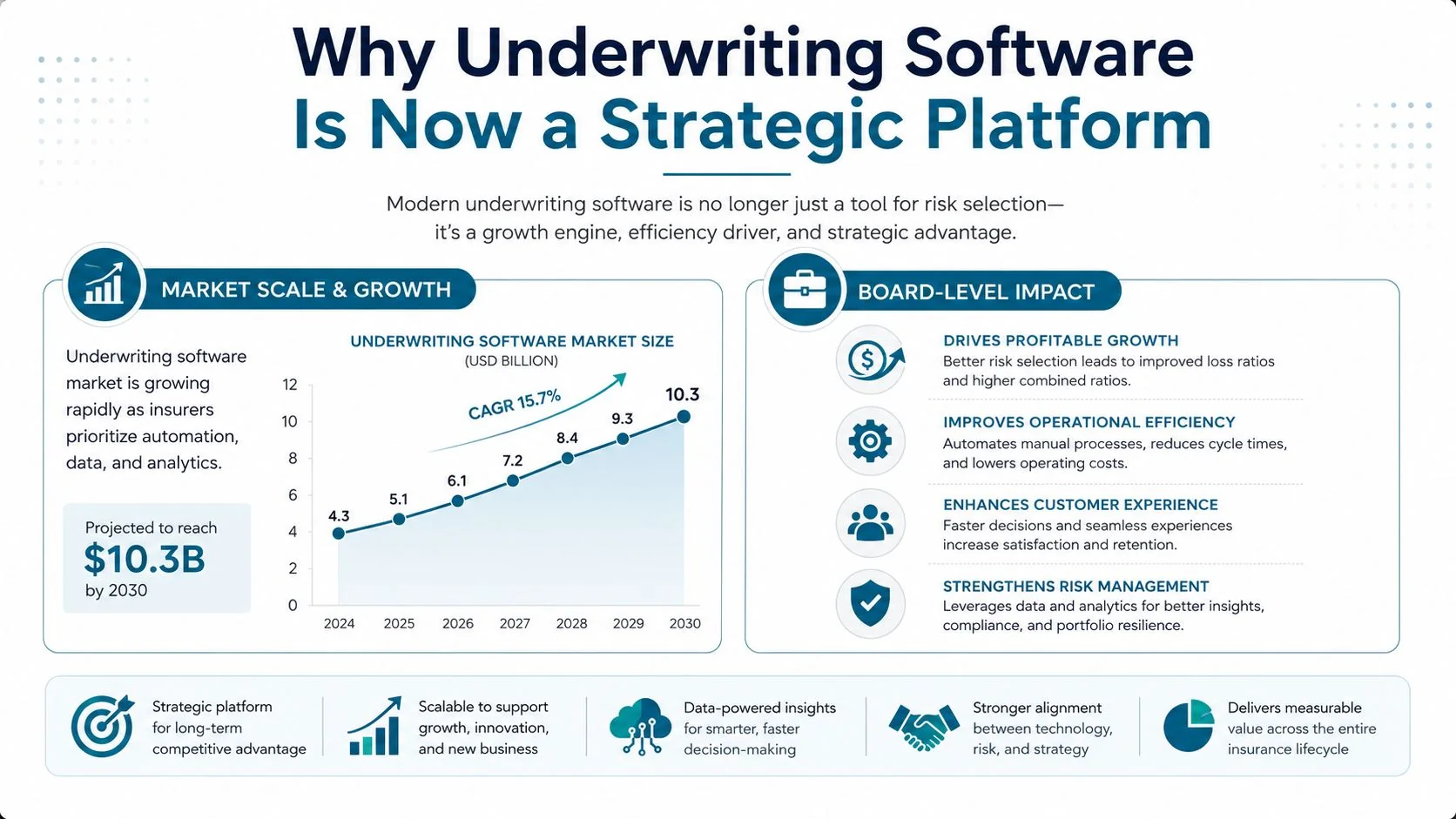
Table of Contents
- Why Underwriting Software Is Now a Strategic Platform
- What Underwriting Platforms Actually Do
- The Four Platform Archetypes Compared
- Real Performance Metrics for AI-Driven Underwriting
- Where Human Judgment Still Has to Stay in the Loop
- How Platform Choice Shifts by Line of Business
- Implementing a Lighthouse Use Case Before Scaling
- Matching Platforms to Insurer Profiles and Common Questions
Why Underwriting Software Is Now a Strategic Platform
Underwriting software has moved into operating-model territory. It now shapes how risks are selected, how terms are set, and how quickly business moves through the file, which is why buyers are no longer treating it as a back-office convenience. Research cited in the market report points to a market that is expanding as carriers put more of the decision path into software, not just the paperwork around it.
The category has moved past workflow digitization
A common mistake is to treat underwriting software insurance as a document-management purchase. That framing is too small. The more relevant distinction is between software that routes work and software that helps decide what the work should be.
The same market source notes that automated underwriting systems accounted for a large share of revenue in 2023, which is a sign that buyers are paying for decision automation, not just digitized intake or cleaner queues (market report). In practice, that means carriers are looking for systems that can ingest submissions, apply rules, evaluate risk, and route exceptions with traceable logic. The software is becoming part of underwriting control, not just workflow administration.
Three buyer profiles usually drive the decision
Practical rule: If your current pain is email sprawl and manual routing, you are still in a workflow-first buying motion. If your pain is inconsistent risk selection, you are in a decisioning-first motion.
Most insurers fall into one of three patterns. Workflow-first carriers want cleaner intake, stronger audit trails, and predictable escalation. Decisioning-first innovators care most about automated accept, decline, or refer outcomes for targeted lines. AI-augmented incumbents want to add intelligence without ripping out policy administration, rating, or distribution systems.
That difference matters because each profile favors a different platform shape. A workflow-first carrier often needs structured intake and governance before anything else. A decisioning-first buyer needs better rules, confidence thresholds, and straight-through processing logic. An AI-augmented incumbent usually wants a platform that can sit on top of existing systems without forcing a full-stack replacement.
The core question is not which tool is best. It is which operating model the insurer is trying to build. That answer determines whether software should mainly control the flow of work, the quality of decisions, or the boundary between automation and human review.
What Underwriting Platforms Actually Do
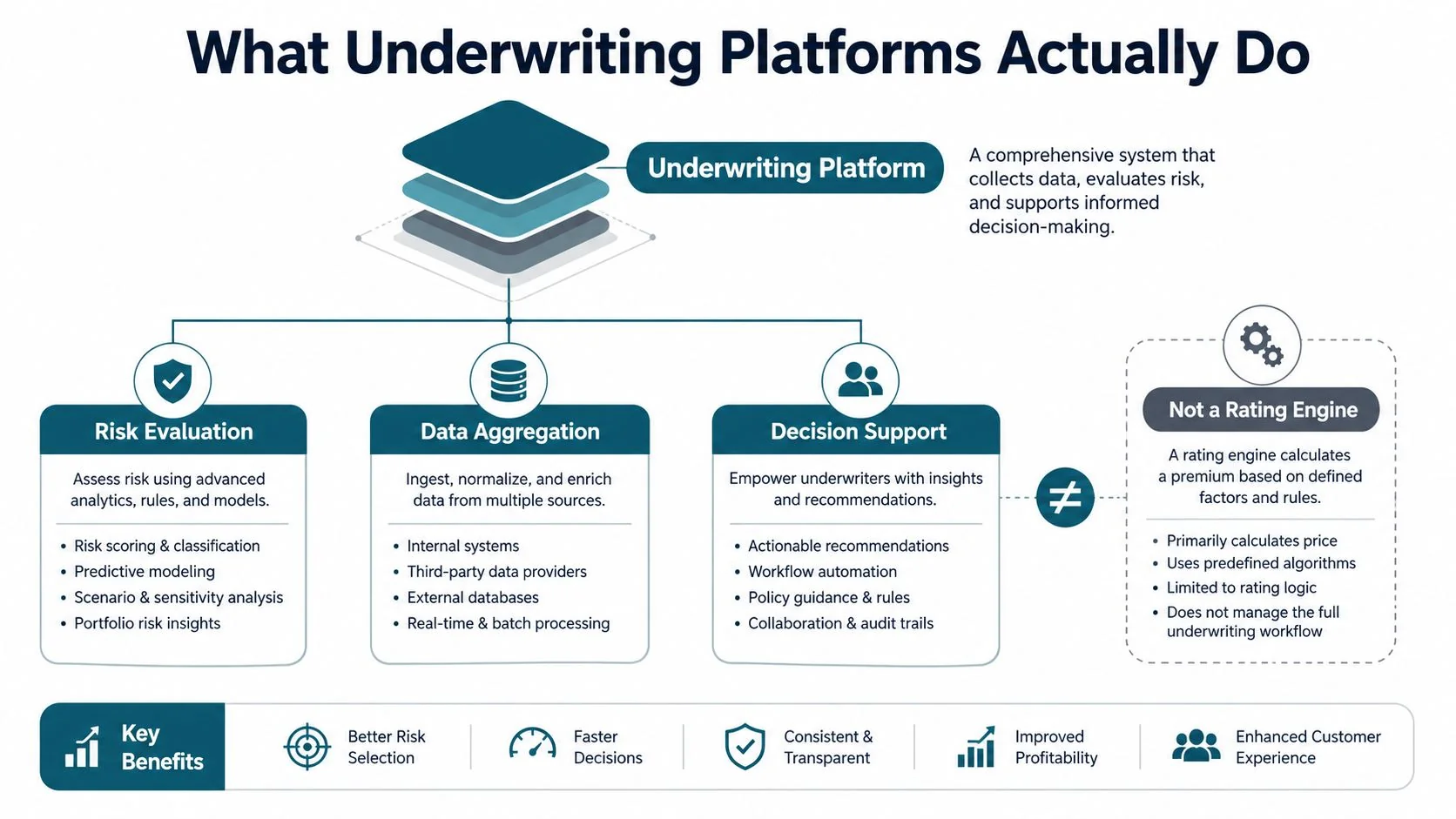
A true underwriting platform does more than price a risk. It evaluates the submission, decides whether to accept, decline, or refer, and sets terms and conditions when the risk is acceptable. That is a different job from a rating engine, which calculates price but doesn't usually own the broader decision logic.
The six capabilities that matter in selection
Software evaluators keep coming back to the same technical criteria, because these are the levers that determine whether a platform fits underwriting operations:
- Submission intake and structured data capture. This answers whether the platform can turn messy applications, spreadsheets, and supporting documents into usable data.
- Underwriting rules configuration. This answers whether business teams can reflect appetite, authority, and referral logic without constant code changes.
- Workflow routing and escalation. This answers who sees the case, when it gets handed off, and how exceptions are tracked.
- Document generation and audit trails. This answers whether the insurer can explain what happened later, especially during review or dispute.
- Compliance controls. This answers whether decisions are made in a way that supports governance and regulatory expectations.
- Integrations with policy administration, CRM, rating, and distribution systems. This answers whether the platform can fit the current stack instead of creating another silo (evaluation criteria reference).
Why interoperability beats feature counting
A feature checklist is usually the wrong way to evaluate underwriting software insurance. A platform can look rich on paper and still fail if it can't exchange data cleanly with the systems around it. Interoperability decides whether underwriters trust the platform, whether operations can adopt it, and whether the business can scale it to another line later.
Underwriting teams don't need another dashboard first. They need a system that can move a case from intake to decision to audit without breaking the chain of evidence.
The best buying conversations focus on handoff points. Where does data enter? Where can a human override the machine? Where does the platform write the audit trail? Those answers tell you more than a long product sheet ever will.
The other practical test is whether the platform reflects how underwriting work is done. A tool that only supports neat, linear processes may look elegant in a demo, then struggle the first time a broker package arrives incomplete or a case needs multiple referral stages.
The Four Platform Archetypes Compared
The market is easier to compare when you stop naming products and start comparing operating archetypes. Four show up repeatedly in RFPs and demos. Workflow platforms prioritize routing and control. Decisioning engines prioritize underwriting logic. AI-augmented suites layer intelligence onto incumbent processes. Point solutions solve one narrow bottleneck and stop there.
Underwriting Software Platform Archetypes at a Glance
| Capability | Workflow Platform | Decisioning Engine | AI-Augmented Suite | Point Solution |
|---|---|---|---|---|
| Submission intake | Strong structured intake, especially for standardized workflows | Variable, often dependent on upstream data quality | Good when layered onto existing intake | Narrow, usually focused on one intake problem |
| Rules configuration | Strong governance and referral logic | Strongest fit for complex risk logic | Moderate, often tied to broader suite constraints | Limited to the use case it was built for |
| Workflow routing | Usually excellent | Adequate, but not always the core strength | Good when integrated well | Narrow, often single-step routing |
| Document generation | Usually solid | Varies by design | Usually adequate | Limited |
| Compliance controls | Strong | Strong where designed for regulated decisions | Moderate to strong | Often basic |
| Integrations | Usually broad | Depends on architecture | Usually broad if suite-based | Often shallow |
Where each archetype wins
Workflow platforms fit carriers trying to replace fragmented manual handoffs while preserving strong oversight. They are useful where compliance and traceability matter more than advanced AI logic. Decisioning engines fit specialty and commercial lines where the key challenge is evaluating risk quickly and consistently, especially when appetite rules are nuanced.
AI-augmented suites are often the compromise choice for incumbents. They're attractive when a carrier already has core systems in place and wants better intake, triage, or decision support without replacing the full stack. Point solutions fit isolated experiments, especially when the organization wants to test one bottleneck before committing to a broader change.
The wrong choice usually comes from treating every underwriting problem as if it needed the same architecture. It doesn't. A carrier with heavy referral governance needs a different platform shape than a team trying to accelerate a narrow line with high submission volume. The procurement mistake is buying for the most visible pain, not the most structural one.
If the platform can't explain its handoffs, it probably won't survive contact with real underwriting operations.
For a useful implementation example of a narrow but high-value workflow, see the case study on generative AI underwriting risk digitization, which illustrates why data capture quality can matter as much as downstream decision logic.
Real Performance Metrics for AI-Driven Underwriting
AI in underwriting earns its place through measurable gains in operating speed and decision quality on routine cases. Recent industry reporting said AI reduced average underwriting decision time from three to five days to 12.4 minutes for standard policies, while maintaining 99.3% accuracy in risk assessment (business intelligence coverage).
Standard policies and complex policies do not improve the same way
That same reporting said complex policies saw a 31% reduction in underwriting processing times and a 43% improvement in risk assessment accuracy. The split matters because standard-policy gains usually come from straight-through processing, where the case fits the rules cleanly and the system can decide quickly. Complex-policy gains usually come from augmentation, where the system helps a skilled underwriter work faster and with more context.
The difference is operational, not cosmetic. A standard policy is where AI proves it can remove friction. A complex policy is where AI proves it can support judgment instead of replacing it.
What the numbers mean in practice
The most dangerous mistake is to build a business case from speed alone. Fast decisions are useful only if they preserve decision quality and keep ambiguous cases out of the wrong automated path. The reported accuracy results show why both metrics matter together, because speed without quality can scale bad judgment.
The better reading is that AI performs best when it narrows the manual workload around the edges. Underwriters get less repetitive triage and better initial signal. The system handles routine cases quickly. Human experts keep responsibility for harder submissions, unusual exposure, or cases where the evidence is incomplete.
| Operational lens | What to watch |
|---|---|
| Straight-through processing | Routine cases should move without unnecessary review |
| Decision quality | Accuracy matters as much as cycle time |
| Underwriter workload | Human time should shift toward exceptions and judgment-heavy cases |
For a second evidence point, the case study on loss ratio and underwriting automation shows that real-world performance depends on how tightly the workflow is controlled, not just on the presence of AI.
The conclusion is simple. AI-driven underwriting should be evaluated on both axes, time and quality, because a platform that only improves one can still create avoidable operational risk.
Where Human Judgment Still Has to Stay in the Loop
The strongest underwriting software is not the one that automates the most. It's the one that knows when to stop. McKinsey's view of the future operating model is a machine-first, human-governed model with explicit lanes for straight-through processing and assisted decisions, plus authority rules, override processes, and human-in-the-loop roles (operating model guidance). That is the part many buying teams underweight.
The handoff design matters more than the automation claim
A platform should not force every case into the same lane. Routine cases can move automatically when confidence is high and the data is clean. Ambiguous or high-severity cases should land with a human before the system hardens a weak decision into a formal outcome.
That means the buying team needs to ask direct questions. Which decisions are always human-controlled? Which cases trigger an override? What confidence threshold sends a submission to review? How is the override captured in the audit trail? Those aren't edge questions. They're the control plane of the whole system.
Practical rule: If a vendor can't describe its override logic clearly, the platform is not ready for regulated underwriting.
What should be measured before anyone signs
The best implementations define measurable objectives up front, then check whether the platform supports them without extra gymnastics. The most useful measures are straight-through processing rate, quote turnaround time, and underwriter productivity. Those are the signals that tell you whether the software is changing the operating model, not just reshuffling queues.
Security, compliance, and audit capabilities also need to be validated before contract signature. A platform that looks smart in a demo but fails an audit conversation is a liability, not an asset. The whole point is to improve decision quality while preserving accountability.
The deeper insight is that over-automation can be a mistake. In many underwriting environments, the highest-value platform is the one that safely routes messy cases back to people and reserves automation for clean, repeatable work. That's not a compromise. It's the design principle that keeps AI useful under regulatory scrutiny.
How Platform Choice Shifts by Line of Business
Underwriting is not one workflow. The data shape changes too much from line to line for that to be true. Deloitte's analysis of generative AI in underwriting points to a real split in value by context, with P&C commercial lines benefiting from multimodal analysis of images and other external signals, while life and annuity underwriting gains more from NLP that can extract meaning from long medical records (Deloitte perspective).
The data modality often decides the platform
P&C commercial teams deal with unstructured submissions, broker attachments, and exposure evidence that may include images or location-based context. In those settings, the platform has to do more than intake forms. It has to help interpret diverse signals and surface what matters quickly.
Life and annuity teams face a different problem. Their hardest documents are often text-heavy and clinically dense, which makes language extraction more valuable than image analysis. The software needs to pull out usable signals from long records without flattening the nuance that underwriters depend on.
Specialty and high-hazard lines are a different buying motion
Specialty and high-hazard commercial lines tend to push buyers toward stronger decisioning logic because the cases are messier and the consequences of weak triage are higher. The issue is not just speed. It's whether the platform can handle complexity without forcing underwriters to rebuild the logic manually every time a submission arrives.
That is why the “one platform for everything” idea often fails early. It sounds efficient, but it ignores how much underwriting work depends on the type of data in front of the team. A carrier that starts with one line can build the right foundations first, then extend later if the operating model supports it.
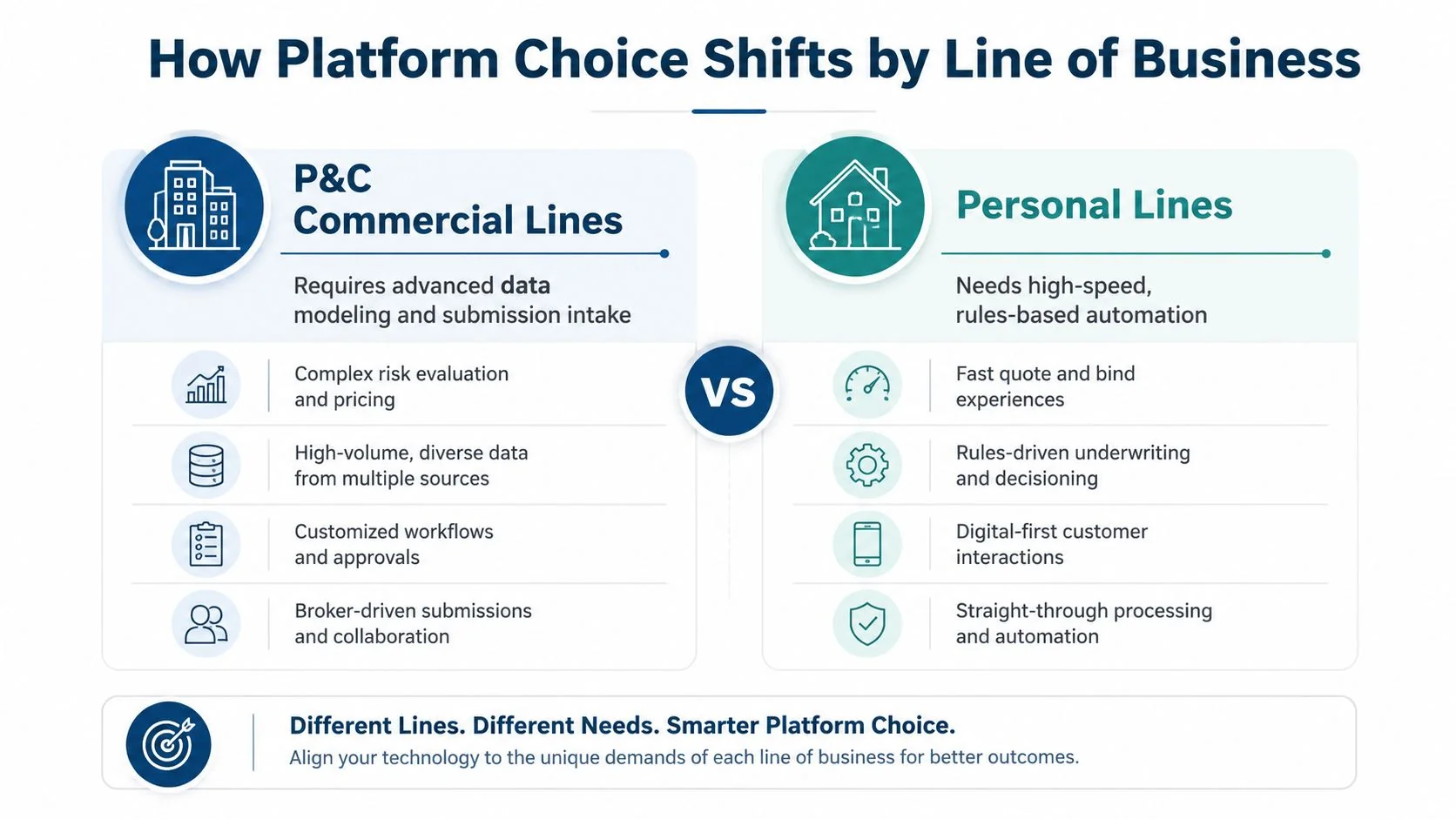
The practical takeaway is to match platform design to the job, not to the slogan. Commercial lines with messy intake need a different stack from personal lines that rely on high-speed rules-based automation. The same is true across life and specialty. One architecture rarely wins everywhere.
Implementing a Lighthouse Use Case Before Scaling
The strongest implementation path is to choose one lighthouse use case and make it work end to end before broadening the program. McKinsey's operating model guidance argues for building only the data foundations needed for the selected workflow first, rather than forcing the entire enterprise into one standard on day one. That approach is less flashy than an enterprise-wide rewrite, but it prevents teams from spending months modernizing low-priority areas while the primary bottleneck stays untouched (operating model guidance).
Start with a narrow objective and a defined data boundary
Choose one workflow where the pain is visible and the data is manageable. Set the business objective before implementation starts. The measures that matter are the same ones that should have informed platform selection in the first place, straight-through processing rate, quote turnaround time, underwriter productivity, and decision accuracy.
Once the scope is fixed, identify the minimum inputs needed to support that workflow. Resist the temptation to load every available field into phase one. Extra fields usually slow delivery, create more exceptions to govern, and make it harder for underwriters to trust what the system is doing.
A narrow data boundary also makes failure easier to diagnose. If approval quality drops, the team can trace the issue to a specific intake path, rule, or document set instead of sorting through a full-enterprise rollout.
Validate controls before you expand
Security, compliance, and auditability need to be tested before wider release. That means checking whether decisions are traceable, whether overrides are documented, and whether the platform can support the organization's review process without forcing analysts to reconstruct the file later.
Integration order matters as much as model quality. Policy administration, CRM, and rating systems should connect in the sequence that protects data flow, not the sequence a sales demo makes look tidy. A rollout can look polished in isolation and still fail once live underwriting traffic starts moving through it.
For a concrete example of a focused adoption path, the case study showing 58% automatic approval in life insurance underwriting shows how a narrow use case can produce operational proof faster than a broad transformation program.
Don't scale the platform until the first workflow is boring. If the team still debates every exception, the operating model is not ready.
The signal to expand is practical. The team trusts the outputs, the override process is stable, and the workflow runs without constant manual rescue. At that point, the next line of business becomes a sensible extension, not a leap of faith.
Matching Platforms to Insurer Profiles and Common Questions
A good fit depends on where the carrier is starting from. Mid-market P&C carriers usually need workflow clarity, fast intake, and enough automation to reduce broker friction. Large multi-line incumbents often need AI-augmented suites that can sit on top of legacy systems without forcing a full replacement. Specialty or MGA-led organizations tend to benefit from sharper decisioning logic and narrower, faster deployments.
How to read the fit signal
If your team spends most of its time cleaning up submissions, a workflow-first platform is usually the better starting point. If your underwriters are overwhelmed by triage and referral volume, a decisioning engine may be the right core. If your core systems are staying in place for now, an AI-augmented suite can be the lower-risk route.
What matters most is not the label. It's whether the platform matches the bottleneck you're trying to remove. A bad fit often shows up when a carrier buys for the wrong pain, then wonders why adoption lags.
Common questions buyers ask
How long does implementation usually take? The honest answer is that it depends on scope, integrations, and how messy the current intake is. A lighthouse use case is the fastest way to get useful results because it avoids enterprise-wide complexity at the start.
What is a realistic straight-through processing rate in year one? That depends on the line of business and the quality of the incoming data. The right expectation is that routine, well-defined cases should move further into automation first, while ambiguous cases stay in human review.
How should AI accuracy claims be evaluated? Ask what data was used, what kinds of policies were included, and whether the platform maintained accuracy on both simple and complex cases. A single headline number is not enough. You need to know whether the system performs well on the submissions your team sees.
The best underwriting software insurance choice is the one that improves both decision quality and operational control without pretending humans are obsolete. If you want a more grounded way to compare platforms, use the evidence-led case studies and implementation patterns at AI for Insurance as a starting point, then pressure-test every vendor claim against your own intake, rules, and audit requirements.
