Types of Risk in Insurance Industry: A 2026 Guide
Discover the main types of risk in insurance industry, from underwriting and market risk to cyber and climate, with examples and mitigation.
Written by AI for Insurance
If you're underwriting a book that's looked steady for years, the hard part usually isn't one obvious problem. It's the morning a hurricane, a cyber incident, and a stressed investment portfolio all hit the same balance sheet at once, while claims teams are trying to work through a surge and finance is watching cash leave faster than it expected. That's why the types of risk in the insurance industry have never been just an actuarial checklist. They're the language insurers use to decide who owns the problem, which model gets stressed, and where capital has to sit.
At a supervisory level, the industry has long been organized around multiple risk families, not a single exposure. That taxonomy still matters because insurance is structurally different from most other businesses, and today's agenda adds cyber, climate, and talent pressure on top of the classic categories. If you're a junior underwriter, the useful question isn't “what box does this fit in.” It's “which box changes the price, the reserve, the reinsurance program, or the board's appetite.”
Table of Contents
- Why Insurers Manage Many Risks at Once
- How Insurance Differs From Banking Risk
- The Traditional Five-Risk Framework and the Modern Agenda
- Underwriting and Market Risk in Practice
- Credit, Operational, and Liquidity Risk Explained
- Cyber, Climate, and Model Risk on the Rise
- How Insurers Measure Each Risk Type
- Mitigation Strategies and the Cross-Risk Reality
Why Insurers Manage Many Risks at Once
A mid-size property and casualty carrier can write a profitable book for years and still get caught off guard by one severe hurricane season. The obvious loss is underwriting. The less obvious damage lands in reinsurance collectability, the investment book, and the claims operation all at once.
A large event can push claims frequency and severity higher, test the quality of reinsurance recoverables, and force the insurer to liquidate assets sooner than planned. The same storm can also expose process gaps, because claims intake, triage, vendor coordination, and fraud controls all get stressed together. That's why the industry's risk language is built around categories that can be assigned to separate owners and separate controls, not because the categories are neat, but because they're actionable.
A single shock rarely stays in one box
The taxonomy used by supervisors and rating frameworks has persisted for a reason. Insurance has long been managed as a multi-risk business, with underwriting, market, credit, liquidity, operational, and related risks treated as distinct sources of capital strain and solvency pressure, as reflected in the European Central Bank and National Bank of Austria discussion of systemic risk factors and in rating-style frameworks that group insurer exposures into major categories such as credit, market, underwriting, operational, and strategic risk. The structure matters because pricing, capital, and governance all depend on knowing which exposure is moving first. You can't fix a hurricane loss with the same lever you'd use for a claims system outage.
Practical rule: if a loss event affects claims, assets, counterparties, and staff processes, don't force it into one bucket just to make reporting tidy.
The right mental model is a portfolio view. The underwriter worries about what gets sold, the ALM team worries about what backs it, the reinsurance team worries about who pays when stress arrives, and operations worries about whether the machine keeps running. A single shock can touch all four.
That's why risk classification is really about decision rights. Each category has to map to a control, a metric, and a named owner. If it doesn't, the taxonomy is only a filing system.
How Insurance Differs From Banking Risk
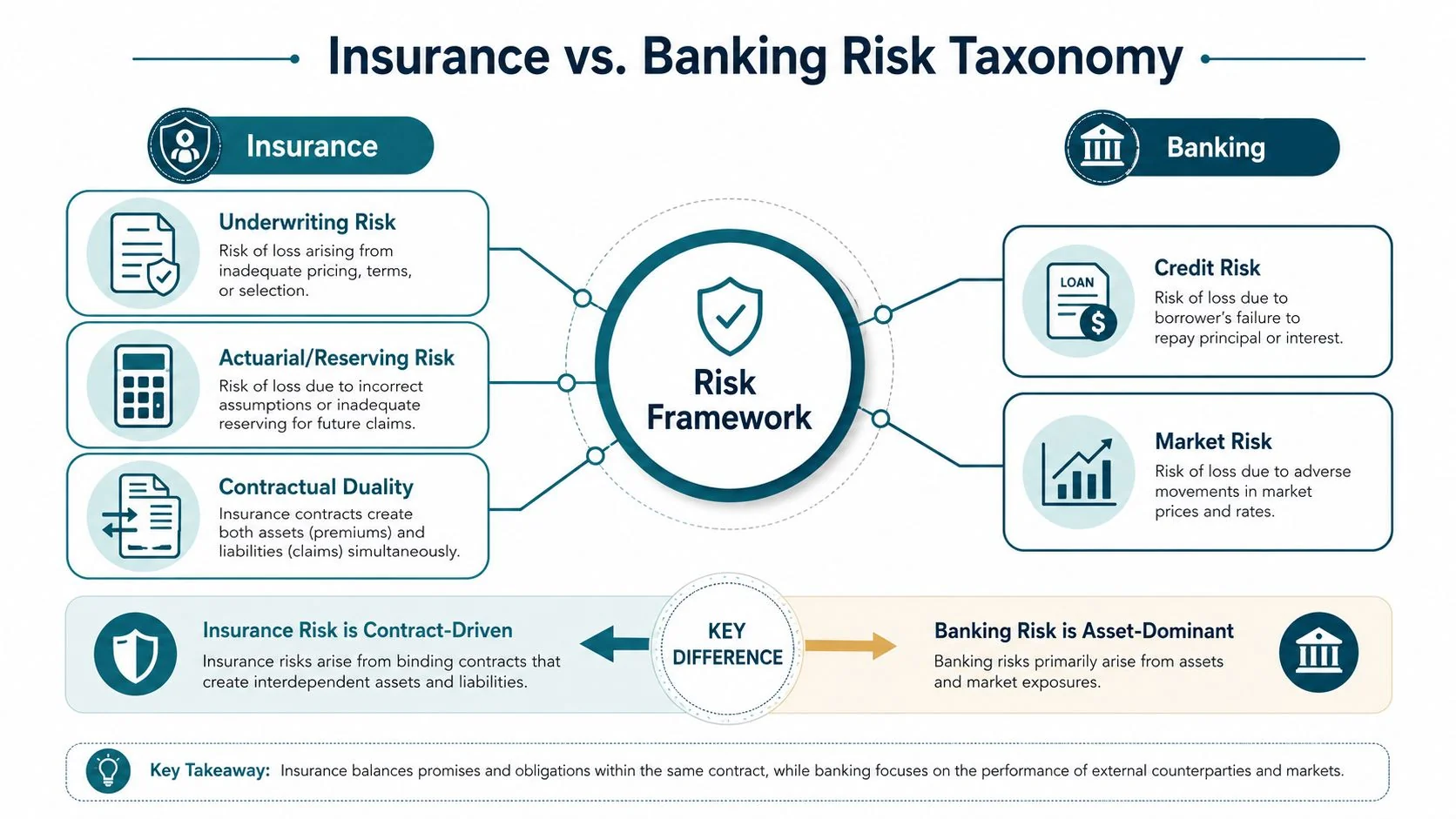
An insurer carries a different kind of balance-sheet tension than a bank. A bank mainly manages lending and funding. An insurer collects premiums, invests them, and commits to future claim payments that may come long after the policy is issued.
A homeowner who sells fire insurance while also owning the lumber yard that supplies the wood would have to watch both sides of the promise at once. The insurer faces the insured event and the performance of the assets backing that promise. If yields move, spreads widen, or the portfolio becomes concentrated in the wrong place, the liability picture changes even when the policy wording stays the same.
Why asset-liability thinking sits at the center
The supervisory taxonomy reflects that duality. The AM Best-style framework groups insurer exposures into insurance risk, credit risk, market risk, operational risk, and liquidity risk, and each category threatens capital in a different way. Insurance risk captures claim frequency, severity, and reserve uncertainty. Market risk captures asset-value volatility. Credit risk captures default by counterparties such as reinsurers or bond issuers. Liquidity risk captures the timing gap between cash in and cash out. Operational risk covers process, people, systems, and external events. That separation helps boards see whether the pressure is coming from pricing, reserving, asset mix, or execution.
An insurer can have clean underwriting results and still drift into trouble if the asset side is mismatched to the liability side.
This is why capital-setting and solvency work in insurance feel more integrated than in many other industries. The insurer's promise is contractual, but the promise is financed by assets that move every day. Pricing has to cover the policy itself and the financial structure behind it.
At board level, the consequence is straightforward. Risk appetite cannot be written as a single sentence like “keep risk low.” It has to state how much underwriting volatility is acceptable, how much duration mismatch is tolerable, how much counterparty concentration is allowed, and how much liquidity buffer the company needs under stress. That is why insurance risk sits at the intersection of actuarial, financial, and operational decisions.
The Traditional Five-Risk Framework and the Modern Agenda
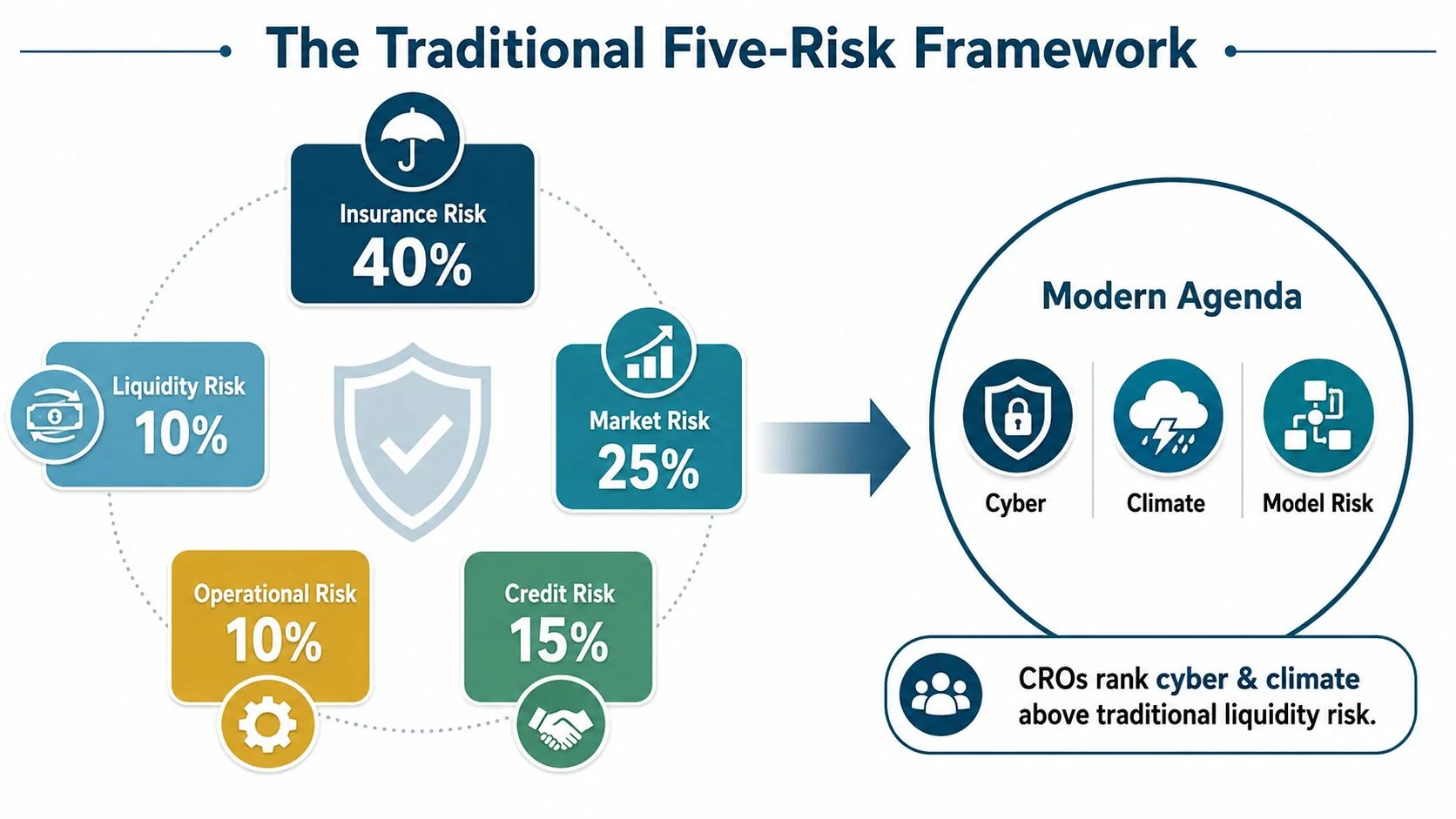
The classic framework is still the backbone: insurance, market, credit, operational, and liquidity risk. That taxonomy is embedded in supervision because it maps cleanly to where capital can be lost, where obligations can be missed, and who inside the firm should own the response. But if you talk to CROs today, the top of the agenda looks broader than the textbook.
EY's global insurance risk survey shows 53% of respondents identifying cybersecurity risk as a major concern, ahead of 35% for core insurance risk such as underwriting, catastrophic, lapse, and longevity risk. The same survey also shows concern across business model change/transformation at 32%, credit risk at 26%, capital allocation at 24%, interest-rate risk at 24%, technology risk at 22%, human capital risk at 22%, regulatory/compliance risk at 22%, and geopolitical risk at 19%. Aon's global insurance risk survey puts the industry's top risks in a similar place, led by cyber attack or data breach, weather and natural disasters, regulatory or legislative changes, climate change, and economic slowdown or slow recovery. That's a clear signal that the modern risk agenda has moved beyond pure underwriting loss drivers into enterprise resilience. EY's global insurance risk survey
The old buckets still matter, but they don't sit alone anymore
The mistake is to treat cyber and climate as separate from the classical framework. They don't replace it. They cut across it. A cyber event can become an underwriting issue, an operational issue, a reputational issue, and a liquidity issue if claims spike and systems are down. Climate pressure can hit claims, reserving, investing, and even product design at the same time.
That's why the supervisory categories still anchor reporting, while the modern agenda drives priorities. The categories tell you how to allocate capital and governance. The current survey data tells you where the pressure is building.
The practical lesson for a junior underwriter is not complicated. Use the five-risk framework to structure the file, but don't stop there. Ask whether the exposure is also creating digital concentration, climate correlation, or talent dependency. In 2026, that broader question is often the one that separates a good rate from a fragile book.
Underwriting and Market Risk in Practice
Underwriting risk sits closest to the policy promise. It covers claim frequency and severity, catastrophe losses, mortality, longevity, lapse behavior, and reserve uncertainty. If the assumptions are wrong, the insurer has priced the contract wrong or set aside too little for future payments.
Market risk sits on the asset side of that same promise. It comes from interest-rate movements, equity volatility, credit spreads, and currency mismatches in the asset portfolio that supports the liabilities. A policy can be priced well, yet the insurer can still take a hit if the assets do not match the liability profile.
Where the two risk types collide
Long-term care shows how quickly these drivers overlap. The liability profile moves with demographic assumptions and discount rates. If longevity improves, claims arrive later and last longer. If rates fall, the present value of those future claims rises. The underwriter and the ALM team are looking at different drivers, but the same contract is under stress.
Insurers use different tools for each side because the questions are different. Underwriting teams watch loss ratios and combined ratios. Reserving teams compare booked reserves with emerging claim patterns. Asset teams look at duration matching and interest-rate sensitivity, including measures such as key-rate DV01 where they are relevant. Pricing software and underwriting workflow controls also matter here, which is why tools like underwriting software for insurance teams are often used to keep pricing assumptions, referral steps, and documentation in one place. The point is not to turn the file into a spreadsheet contest. It is to see which assumption moves the result first.
Rule of thumb: pricing owns the liability story, ALM owns the asset story, and both teams should be in the same stress test before the policy is bound.
The wording matters because these risks are easy to blur in meetings. Rate movements and claim outcomes require separate analysis. A poor result after rates move does not indicate an underwriting failure, and a weak loss ratio does not guarantee investment success. The right review separates the sources of volatility so management knows whether to change rate, limit, duration, or reserve strength.
For underwriting discipline, that separation matters. If asset noise and claim noise are mixed together, the portfolio gets misread and the renewal decision can go in the wrong direction.
Credit, Operational, and Liquidity Risk Explained
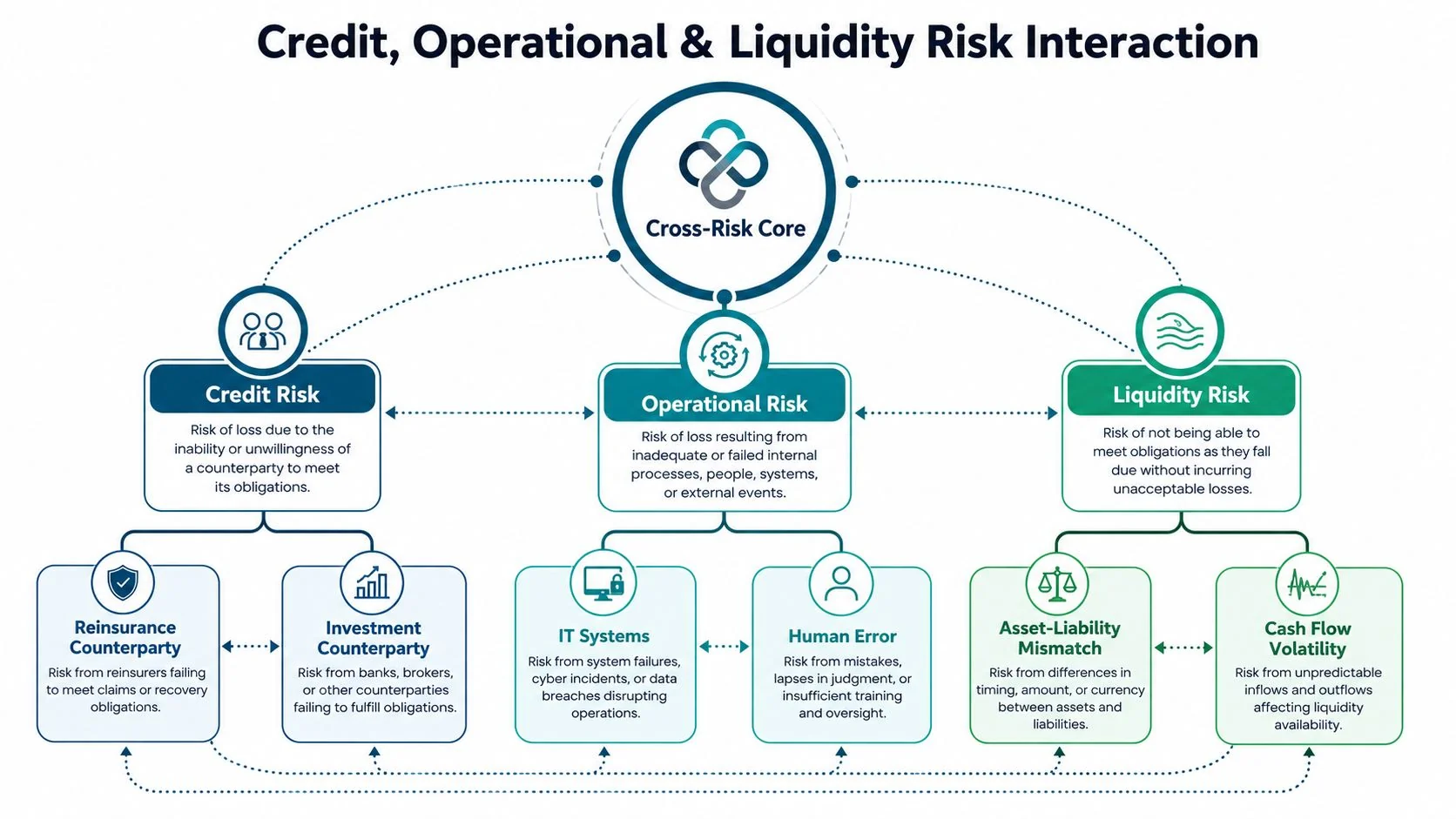
These three categories are smaller individually than underwriting or market risk, but they can still do serious damage because they often appear when the firm is already under stress. Credit risk is mostly counterparty risk in insurance. That includes reinsurance recoverables, broker collectability, corporate bond holdings, and bank exposures where premium cash sits before it's deployed.
Operational risk is the catch-all for process, people, systems, and external-event failures. A manual entry error, a claims platform outage, a failed vendor handoff, or a fraud ring can all sit here. Liquidity risk is different again. It's the timing mismatch between premium inflows and claim outflows, and it becomes sharper when catastrophe losses force cash out quickly while markets are also moving against the insurer.
Why these three belong together
A reinsurer's failure is a credit problem, but the operational response can magnify it if recoveries aren't tracked correctly. A claims system outage is operational, but it can create a liquidity problem if payments are delayed and then bunch up later. A stressed market can worsen all three by tightening funding and making counterparties weaker.
The Aon risk survey is useful here because it puts cyber attack or data breach at the top of the list, which fits squarely inside operational risk, and regulatory or legislative changes among the leading concerns, which can spill across credit, operational, and liquidity decisions. Rules can change collateral needs, reinsurance structures, or payment timing, so the issue is rarely confined to one desk.
| Risk Type | What It Usually Means | Typical Control Focus |
|---|---|---|
| Credit risk | Counterparty default or non-payment | Limits, collateral, recoverability reviews |
| Operational risk | Process, people, systems, external failure | Controls, incident management, resilience |
| Liquidity risk | Cash timing mismatch under stress | Forecasting, buffers, contingent funding |
A useful control question is whether the model separates the risks cleanly. If one counterparty failure is being treated like a generic market shock, or if a claims outage is folded into underwriting, the capital view gets distorted. The better discipline is to model each one on its own terms, then test the combined effect.
Cyber, Climate, and Model Risk on the Rise
A cyber event that starts as a systems issue can quickly become an underwriting problem, a claims problem, and a capital problem. That is why cyber risk no longer sits comfortably as just one more item inside operational risk. In practice, many insurers now treat it with its own underwriting view, its own accumulation logic, and its own reinsurance discussion, because one severe incident can affect liability claims, asset disruption, and brand damage at the same time. A junior underwriter who only looks at the policy wording misses the point; the question is how much correlated loss the portfolio could absorb if a single event hits many insureds at once. For a practical example of faster cyber screening and accumulation thinking, see this At-Bay cyber insurance underwriting case study.
Climate risk needs separate treatment for the same reason, it reaches the balance sheet through more than one path. The actuarial taxonomy usefully separates physical, liability, and transition/economic risk. That split helps insurers see whether the shock is coming from storms and floods, litigation and responsibility claims, or shifts in policy and asset values. The reason for separating them is practical, because each channel can push claims, reserves, and investments in the same direction, and a pricing view that misses one channel can understate the total impact.
Why model risk deserves a seat at the table
Model risk is the risk that the pricing, reserving, capital, or scenario model is wrong, incomplete, or too opaque to trust. As insurers use more AI and machine learning in pricing and claims, that risk becomes harder to ignore. A model can look fine in ordinary conditions and still fail when the next event does not resemble the training data. In day-to-day decision-making, that means the pricing indication may look precise while the underlying assumptions are already stale.
The actuarial taxonomy from the UK discussion paper is a useful reminder that insurance risk can be broken down with more granularity than the five supervisory buckets. It distinguishes demographic risk, persistency risk, option take-up risk, process risk, heterogeneity risk, catastrophe risk, liquidity risk, operational risk, strategy risk, frictional risk, tax risk, and aggregation/diversification risk. That level of detail matters because a portfolio can appear diversified at the policy level and still concentrate badly by geography, peril, or correlated behavior. The same idea applies to model risk, a model may spread exposure neatly across cells and still hide a sharp concentration in the assumptions underneath.
If the model cannot explain why the loss happened, it should not be the only basis for the decision.
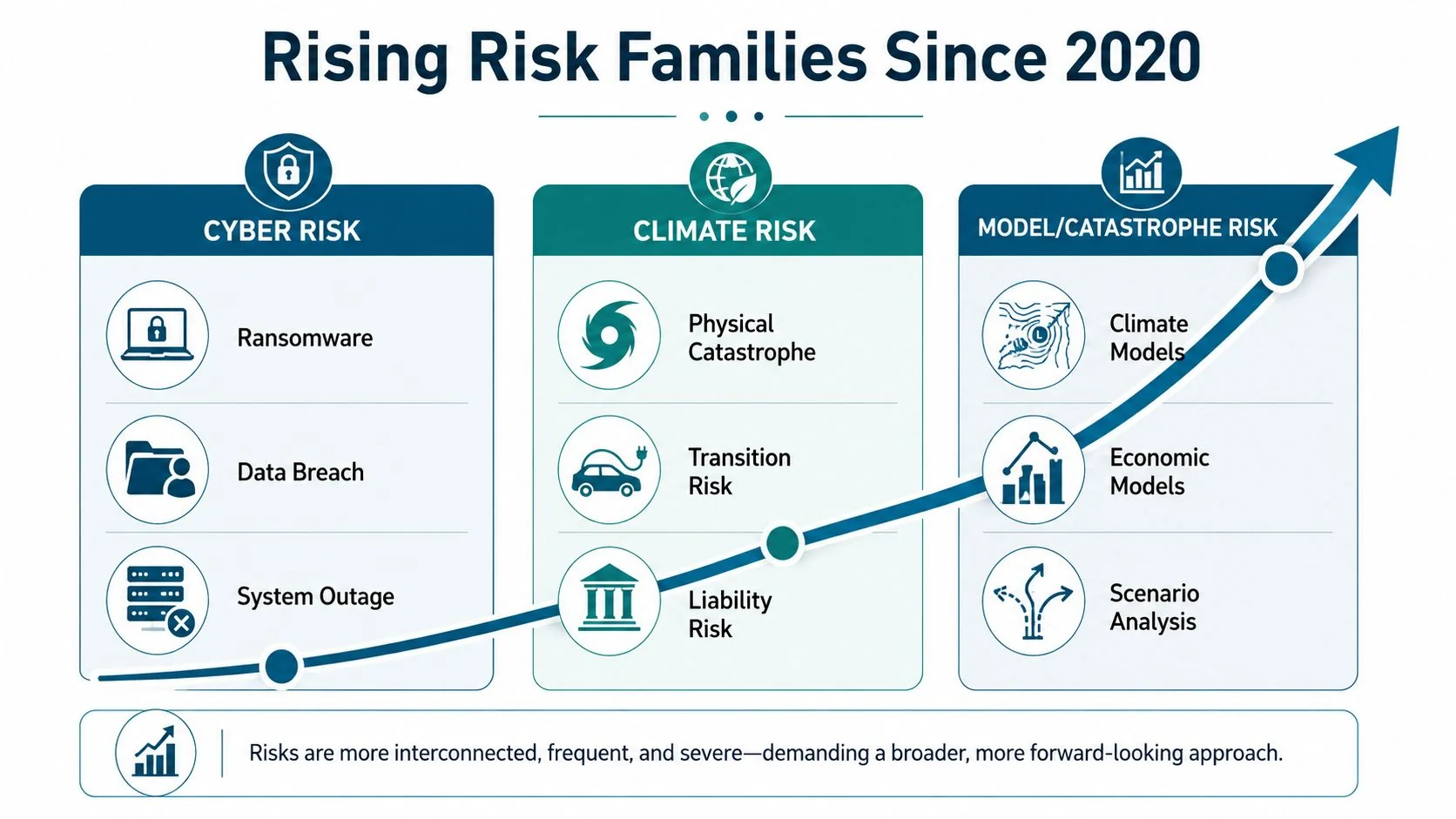
The practical takeaway is simple. Cyber, climate, and model risk are not side topics. They are the places where the older taxonomy gets pressure-tested most clearly, because each one cuts across pricing, claims, reserves, reinsurance, and capital planning. They also explain why CRO agendas feel broader now than they did a decade ago, the list of exposures has not replaced the classic framework, it has made its limits more visible.
<iframe width="100%" style="aspect-ratio: 16 / 9;" src="https://www.youtube.com/embed/vWd7eFnSoAs" frameborder="0" allow="autoplay; encrypted-media" allowfullscreen></iframe>
How Insurers Measure Each Risk Type
Different risk types need different measurement tools, and that's where a lot of junior practitioners get tangled up. Value-at-Risk and Tail Value-at-Risk are common for market risk because they help quantify portfolio loss under adverse conditions. They translate less cleanly to long-tail insurance liabilities, where scenario analysis and reverse stress testing usually add more value.
Matching the metric to the exposure
Underwriting risk is often watched through loss ratios, combined ratios, reserve development, and scenario tests tied to claims behavior. Credit risk leans on counterparty assessment and recovery expectations. Operational risk usually depends on loss-event databases and scenario libraries, because the events are irregular and messy. Liquidity risk needs cash-flow forecasting and collateral planning. Model risk needs validation, challenger models, and review of assumptions, not just output.
The supervisory backbone is still the ORSA process, plus stress testing and scenario design. Those tools force management to think about low-probability, high-impact combinations, which is exactly where insurance losses often turn ugly. A good stress test doesn't just ask whether one risk moves. It asks what happens when several move together.
| Risk Type | Primary Metric | Common Stress Test | Owner |
|---|---|---|---|
| Market risk | VaR or TVaR | Rates, spreads, equity shock | ALM or treasury |
| Underwriting risk | Loss ratio, reserve run-off | Catastrophe, mortality, lapse | Pricing or actuarial |
| Credit risk | Exposure and recoverability | Counterparty default | Credit or reinsurance |
| Operational risk | Loss-event trends | System outage, process failure | Operations or risk |
| Liquidity risk | Cash-flow forecast | Claim spike, market stress | Finance or treasury |
AI and machine learning can improve pattern detection, but they also add model risk when the output is hard to explain. That's why board reporting has to stay simple enough for non-specialists to follow. If a director can't read the metric and understand the decision, the report has missed the point.
Mitigation Strategies and the Cross-Risk Reality
Mitigation starts with the category, but it does not stop there. Underwriting risk is reduced through diversification, reinsurance, and disciplined pricing. Market risk is controlled with duration matching, hedging, and asset-liability management. Credit risk depends on counterparty limits and collateral. Operational risk needs process controls and resilience testing. Liquidity risk needs cash buffers and contingent funding. Cyber risk calls for stronger underwriting standards and incident response. Climate risk pushes scenario-aware investing and product redesign. Model risk needs governance, validation, and challenger views.
A junior underwriter can see the logic more clearly by treating each lever like part of one machine. If the pricing view is sound but reinsurance is thin, the portfolio still carries too much tail exposure. If asset duration is out of line with liabilities, the balance sheet absorbs extra strain when rates move. If operations are fragile, even a well-priced book can be disrupted by claims handling or systems failure. If cyber controls are weak, the loss may begin in operations and show up later in underwriting results.
The hurricane test
Go back to the hurricane scenario from the opening. A well-run insurer would not treat that event as only a claims problem. It would already have reinsurance in place, asset duration aligned with liabilities, liquidity buffers set for a claims surge, and business continuity plans for the operation. The claims team would still be under pressure, but the event would not be allowed to spread unchecked into every corner of the balance sheet.
That is what cross-risk thinking looks like in practice. Each category has a specific lever, but the levers have to work together. If reinsurance is weak, the loss hits earnings harder. If assets are too long or too risky, the asset side compounds the problem. If liquidity is thin, a manageable loss can turn into a funding issue. If cyber controls are weak, the event can start in operations and end in underwriting. For insurers building digital workflows, the same logic belongs in platform design too, which is why implementation discussions around digital insurance platforms often come back to data control, workflow discipline, and clear ownership across teams.
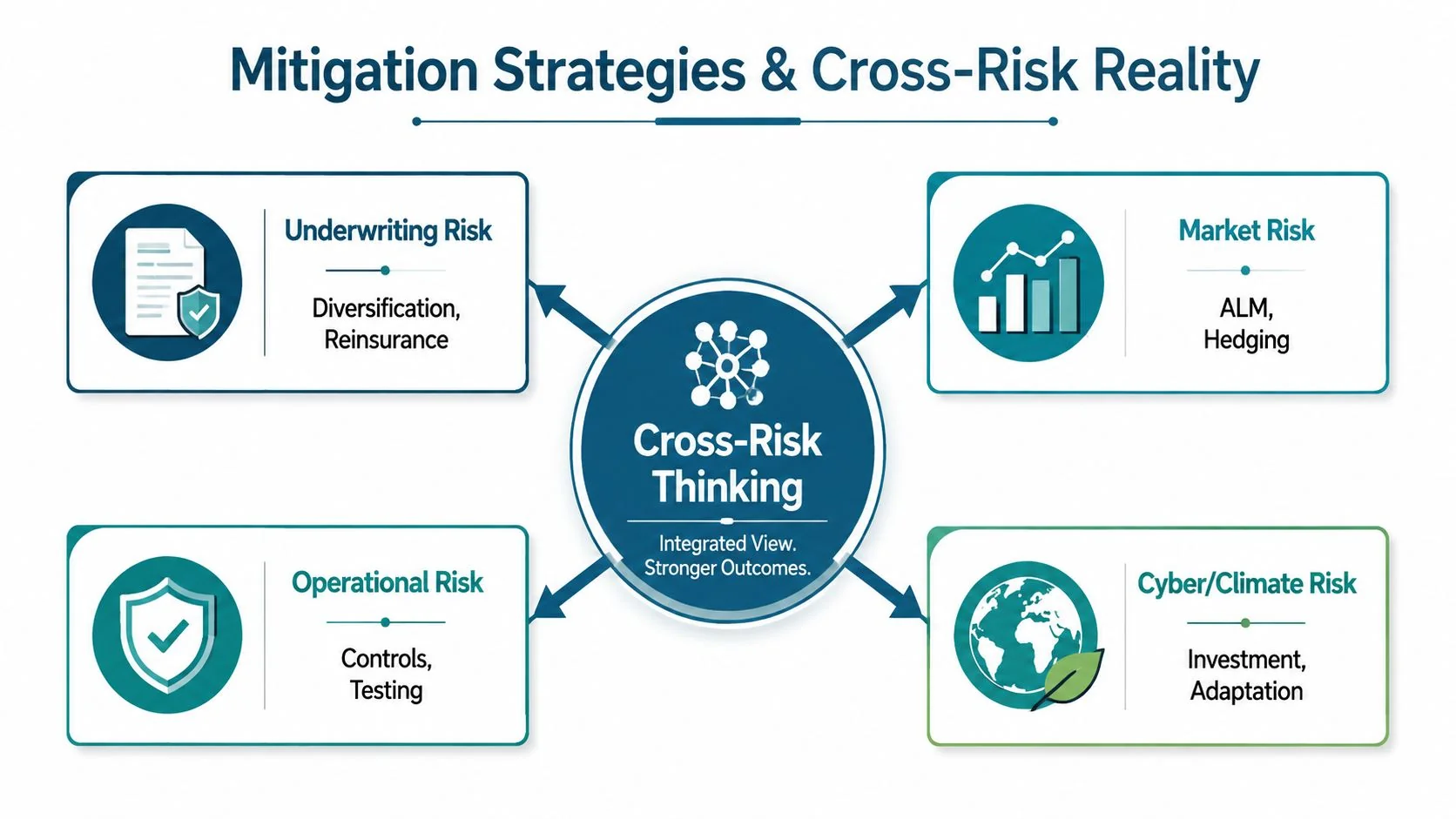
The structural lesson is simple. The categories are useful accounting buckets, but real losses rarely respect the lines drawn between them. If you want a cleaner portfolio, a stronger rate setting process, and a board that trusts the capital story, use the taxonomy to assign ownership, then stress the overlaps before the market does.
If you want a practical way to keep turning this taxonomy into better decisions, use the case studies and implementation examples at AI for Insurance to compare how insurers are applying risk thinking in underwriting, claims, and operations, then bring those lessons back to your own pricing and capital review process.
