Software for Insurance Company: Top Solutions 2026
Compare software for insurance company operations in 2026. Covers policy admin, claims, underwriting, analytics, AI, and case studies.
Written by AI for Insurance
You're in a vendor demo, and the deck looks polished. Every screen claims to unify policy, claims, billing, reporting, and AI in one clean workflow. The problem is that your team already knows the hard part isn't the demo, it's the migration, the integration debt, and the operational mess that shows up after go-live.
That's the core decision in software for insurance company buyers. The right platform is the one your claims leaders, underwriters, finance team, and IT group can live with in three years, not the one that flashes the most features in one afternoon. The U.S. insurance claims processing software market alone is estimated at $16.5 billion in 2026, with 2.4% CAGR growth from 2020 to 2025, and 483 businesses in the segment in 2025, up at 3.9% CAGR over the same period, which is a good reminder that this is a genuine operating market, not a niche add-on (IBISWorld).
| Category | Best For | Main Risk | What Usually Breaks |
|---|---|---|---|
| Policy Administration | Core policy lifecycle and renewals | Heavy replacement effort | Data migration and downstream integrations |
| Claims Management | Intake, triage, adjuster work, payment handling | Workflow redesign | Exception handling and legacy handoffs |
| Underwriting Workbench | Risk review, appetite, pricing support | Overpromising automation | Human review still needed for edge cases |
| Billing and Payments | Premium collection and receivables | Poor finance alignment | Reconciliation and status sync |
| Data and Analytics | Performance visibility and benchmarking | Reporting without action | Dashboards that don't change operations |
Table of Contents
- Why Software Choices Define an Insurer's Next Decade
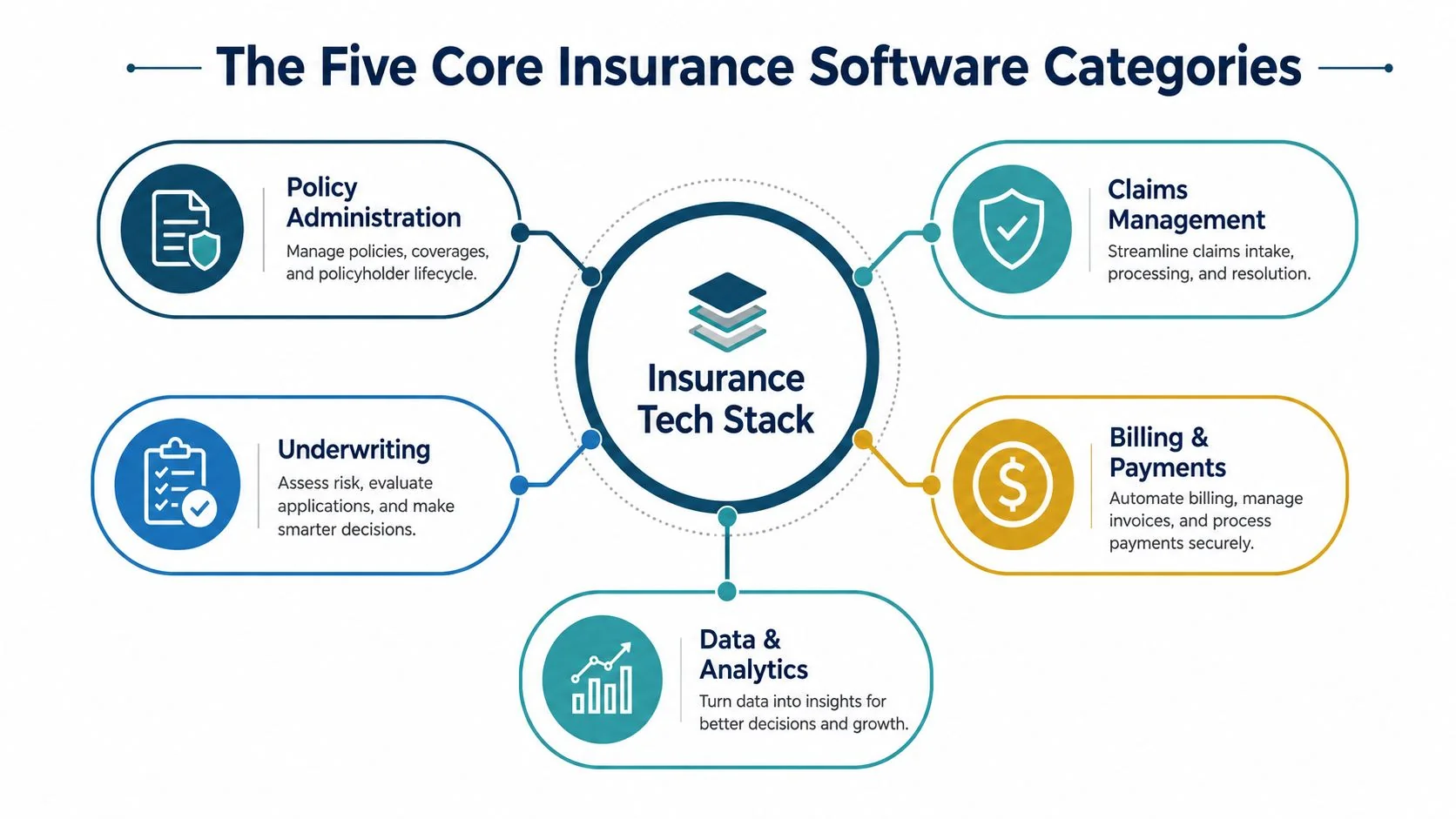
- The Five Core Software Categories Insurers Actually Buy
- Comparing Categories Side by Side at a Glance
- Selection Criteria That Predict Vendor Wins
- AI and Integration as Operational Capabilities
- Situational Recommendations by Carrier Profile
- Implementation Reality Beats Feature Lists Every Time
- A 30-Day Evaluation Checklist for Insurance Software Buyers
Why Software Choices Define an Insurer's Next Decade
A claims CIO told me about a replacement program that started as a “policy admin upgrade” and turned into a full operating-model debate. That happens because software for insurance company decisions are never isolated. If policy, billing, claims, and analytics don't exchange clean data, the business ends up paying for rekeying, manual controls, and endless reconciliation.
The stack matters more than the demo
Insurers don't run on one shiny suite anymore, they run on a portfolio. One system may own policy issuance, another manages claims, a third supports pricing or actuarial review, and analytics sits on top trying to make sense of the whole thing. That's why the wrong shortlist can haunt a carrier for years, especially once migration work starts and the first exception cases appear.
The smarter mindset is simple, choose for operational fit and future support, not feature theater. A platform that looks weaker in a demo can still win if it integrates better, fits the line of business, and doesn't trap your team in custom work every time rules change. That's especially important in a market where the software category has become both large and still expanding, not a static buy-and-forget purchase (IBISWorld).
Practical rule: if a vendor can't explain how data moves from intake to settlement to finance, the product is already behind your operating reality.
Different lines expose different pain points
A personal auto carrier cares about high-volume claims flow and straight-through processing. A life insurer cares more about data model depth, underwriting support, and actuarial visibility. Commercial property teams live in a messier world of exceptions, documents, and escalation paths. The platform that works in one line can fail badly in another because the workflow, regulation, and lifecycle aren't the same.
That's why generic “best software” rankings are usually too shallow to matter. Real buyers are choosing the next operating layer of the company, and that choice affects how quickly they can launch products, absorb growth, and respond to loss trends for years after implementation.
The Five Core Software Categories Insurers Actually Buy
Before you compare vendors, get the categories straight. Insurers do not buy “software” in the abstract. They buy systems to run specific workflows, and those workflows map to distinct modules and operating owners.
What each category does
Policy administration handles the policy lifecycle, from quote and issuance through endorsements, renewals, and cancellations. It matters most when a carrier is modernizing a core line, especially in personal lines and standard commercial products where consistency and throughput matter.
Claims management covers first notice of loss, assignment, adjudication, reserves, settlement, and payment coordination. It is the obvious priority for carriers dealing with high claim volumes, complex exceptions, or heavy customer-service pressure. If your claims team spends too much time chasing documents or manually routing files, the pain sits there.
Underwriting workbench supports risk review, appetite checks, pricing support, referrals, and decision documentation. It shows up in life and commercial lines where human judgment still dominates, but underwriters need better triage and cleaner access to data. For a closer look at that category, use this underwriting software guide for insurance teams.
Billing and payments is the finance-facing side of the house, premium collection, receivables, refunds, and reconciliation. It matters whenever cash flow, billing accuracy, and policy status need to stay in sync across systems.
Data and analytics turns operational activity into management insight. The point is not just dashboards, it is linking performance metrics to action. One insurance analytics platform cited by F6S offers about 400 metrics and 200 templates, covering sales, claims, underwriting, reinsurance, financial, actuarial, and operations use cases.
Why the category boundary matters
If you blur the categories, you buy the wrong thing. Analytics does not replace transactional claims software. Policy administration does not solve underwriting judgment. A core suite can bundle several functions, but that does not mean every module is equally mature or equally easy to deploy.
The fastest way to waste budget is to ask one system to solve three different operating problems at once.
That is why most carriers end up with some blend of point solutions, core suite modules, and a reporting layer on top. The right mix depends on how much change the organization can absorb, how old the current stack is, and whether the target line of business can tolerate a phased rollout or needs a cleaner reset.
Comparing Categories Side by Side at a Glance
Here's the short version. Some categories own transactions, some support decisions, and some only make sense if the data foundation is already solid. Buyers who separate those roles early make better shortlist decisions and waste less time in demos.
| Software Categories at a Glance | Primary Workflow Owner | Line of Business Fit | Integration Surface | AI Maturity |
|---|---|---|---|---|
| Policy Administration | Policy operations team | Strong in personal lines, standard commercial, and life policy lifecycle | High, especially with billing, claims, and document systems | Moderate, mostly workflow assist and data validation |
| Claims Management | Claims operations team | Strong in P&C and specialty claims, useful wherever volume and exception handling matter | Very high, touches intake, payments, document handling, and finance | Moderate to high in triage, routing, and document handling |
| Underwriting Workbench | Underwriting and pricing team | Strong in life, commercial, and specialty risk review | High, usually connected to data sources, rules engines, and policy systems | Moderate, often used for triage and decision support |
| Billing and Payments | Finance and billing team | Strong where premium collection and reconciliation are operationally sensitive | Medium to high, tied to policy status, finance, and customer records | Low to moderate, mainly exception detection and automation |
| Data and Analytics | Executive, operations, actuarial, and business teams | Broad fit across life, P&C, and health | Very high, depends on clean feeds from core systems | High on insight generation, but not transactional ownership |
What this matrix tells you
Analytics is powerful, but it rarely owns a transaction. Claims owns work, but without strong integration it just becomes a better place to queue problems. Underwriting support can sharpen decisions, but if the policy and data layer is weak, the output is still based on incomplete inputs.
Core platform suites can reduce integration friction if the modules are mature and the implementation team knows your line of business. They can also slow everything down if you buy breadth you don't need and then spend a year untangling half-used modules.
The clean way to decide is to ask one question for every category, does it own the workflow, or does it support the workflow? That answer should drive your evaluation more than any feature checklist.
Selection Criteria That Predict Vendor Wins
Most public buyer guides obsess over feature lists. Insurers do not buy software that way. They score vendors on whether the platform can cover the full workflow, connect to adjacent systems, and fit the operating model without turning every change into a custom project.
What the best scorecards measure
Industry evaluation patterns often benchmark against functional features and technical capabilities, with requirements scored for out-of-the-box support. That structure is useful because it forces discipline. A platform cannot hide behind a slick interface if it fails on integration, configuration, or line-specific depth.
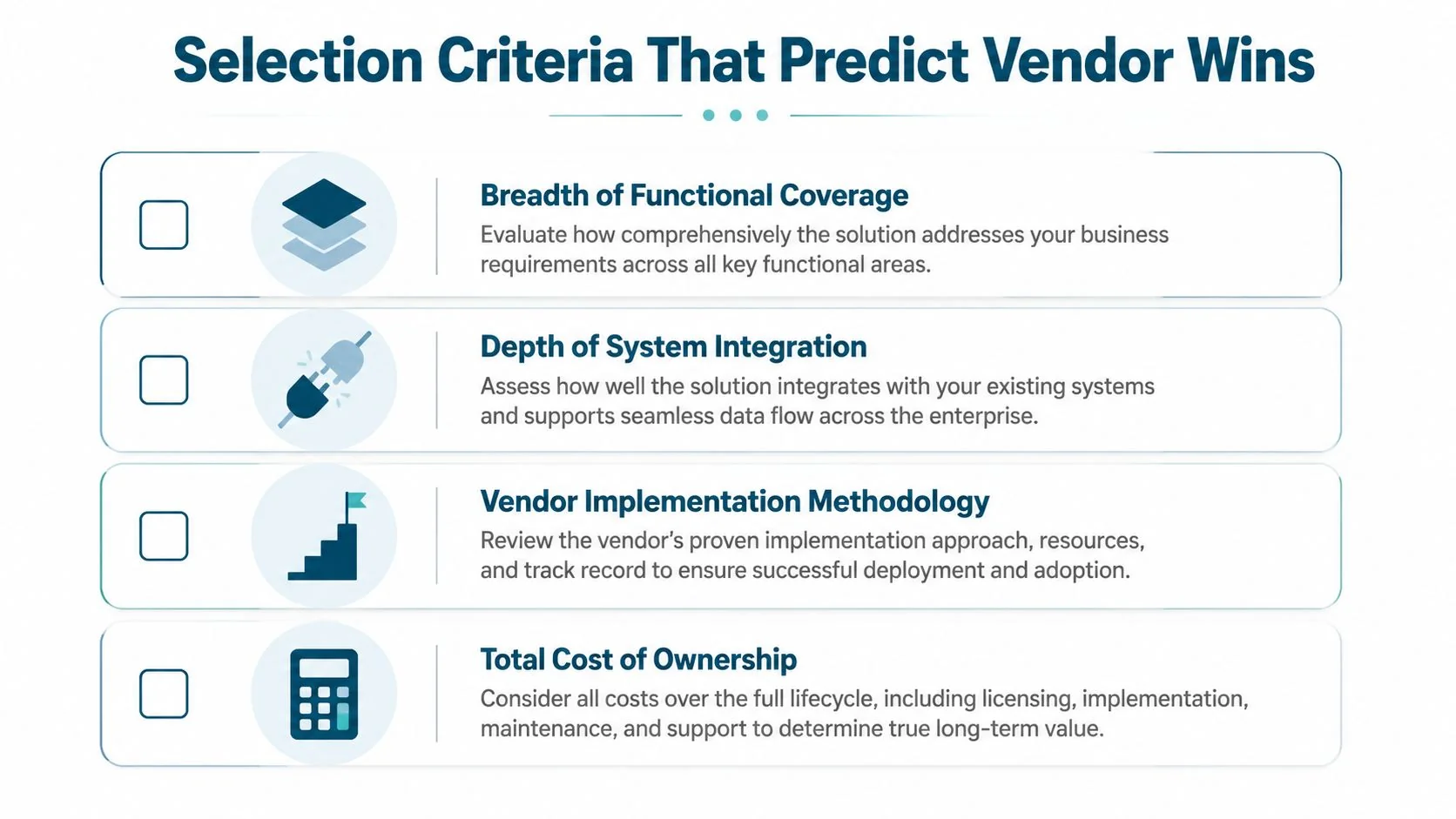
The first criterion is breadth of functional coverage. If you are replacing a core module, you need enough coverage to avoid building side systems for basic work. The second is integration depth, because insurance software lives or dies on its ability to talk to policy, claims, billing, document, CRM, and data layers. The third is configurability without code, because every hard-coded change becomes tomorrow's backlog. The fourth is implementation method, which is where many projects fail.
Practical rule: score the vendor on what it can do on day one, not what a services team promises to bolt on later.
Why overall fit beats a single category win
One evaluation may call a platform a leader in dashboards and reporting, while another lists a different enterprise suite as the stronger all-around option. That is not a contradiction, it is a warning. A strong reporting layer does not make the vendor the right choice for policy replacement, claims modernization, or enterprise integration.
That is also why selection criteria should be weighted differently by project type. If you are replacing only one module, functional depth in that module should carry the most weight. If you are modernizing the core, focus more on integration architecture, migration support, and the vendor's ability to manage a long deployment without breaking operations.
The cleanest scorecard is the one your claims lead, underwriting lead, finance lead, and CIO all agree on before demos start. If they cannot agree on the scoring logic, they will not agree after implementation either.
One more filter matters, and it cuts through a lot of vendor noise. If a system cannot survive migration, data cleanup, and integration debt, its feature list is irrelevant. Buyers should ask whether the implementation team can map legacy workflows into the new model without breaking controls, creating duplicate entry, or forcing staff to keep old systems alive as shadow processes.
AI claims also need to be treated as operating claims, not marketing copy. Use AI for Insurance's overview of applied AI in insurance as a reference point for separating workflow automation from presentation-layer theater. If the AI cannot route work, flag anomalies, or reduce manual handling in a measurable way, it is decoration.
The same discipline applies to integration. A vendor that offers a clean demo but weak data movement will push complexity onto your teams later. That is the wrong trade. Give more weight to the platforms that fit your core systems, support realistic migration timelines, and let you change processes without calling a developer for every adjustment.
AI and Integration as Operational Capabilities
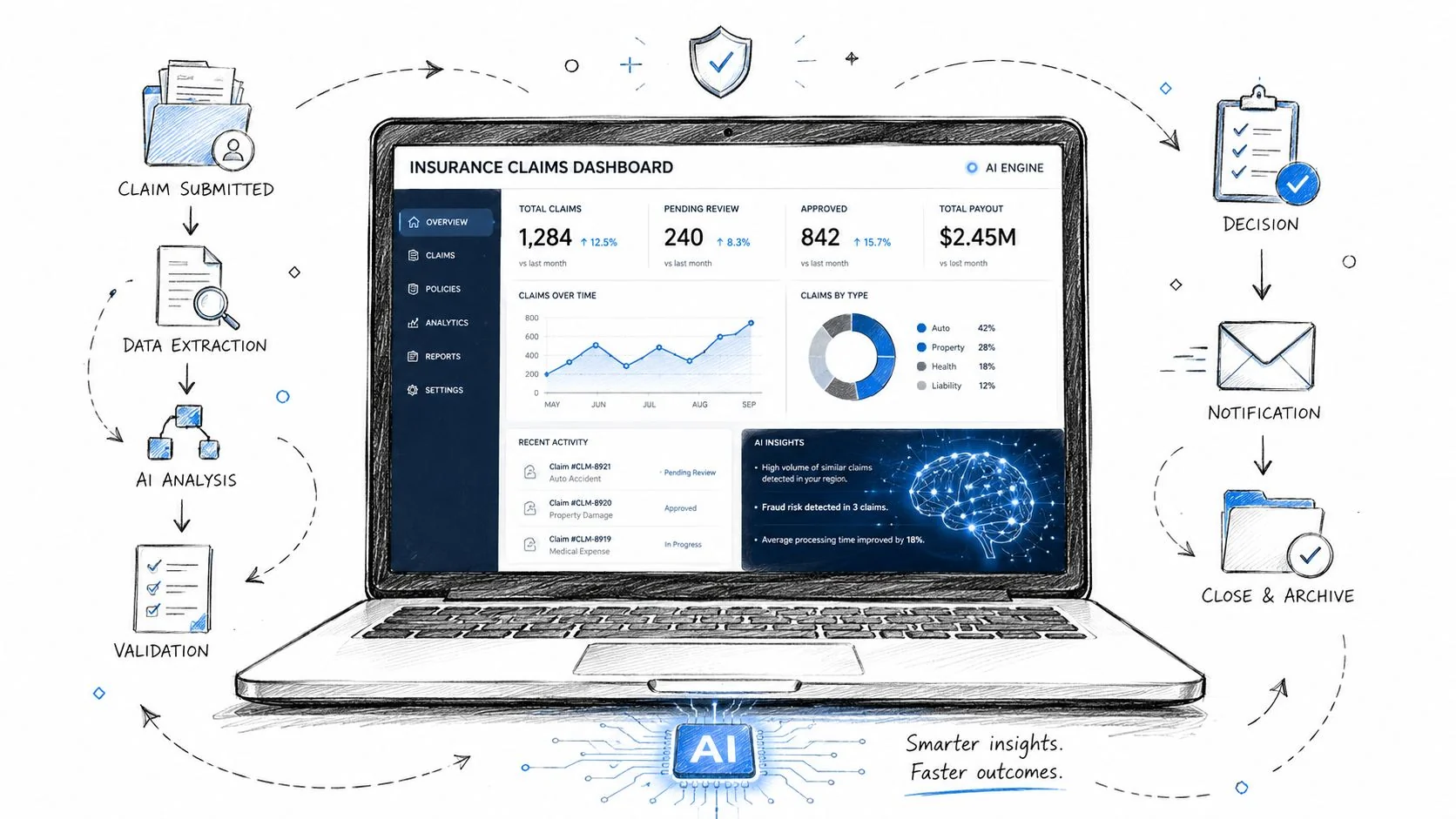
AI in insurance is useful only when it changes a workflow. If it just decorates a dashboard, it adds noise. Integration matters just as much. If a system cannot move clean data across the stack, the AI on top of it will automate bad inputs faster.
Where AI is useful
Insurance analytics environments track direct premiums written, losses paid, large claims count, average days to close, reserve deviation, claims ratio, and loss ratio to monitor performance and spot issues. That matters because AI should connect to those operating measures, not just produce another set of charts. The useful jobs are triage, anomaly detection, work routing, and helping staff spend time on the cases that need judgment.
Most AI marketing in insurance oversells automation as transformation. It is not. A workflow that cuts manual steps but keeps human review for exceptions can be valuable. A workflow that removes human judgment where regulation or complexity demands it is a liability.
The useful discussion around AI is narrower than the hype. For a grounded view of the current market conversation, see this AI insurance market overview 2026 guide.
Integration is the hidden ROI lever
A claims system that cannot sync with policy status and payment status forces staff to reconcile by hand. An underwriting tool that cannot pull the right exposures wastes analyst time. A reporting layer that cannot standardize data definitions across lines turns benchmarking into argument. Integration is not an IT detail. It is the mechanism that lets AI and analytics produce real operational value.
The benchmark discipline matters here too. McKinsey's Insurance 360° framework uses standardized taxonomy to compare unit costs across the full value chain, including policy issuance and claims management, across life, P&C, and health lines (McKinsey). That kind of normalization keeps AI outcomes honest. If the operating measure is not comparable, the improvement claim is weak.
<iframe width="100%" style="aspect-ratio: 16 / 9;" src="https://www.youtube.com/embed/Y3PcRp5RFzk" frameborder="0" allow="autoplay; encrypted-media" allowfullscreen></iframe>The right vendor question is simple. Show the workflow, the data exchange, the human review points, and the operating metric it changes. If the answer stays at the feature level, keep pressing.
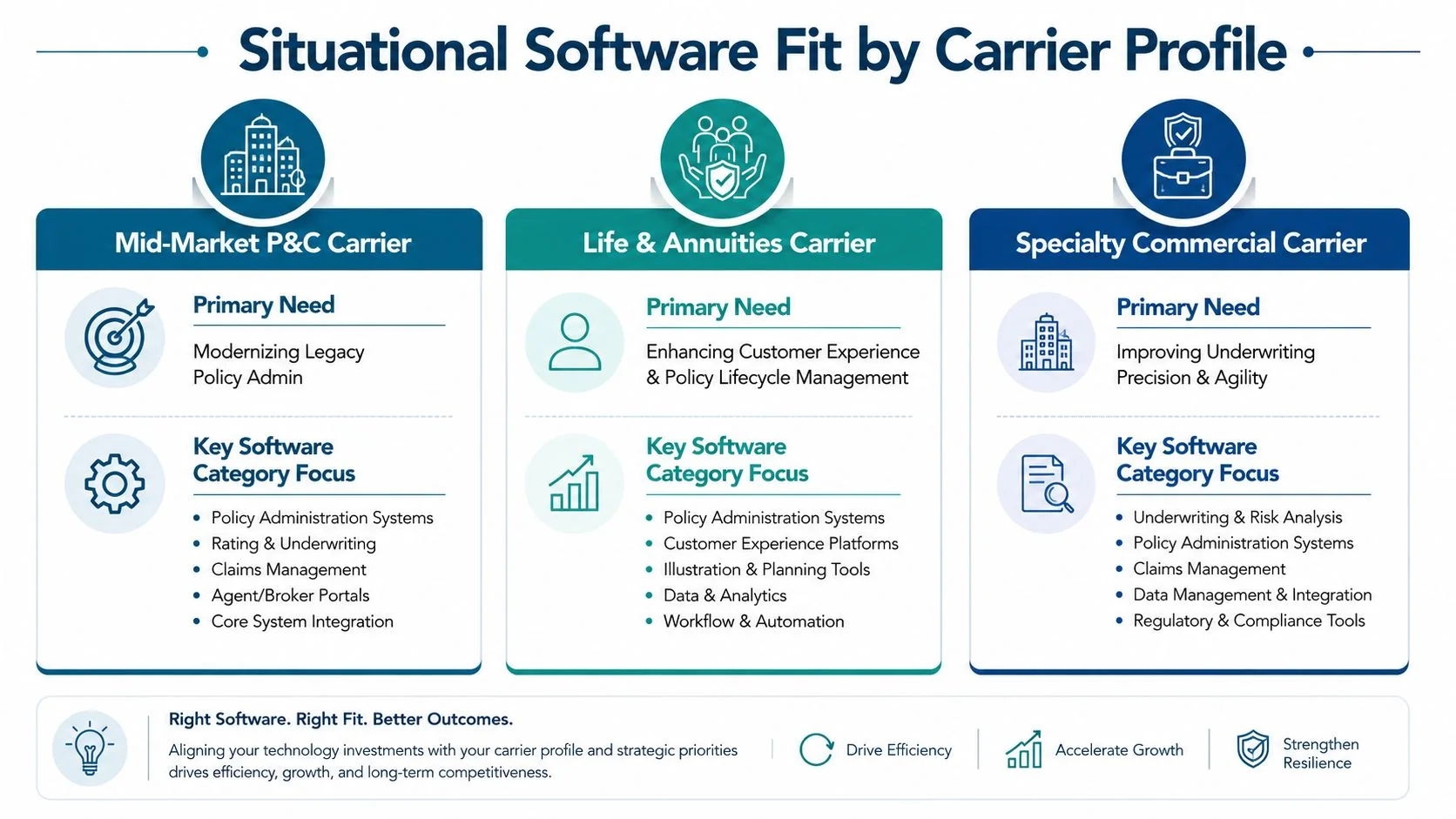
Situational Recommendations by Carrier Profile
There is no universal winner in software for insurance company selection. There are only better fits for specific carriers, lines, and operating constraints. The shortlist should follow the business problem, not the marketing pitch.
Mid-market P&C carrier modernizing legacy policy admin
This buyer should prioritize policy administration first, then claims integration, then analytics. The main goal is usually to replace a brittle core without freezing the rest of the company. That means the vendor has to support data migration, policy lifecycle edge cases, and downstream sync into claims and billing without turning every change request into a project.
The trade-off is speed versus completeness. Mid-market carriers often accept some functional compromise if the platform is stable, configurable, and realistic to implement. What they should not accept is a polished demo with weak migration planning. If the vendor can't explain how legacy policies move, how endorsements are handled, and what breaks at cutover, the project will drag.
Life insurer focused on underwriting and actuarial analytics
This profile should lean into underwriting workbench and data and analytics. Better decision support, cleaner visibility, and a stronger analytical layer for pricing and risk review are needed. The data model has to hold up under actuarial scrutiny, and the reporting structure has to reflect how the company measures risk and profitability.
The right demo here is less about front-end polish and more about data lineage, metric consistency, and how the system handles exceptions. Life teams should demand like-for-like comparisons across units and portfolios, because if the metric definitions drift, management ends up comparing incompatible numbers. That's exactly where standardized benchmarking frameworks earn their keep.
Small regional carrier adding AI to an existing core
This buyer should stay focused. The first target is usually claims management or a narrow workflow inside underwriting or service, not a full platform replacement. The goal is to remove repetitive manual work, route cases better, and improve service without creating a core migration risk.
The trade-off is clear. These carriers can move faster if they keep the scope tight, but they need to watch for integration friction and overpromised AI claims. One practical option in this space is AI for Insurance, which describes itself as an all-in-one insurance management software and also publishes an open database of verified insurance AI implementations. Use a resource like that as a reference point, not as a substitute for your own workflow testing.
Implementation Reality Beats Feature Lists Every Time
A vendor can show you a beautiful workflow in an hour. The implementation team has to make that workflow survive data migration, user adoption, controls, and exceptions for years. That's the part most buyer content skips, and it's the part that determines whether the project delivers value or just creates a new backlog.
The questions that expose weak plans
Ask how long replacement takes in the line of business, not in the demo scenario. Ask what data must be migrated, what gets archived, and what gets rekeyed. Ask how claims and underwriting work changes when the new system goes live, because the process rarely stays the same once the platform changes.
Ask how ROI will be measured after launch. If the answer is vague, the project team probably hasn't defined the operational metrics tightly enough. In insurance, line-of-business differences matter. P&C, life, and health do not share the same data model, the same regulatory environment, or the same lifecycle, so generic implementation advice can be dangerously misleading.
Bottom line: if the implementation plan sounds easy, it's probably incomplete.
The better way to judge a vendor is to ask for the migration path, the integration map, the control points, and the post-go-live operating model. Then compare those answers against the actual work your staff will do. That's where cost shows up, and that's where weak platforms reveal themselves.
For an example of what a focused overhaul can do when the operating model is addressed directly, review this case study on a product launch cycle cut to four weeks. The lesson is not the headline, it's that process and system change have to move together.
A 30-Day Evaluation Checklist for Insurance Software Buyers
Start with a shortlist built by category, not by brand buzz. Then score each option against the functional and technical criteria that matter to your line. After that, pressure-test integration, migration, and support with the people who will live with the system.
-
Week 1, define the problem clearly. Decide whether you need policy, claims, underwriting, billing, analytics, or a mix. Write down the operational pain points in plain language.
-
Week 2, run the workflow test. Make the vendor walk through your real cases, not generic ones. Ask where human review stays in place.
-
Week 3, inspect the implementation plan. Review data migration, integration points, and cutover steps. If they can't explain failure handling, that's a warning sign.
-
Week 4, score for decision quality. Compare references from the same line of business, verify the AI outcomes they can prove, and choose the platform that fits your operating reality.
Use the first month to separate glossy software from deployable software. If a vendor can't survive that filter, it doesn't belong on the final shortlist.
If you're evaluating software for insurance company operations right now, bring your claims leader, underwriting lead, and IT owner into the same room and score the shortlist together. The fastest way to avoid a bad purchase is to force every vendor to explain migration, integration, and workflow impact in your own terms before you commit to another demo.
