Risk Management for Insurance Companies in 2026
Risk management for insurance companies explained: governance, AI tools, and case studies showing how insurers measure and mitigate modern threats.
Written by AI for Insurance
USD 137 billion in insured natural-catastrophe losses in 2024 wasn't an exceptional spike. It was the fifth consecutive year above USD 100 billion, according to the Swiss Re Institute's catastrophe-loss analysis. For insurers, that changes the question from “How do we prepare for a rare disaster?” to “How do we run a balance sheet in a persistently volatile loss environment?”
That shift reaches well beyond catastrophe underwriting. It affects reinsurance, capital allocation, exposure concentration, operational resilience, cyber accumulation, data governance, product design, and the insurer's ability to transfer risk to customers who know they're exposed but still remain uninsured or underinsured.
Risk management for insurance companies in 2026 is therefore a strategic operating system. It connects risk appetite to pricing, portfolios to capital, models to governance, and awareness of danger to actual protection.
Table of Contents
- Why Insurer Risk Management Has Moved to the Center of Strategy
- What Enterprise Risk Management Actually Means for an Insurer
- The Core Risk Categories Every Insurer Must Govern
- Governance Architecture From Board to Three Lines of Defence
- Analytics and AI Tools for Measuring and Mitigating Risk
- The Hidden Problem of Awareness Versus Actual Protection
- A Catastrophe Modeling Case Study From Appetite to Capital
- What a Modern Risk Management Program Should Pressure Test
Why Insurer Risk Management Has Moved to the Center of Strategy
A mid-sized property and casualty carrier can face several material stresses in quick succession. A severe event may be followed by another peril, claims inflation, delayed reinsurance recoveries, or operational disruption. The governance problem is the interaction among those pressures. Each one can alter pricing assumptions, liquidity planning, capital buffers, and management capacity before the portfolio has stabilized.
Recent loss data places that scenario within routine strategic planning. Swiss Re Institute reported USD 137 billion in insured natural-catastrophe losses in 2024, compared with USD 318 billion in global economic catastrophe losses. Because 57% of economic losses were uninsured, the protection gap was about USD 181 billion. Swiss Re also reported a 5–7% annual real rate of catastrophe-loss growth in recent years and projected insured losses could approach USD 145 billion in 2025. The Swiss Re Institute sigma report on natural catastrophes documents the underlying analysis.
The protection gap has a second implication for insurers. Awareness of exposure does not guarantee purchased cover, adequate limits, or a transfer that will respond under stress. Risk management therefore has to assess both the hazard and the distance between recognized risk and effective protection.
From tail-event planning to recurring balance-sheet management
Verisk's January 2026 assessment raised the planning baseline. It said insurers should be prepared to withstand USD 171 billion in insured catastrophe losses in an average year, USD 19 billion above its prior estimate. The same analysis placed the 10-year average annual insured loss at USD 134 billion and the 5-year average at USD 139 billion. The Verisk loss outlook indicates that an average year now sits well above older assumptions.
That shift gives the CRO a coordinating role. Capital allocation, reinsurance purchasing, accumulation controls, underwriting limits, investment risk, and growth decisions affect the same capacity to absorb another shock. They cannot be governed as separate conversations.
Practical rule: If the risk appetite statement does not change what the business writes, buys, retains, or escalates, it is not a management tool. It is only a statement.
Board awareness is no longer the main constraint. Directors generally recognize that flood, cyber, climate-related hazards, and market stress matter. The harder test is execution: can the insurer measure the exposure, price it, transfer it, and verify that the transfer will respond when needed? That gap between risk awareness and actual protection places data quality and AI readiness at the center of modern enterprise risk management. Models cannot support reliable decisions when exposure records, policy terms, or transfer conditions are incomplete or inconsistent.
What Enterprise Risk Management Actually Means for an Insurer
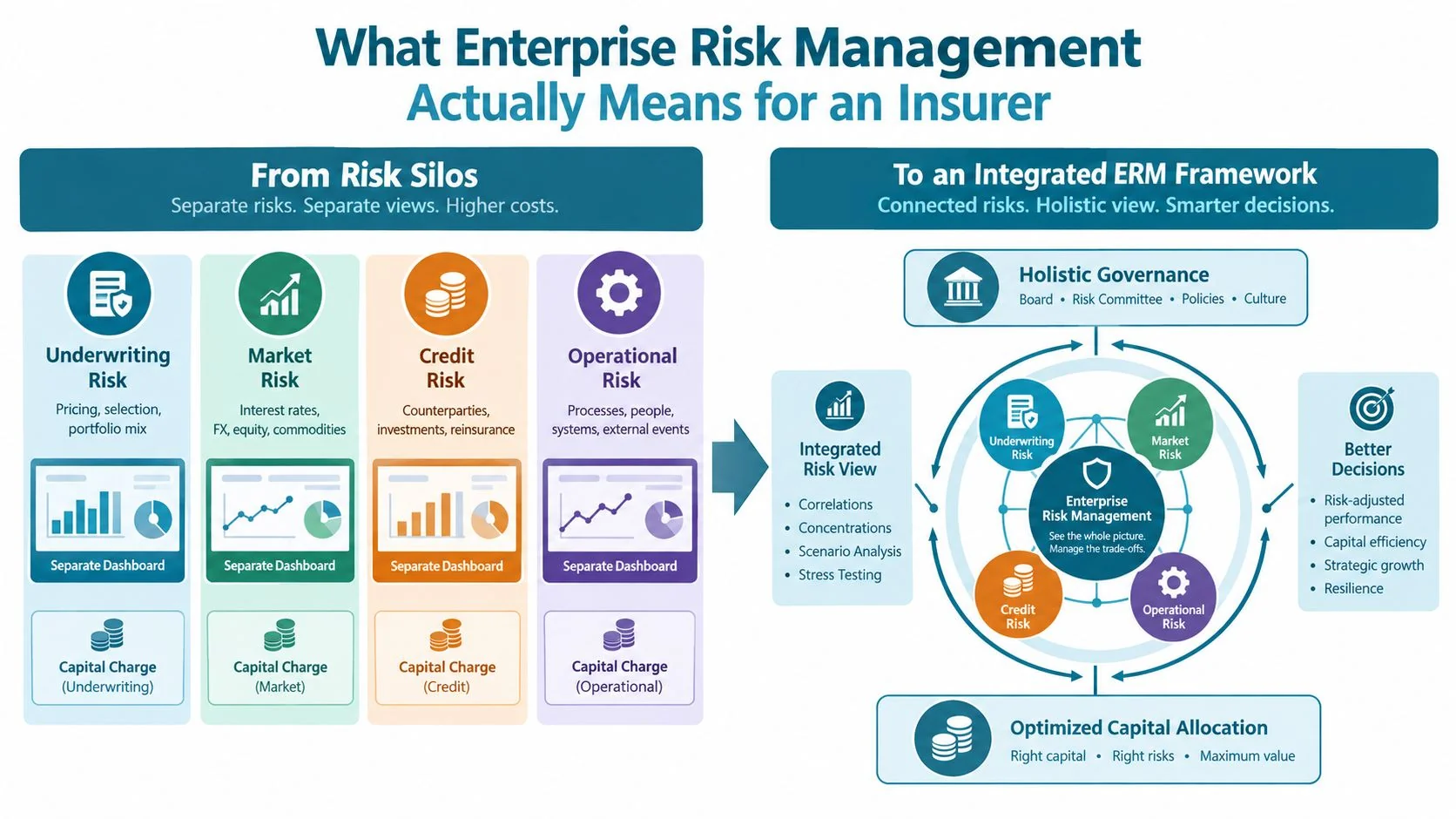
Traditional insurance risk oversight often gives each function its own dashboard. Underwriting tracks loss ratios and accumulation, investments track market exposure, credit teams assess counterparties, and operations monitor incidents. Those views can be useful, but they don't automatically show how one event moves through the entire enterprise.
Enterprise risk management replaces the collection of isolated lookouts with a coordinated bridge. The underwriting team sees a concentration, the investment team sees asset sensitivity, the treasury team sees liquidity needs, and the CRO connects those observations to the insurer's capital and risk appetite.
The four operating pillars
Risk identification starts with more than a register of named hazards. It should capture where exposures originate, which entities own them, how they can interact, and what assumptions could make them larger than reported.
Risk measurement converts those exposures into outputs management can use. Depending on the risk, that may involve scenario analysis, stochastic simulation, economic capital modeling, liquidity projections, or qualitative assessments supported by documented evidence.
Risk monitoring keeps the view current. Exposure changes after every new policy, renewal, investment, acquisition, vendor dependency, and reinsurance placement. Monitoring should therefore connect limits and triggers to operating data, not rely only on periodic committee packs.
Risk response determines what the insurer will do. Options include changing price, declining business, tightening terms, reducing accumulation, purchasing reinsurance, holding additional capital, improving controls, or accepting the exposure within a documented appetite.
Why the framework must sit above individual functions
A written risk appetite statement anchors all four pillars. It should define the types and concentrations of risk the board is willing to accept, the capacity it wants to preserve, and the conditions that require escalation. Regulatory frameworks and supervisory processes, including Solvency II, ORSA, and risk-based capital regimes, make this connection between governance, capital, and reporting part of the insurer's formal operating environment.
The practical test is simple. Can a business leader trace a board-approved appetite limit to a portfolio measure, a monitoring report, an escalation trigger, and a decision? If not, the insurer has risk documentation, but it may not have enterprise risk management.
The Core Risk Categories Every Insurer Must Govern
An insurer's risk register should cover underwriting, market, credit, operational, liquidity, strategic, regulatory, and emerging risks. The categories are distinct, but the balance-sheet consequences are connected. A catastrophe can create underwriting losses, reduce asset flexibility, increase reinsurance receivables, strain claims operations, and expose weaknesses in data or vendor controls.
| Risk Category | Typical Capital Share | Primary Modeling Tool | Key Emerging Exposure |
|---|---|---|---|
| Underwriting | Portfolio-dependent | Pricing models, actuarial projections, catastrophe simulations | Non-stationary hazard and accumulation |
| Market | Portfolio-dependent | Economic capital and asset-liability models | Interest-rate and spread volatility |
| Credit | Portfolio-dependent | Counterparty exposure and default models | Reinsurance and investment concentration |
| Operational | Portfolio-dependent | Scenario analysis and control assessments | Service disruption and third-party dependency |
| Liquidity | Portfolio-dependent | Cash-flow stress testing | Claims surges and collateral demands |
| Strategic | Portfolio-dependent | Business-plan stress testing | Growth, exit, and portfolio repositioning |
| Regulatory | Portfolio-dependent | Compliance monitoring and capital assessment | Changing prudential expectations |
| Emerging | Portfolio-dependent | Scenario modeling and expert assessment | Cyber, climate, AI, and digital assets |
The categories require different evidence
Underwriting risk needs portfolio segmentation, exposure quality, claims experience, wording analysis, and scenario testing. Catastrophe modeling adds hazard, vulnerability, exposure, and financial modules so the insurer can estimate not just event severity, but the loss generated by its actual portfolio.
Market and credit risk require a balance-sheet view. Life insurers with long-duration liabilities must connect asset behavior to liability sensitivity, while all insurers need to understand how investment losses, spread movements, and counterparty deterioration affect solvency and liquidity.
Operational and liquidity risk often resist neat probability estimates. Management must examine control failures, claims-system outages, vendor interruptions, payment demands, collateral requirements, and the timing of cash inflows and outflows.
Strategic and regulatory risk belong in the same enterprise conversation because a product launch, market withdrawal, acquisition, or regulatory interpretation can alter the insurer's risk profile before the financial statements show the effect.
Cyber and climate expose correlation weaknesses
Cyber should be divided into underwriting cyber risk and operational cyber risk. Actuarial guidance summarized in guidance on integrating catastrophe models into insurance capital management distinguishes the risk arising from cyber policies the insurer writes from the operational cyber exposure that exists even when the insurer doesn't offer cyber coverage.
That distinction matters because a single systemic event can affect affirmative cyber policies, internal systems, business interruption, third-party providers, market positions, and reinsurance recoveries. A credible register therefore weights correlations, not just individual risk scores. The overview of risk types in the insurance industry provides a useful starting point for organizing those categories, but the board still needs an insurer-specific view of interaction and concentration.
Governance Architecture From Board to Three Lines of Defence
Good governance doesn't stop at assigning titles. It creates a chain of accountability that lets the board move from broad tolerance to daily decisions.
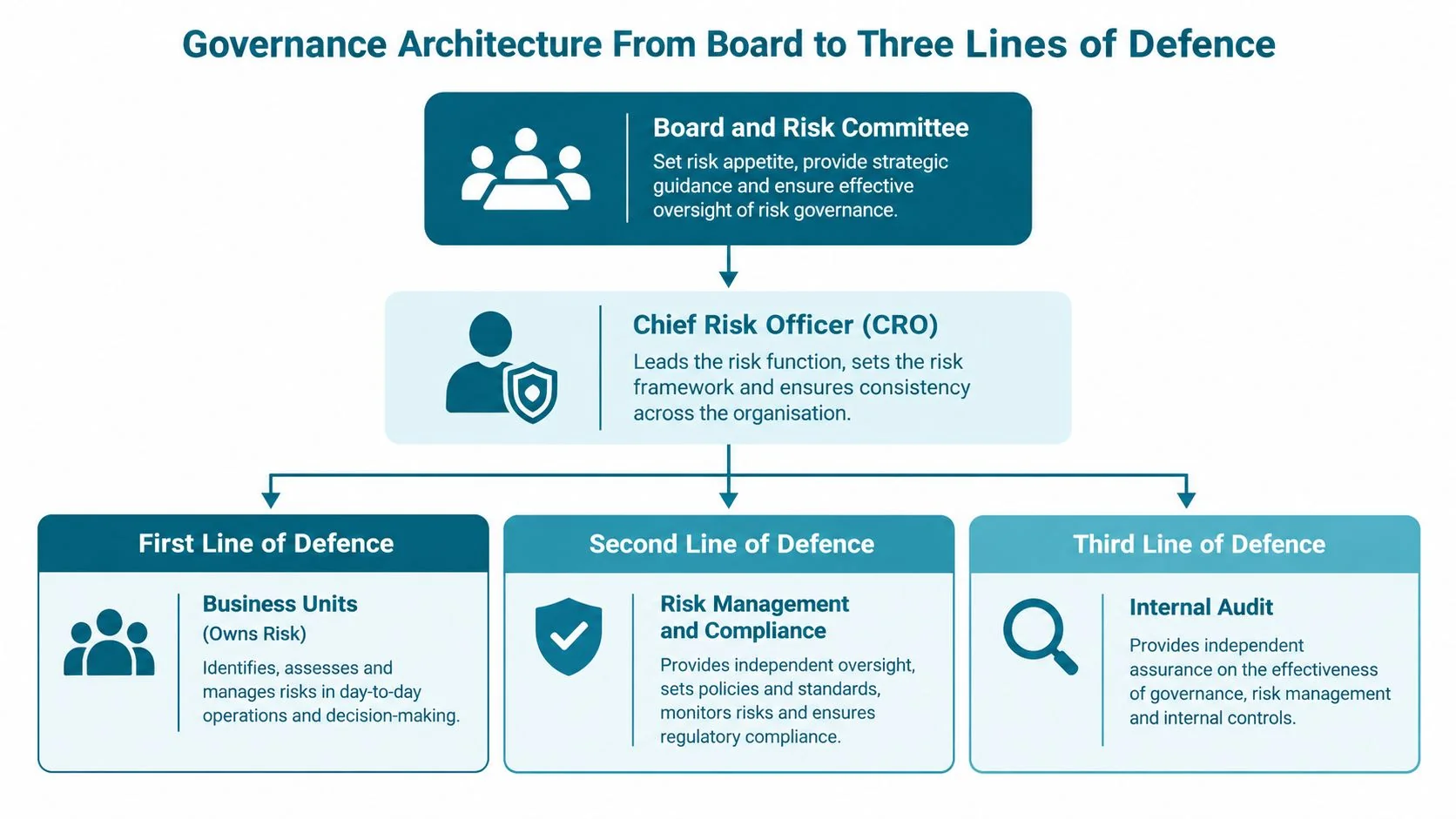
At the top, the board and risk committee approve the strategy, risk appetite, capital position, and escalation framework. The CRO then turns those decisions into an independent enterprise view, while business leaders remain responsible for managing the risks created by underwriting, investing, claims, technology, and operations.
Turning appetite into operating limits
A useful cascade has four layers:
- Board appetite: Define acceptable risk types, concentrations, volatility, and capital preservation objectives.
- Policy limits: Translate the appetite into underwriting, investment, counterparty, liquidity, model, and operational policies.
- Management thresholds: Set portfolio triggers that indicate when a team must review, slow, refer, or stop an activity.
- Escalation actions: Specify who receives the alert, what evidence they review, and which decision follows.
A limit without an owner is decorative. The underwriting function needs to know which exposure measure governs a referral. Treasury needs to know which liquidity signal requires action. The reinsurance team needs to understand which modeled outcome changes the purchase decision.
The three lines need different responsibilities
The first line owns risk. Business units make decisions and operate controls.
The second line, including risk management and compliance, sets frameworks, challenges assumptions, monitors limits, and provides an independent view of whether controls work.
The third line, internal audit, evaluates the effectiveness of governance and control systems without taking operational ownership.
ORSA connects these layers by bringing strategy, risk profile, capital resources, and stress results into one self-assessment. The most common failure isn't the absence of an appetite statement. It's the failure to connect that statement to current data, delegated authority, model outputs, and documented action.
A board should ask to see the evidence trail. It should be possible to move from a limit breach to the underlying exposure records, the accountable executive, the second-line challenge, the remediation decision, and the follow-up review.
Analytics and AI Tools for Measuring and Mitigating Risk
Insurers don't lack analytical ambition. They often lack the data discipline required to use advanced models safely. EY's 2026 insurance CRO survey identifies fragmented legacy environments and inconsistent data quality as major barriers to AI adoption and real-time risk insight. The same survey highlights that many insurers still lack a clear risk position on crypto, tokenized assets, and stablecoin exposure. Those findings are summarized in the EY insurance CRO survey publication.
The constraint is therefore less about finding another model and more about proving that the inputs, controls, assumptions, and outputs are fit for a capital decision.
Four layers of a credible analytics stack
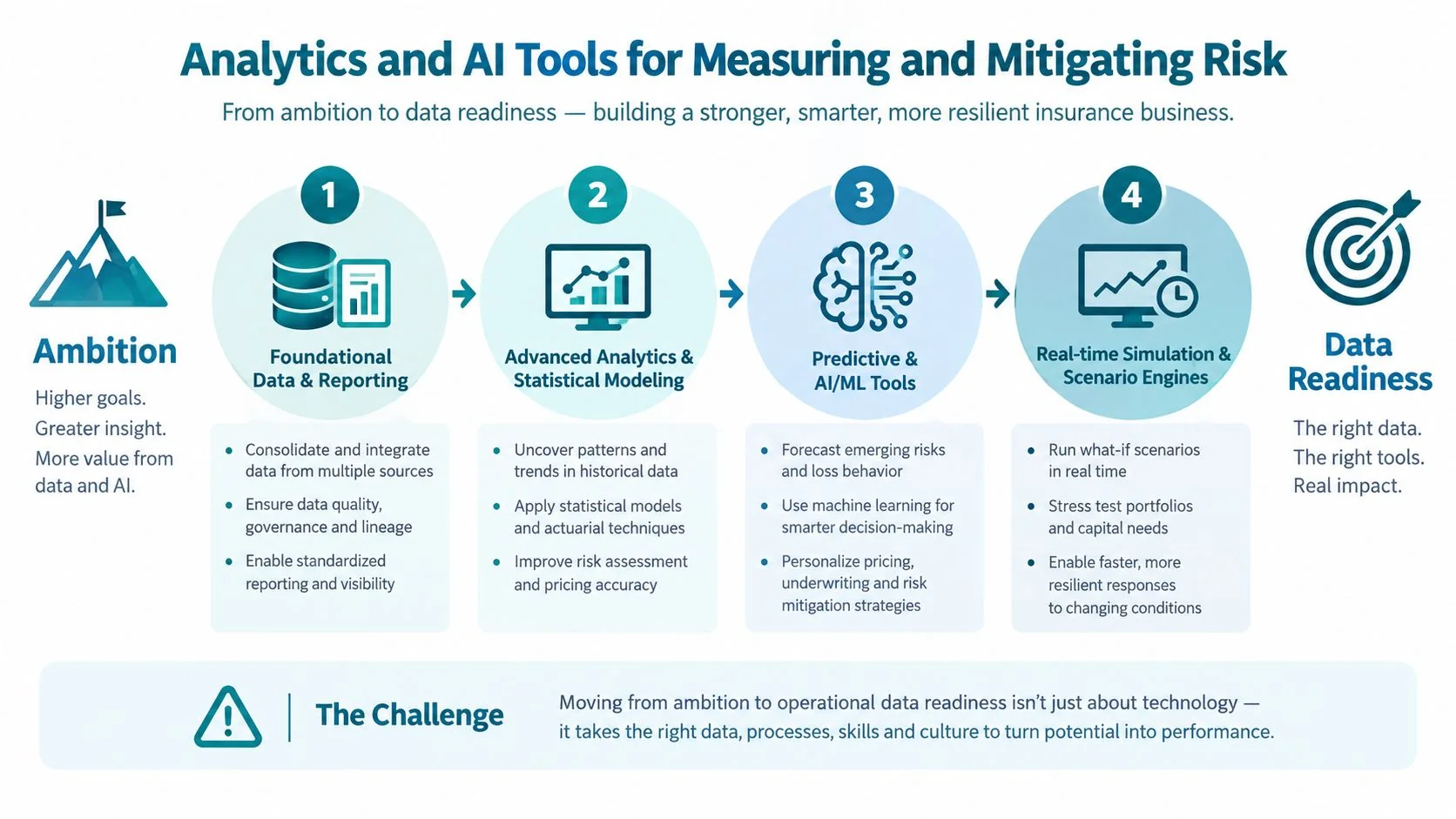
Foundational data and reporting come first. Policy records, locations, limits, deductibles, claims, investments, counterparties, vendors, and reinsurance terms need consistent definitions and traceable ownership. If an exposure can't be reconciled, the insurer shouldn't treat a precise model output as precise knowledge.
Statistical and capital modeling then converts governed data into frequency, severity, solvency, liquidity, and scenario results. Validation must test the model's conceptual soundness, implementation, limitations, and use.
Predictive and machine-learning models can support underwriting, fraud detection, claims triage, and exposure monitoring. They require documented training data, outcome definitions, drift monitoring, explainability appropriate to the use case, and controls over human override. The guide to predictive analytics in insurance offers context on this analytical category.
Real-time simulation and generative-AI assistants may help aggregate exposures, summarize regulatory material, identify inconsistencies, or prepare management information. They shouldn't become the source of record. A human owner still needs to verify outputs, preserve evidence, control access, and approve any decision that affects capital or policyholder treatment.
Cyber shows why completeness matters
An insurer that models only its cyber book misses operational cyber exposure. The risk framework must include internal systems, business interruption, third-party dependencies, systemic spillovers, market effects, and reinsurance recoveries. It must also distinguish a model's confidence from the insurer's confidence in the underlying data.
Governance test: Ask whether a model validation team can reproduce the result from the original source records. If it can't, the problem is data governance, not artificial intelligence.
AI readiness is consequently an enterprise-risk issue. Legacy fragmentation can prevent the CRO from seeing accumulation in time, while weak lineage can make a complex prediction difficult to defend to a regulator, board, auditor, or policyholder.
The Hidden Problem of Awareness Versus Actual Protection
Insurers often treat protection gaps as external market conditions. That view misses an internal diagnostic. A protection gap shows whether products, prices, distribution, policy wording, and risk-transfer mechanisms match how customers assess and fund risk.
As cited above, Swiss Re's 2024 catastrophe figures show the scale of the disconnect. Economic catastrophe losses reached USD 318 billion, while insured losses were USD 137 billion, leaving about USD 181 billion uninsured. A majority of economic losses therefore remained outside insurance protection.
| Peril | Estimated Economic Loss ($bn) | Insured Loss ($bn) | Protection Gap (%) |
|---|---|---|---|
| Natural catastrophes, 2024 | 318 | 137 | 57% uninsured |
| Flood | Not provided | Not provided | Persistent gap |
| Cyber | Not provided | Not provided | Persistent gap |
The table requires a narrow reading. The verified figures describe a global all-catastrophe view, not separate flood or cyber loss calculations. Munich Re's RiskScan 2026 identifies persistent protection gaps for flood and cyber, and reports that cyber awareness is high while adoption still lags, particularly among consumers and small businesses. Its RiskScan 2026 survey points to the management question that matters: why does knowledge of risk fail to produce coverage?
Awareness doesn't automatically create demand
Affordability can constrain purchase decisions. Other barriers include low perceived urgency, confusing policy language, exclusions, unsuitable limits, and a mismatch between annual insurance products and how households or small businesses budget for risk. A customer may understand a flood or cyber threat and still judge protection too difficult, too expensive, or too uncertain.
The resulting exposure belongs in ERM discussions. Product design and distribution shape the future risk pool, retention, claims behavior, and reputation. A carrier can maintain disciplined capital management while uncovered exposure grows around its customers and communities.
CROs should ask whether product teams measure conversion from risk awareness to actual protection. They should also test whether underwriting rules discourage desirable coverage and whether claims data reveals recurring uninsured losses that product changes could address. The objective is not to place every risk into a policy. It is to identify where risk transfer fails, then determine whether the insurer can offer sustainable cover without underpricing the exposure.
AI readiness and data quality determine how well the carrier can answer those questions. If customer, exposure, pricing, and claims records cannot be connected, management cannot distinguish weak demand from unsuitable design or incomplete distribution. That makes data lineage a protection-gap control, not merely a technology concern.
A Catastrophe Modeling Case Study From Appetite to Capital
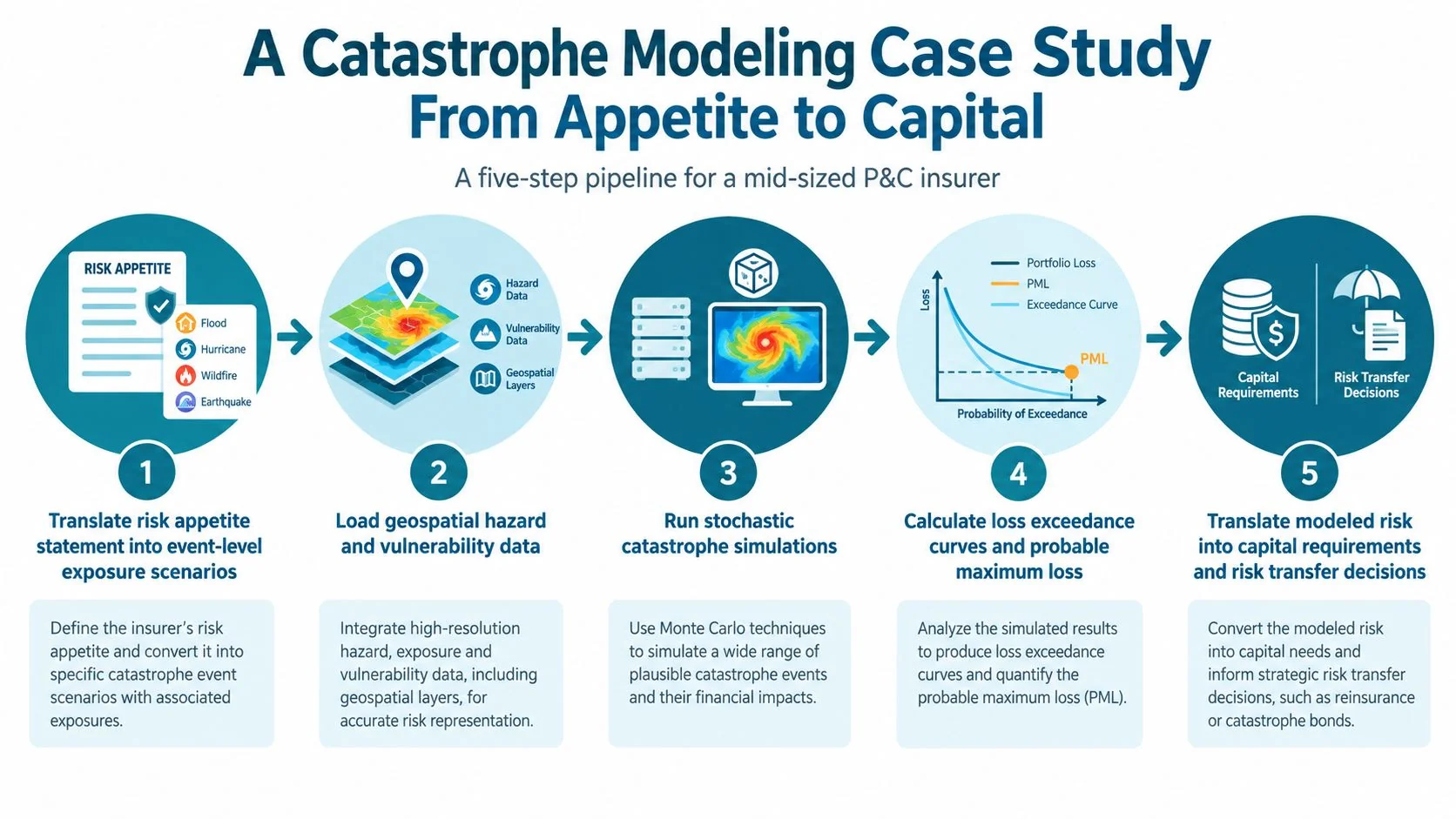
Take a representative mid-sized property and casualty insurer with a board-approved tolerance for catastrophe accumulation. The value of the exercise isn't the fictional company. It's the sequence that turns a broad appetite into a decision about exposure, capital, and reinsurance.
Five decisions in the pipeline
First, translate appetite into event-level triggers. “We accept catastrophe risk within our capital capacity” is too broad for underwriting teams. Management must define which event scenarios, geographic concentrations, gross losses, net losses, and capital impacts require referral or action.
Second, create a controlled exposure layer. Policy locations need to be geocoded, duplicates removed, limits and deductibles standardized, occupancy and construction fields reviewed, and missing values flagged. The exposure layer should have a named data owner and a reconciliation process back to policy administration records.
Third, run stochastic event sets. Modern catastrophe models connect hazard, vulnerability, exposure, and financial terms across thousands of simulated scenarios. The catastrophe-risk modeling overview describes how those outputs support capital adequacy, reinsurance purchasing, and risk appetite decisions.
The insurer should compare model perspectives, document parameter choices, and challenge results that depend heavily on uncertain data. A return-period scenario can be useful, but it isn't a guarantee that the next event will resemble the modeled event set.
Fourth, place modeled loss against the economic balance sheet. Average annual loss supports pricing and portfolio planning. Tail loss metrics, gross and net, show how the reinsurance tower changes the insurer's retained exposure. Management then tests whether available capital and liquidity can support claims, collateral, expenses, and delayed recoveries.
Fifth, feed the result into ORSA and reverse stress testing. The question becomes: what combination of event severity, concentration, reinsurance failure, claims development, and market movement would threaten the insurer's ability to pay? Sign-off should involve underwriting, actuarial, finance, treasury, reinsurance, risk, and the board-level committee.
The case study on AI-supported hurricane scenario simulation illustrates the direction of advanced scenario analysis, but faster simulation doesn't remove the need for exposure governance and validation.
<iframe width="100%" style="aspect-ratio: 16 / 9;" src="https://www.youtube.com/embed/m_lPe9Psed4" frameborder="0" allow="autoplay; encrypted-media" allowfullscreen></iframe>A model becomes a risk-management asset only when the insurer can explain what it measured, what it omitted, who challenged it, and which decision changed because of the output.
What a Modern Risk Management Program Should Pressure Test
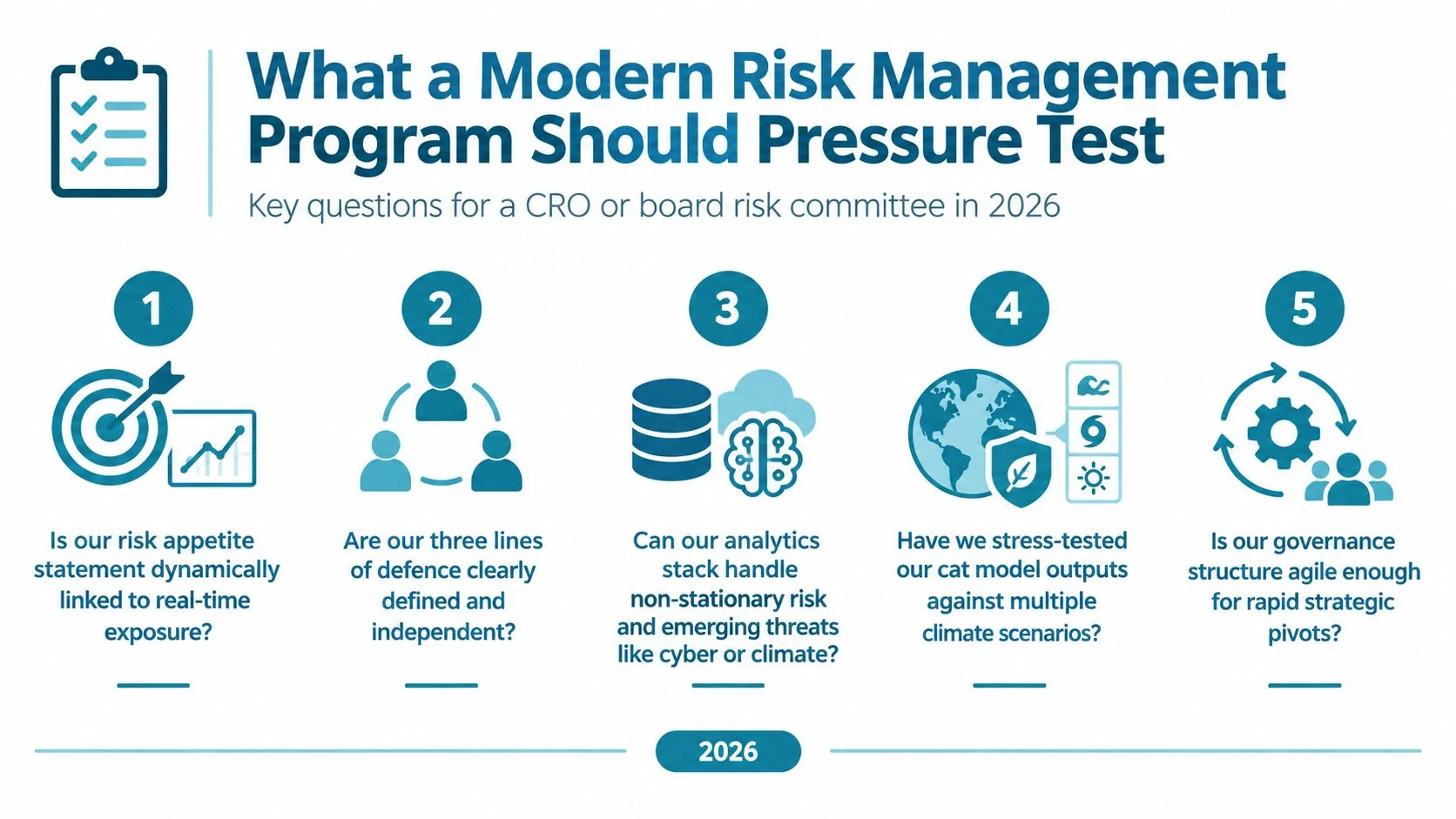
A board or CRO should test the program through evidence, not policy language. The following questions can go directly into a risk committee pack.
Questions for the risk committee
-
Does appetite connect to live exposure? Ask whether current underwriting, claims, investment, cyber, and reinsurance data can show where the insurer sits against each material limit.
-
Can the second line challenge the model independently? Review validation findings, data limitations, override practices, and unresolved issues. A second line that only reports model output isn't providing effective challenge.
-
Are concentrations measured across risks? Climate and cyber exposures can appear in underwriting, operations, vendors, investments, and reinsurance. The register should identify shared dependencies and common causes.
-
Can the insurer pay after a severe catastrophe? Test gross and net losses, reinsurance counterparty performance, collateral, claims timing, liquidity, and capital actions under a severe but coherent scenario. The assessment should examine the full ability-to-pay chain, not just the headline modeled loss.
-
Is data lineage complete? Trace a material capital-model input from its policy or investment source through transformation, calculation, validation, reporting, and committee approval. Missing lineage should be treated as a control issue.
-
Does emerging-risk governance produce decisions? AI model risk, digital assets, systemic cyber, climate uncertainty, and protection-gap conversion need named owners, defined indicators, escalation routes, and documented responses.
The standard should be operational proof
A mature program can show how a limit changed a decision, how a model challenge changed an assumption, how a data defect was corrected, and how a reinsurance structure responds under stress. It can also explain which risks remain outside the model and how management compensates for that uncertainty.
The central conclusion is uncomfortable but useful. Insurers don't become resilient by knowing more about risk. They become resilient when knowledge changes exposure, capital, controls, product design, and transfer decisions.
If your board pack still treats catastrophe, cyber, data quality, and protection gaps as separate topics, use the checklist above in your next risk committee meeting. Map each question to an accountable executive, supporting evidence, and a dated remediation decision, then commission an independent review of the gaps before the next ORSA cycle.
