Policy Life Cycle in Insurance: From Quote to Renewal
Explore the policy life cycle in insurance from quote to renewal, including where AI fits, measurable outcomes, and the governance gaps most guides ignore.
Written by AI for Insurance
On a typical working day, Lloyd's says that more than £49.9 million is paid in insurance claims, equivalent to more than £34,620 per minute. Lloyd's historical account of the market makes the operational point clear: insurance is a continuous flow of risk presentation, underwriting, premium collection, servicing, loss notification, adjustment, and settlement, not a single contract event.
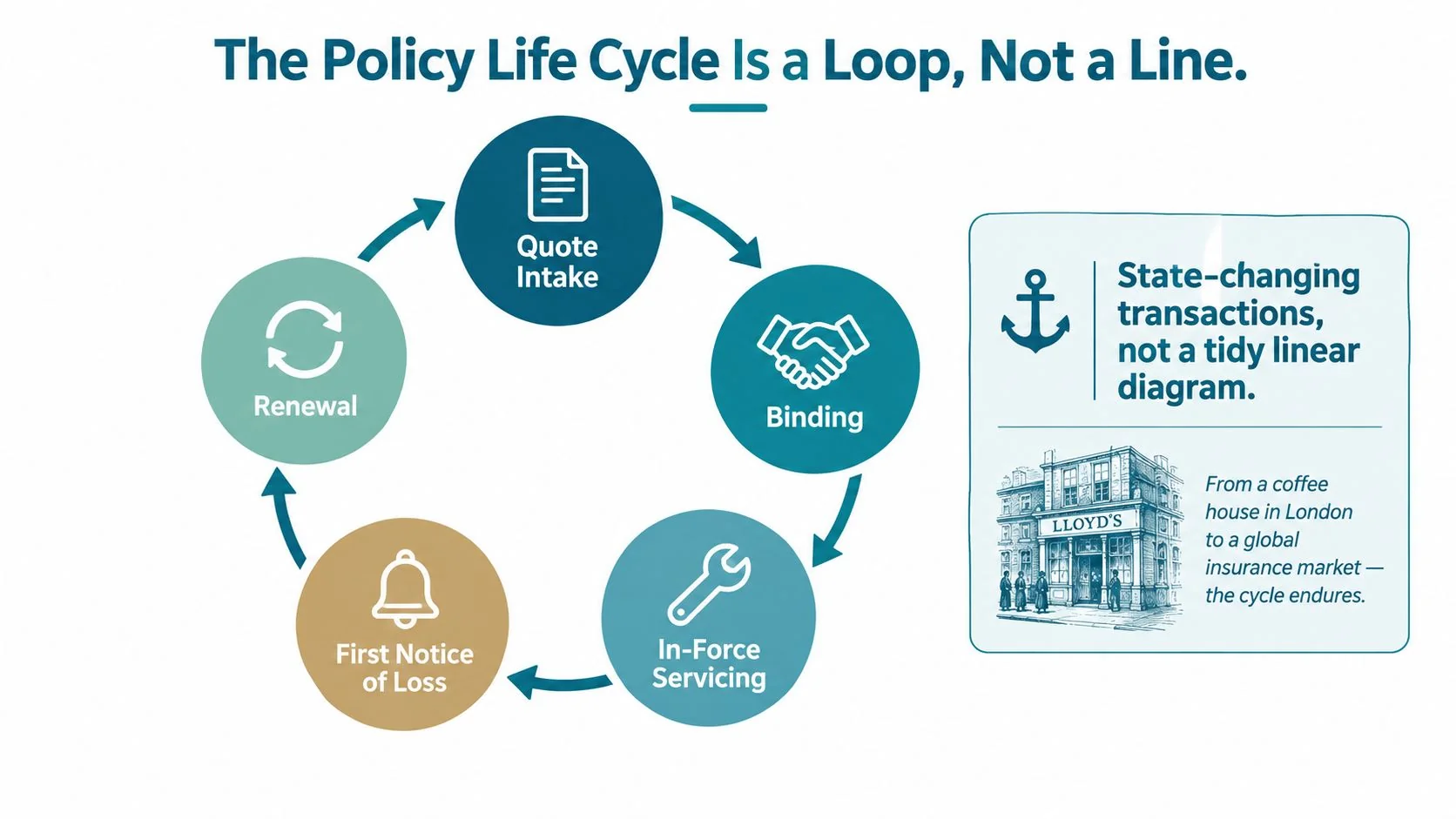
That flow is usually drawn as a neat line from quote to bind, issue, renewal, and cancellation. In practice, the policy life cycle in insurance is a recurring loop of state-changing transactions. Each transaction changes the authoritative policy record, creates downstream obligations, and supplies data for the next decision. AI can accelerate those handoffs, but it also changes who must explain, review, correct, and monitor each decision.
Table of Contents
- What the Policy Life Cycle Looks Like
- The Underwriting to Renewal Feedback Loop
- Where AI Fits at Each Lifecycle Stage
- What End-to-End Automation Actually Delivers
- The Governance Gap Most Lifecycle Diagrams Miss
- Renewal Cancellation and the New Coverage Question
- Metrics That Reveal Customer Impact
- Building a Lifecycle Map That AI Can Be Measured Against
What the Policy Life Cycle Looks Like
Edward Lloyd's coffeehouse dates to 1688. The modern Lloyd's market emerged after its move to the Royal Exchange in 1774 and its separation from the coffeehouse business. Lloyd's subscription-and-settlement model organized insurance around risk presentation, underwriting and acceptance, premium payment, policy administration, loss notification, claims adjustment, and settlement. Lloyd's records that, after HMS Lutine sank, the claim was reportedly paid in full two weeks after the loss.
The historical detail matters because each stage creates records and decisions for the next. Underwriting establishes coverage and price. Issuance establishes terms, dates, documents, and billing obligations. Servicing changes the policy state. A claim tests obligations created earlier, while its outcome can influence renewal.
The operational record is more important than the diagram
A policy begins with a dated transaction, such as a bound quote or issuance instruction. That event should create or update the authoritative policy record, including:
- Coverage terms: What is insured, subject to which limits, conditions, and exclusions.
- Effective dates: When coverage starts, changes, or ends.
- Financial obligations: Premium, billing schedule, commissions, and settlement information.
- Supporting evidence: Application data, underwriting rationale, generated documents, and correspondence.
- Downstream permissions: Whether a loss falls within the policy period and whether a claim can proceed.
An endorsement, cancellation, reinstatement, or renewal should not overwrite history. It should add an effective-dated transaction that explains what changed and why. That record structure supports insurance policy management systems, particularly when an automated decision must be reconstructed later.
Operational rule: Treat every lifecycle handoff as a controlled state change, not as a task disappearing from one queue and appearing in another.
The contractual lifecycle describes the legal status of coverage. The operational lifecycle also includes data capture, validation, document production, billing synchronization, claims eligibility, regulatory reporting, customer communication, and exception handling. A policy can be contractually active while its data remains incomplete, its endorsement awaits review, or its billing state is out of sync.
These mismatches define AI accountability. An intake model may extract an exposure incorrectly. An underwriting model may use stale information. A document-generation service may omit a revised exclusion. A claims triage system may route a severe loss as routine. Each handoff needs an accountable owner, an evidence trail, an override path, and a customer communication record. Metrics should then test whether those controls prevented errors, not merely whether the transaction completed.
The Underwriting to Renewal Feedback Loop
Consider a motor-insurance applicant whose history includes an open claim, an undecided incident, a split-fault event, or damage handled privately without a formal claim. A contemporary Lloyds motor-insurance explanation says insurers commonly ask about claims, accidents, and damage involving each driver during the previous three years, then check the information against the Claims and Underwriting Exchange before pricing coverage. The explanation of claims history and renewal pricing shows why a lifecycle event rarely stays in one period.
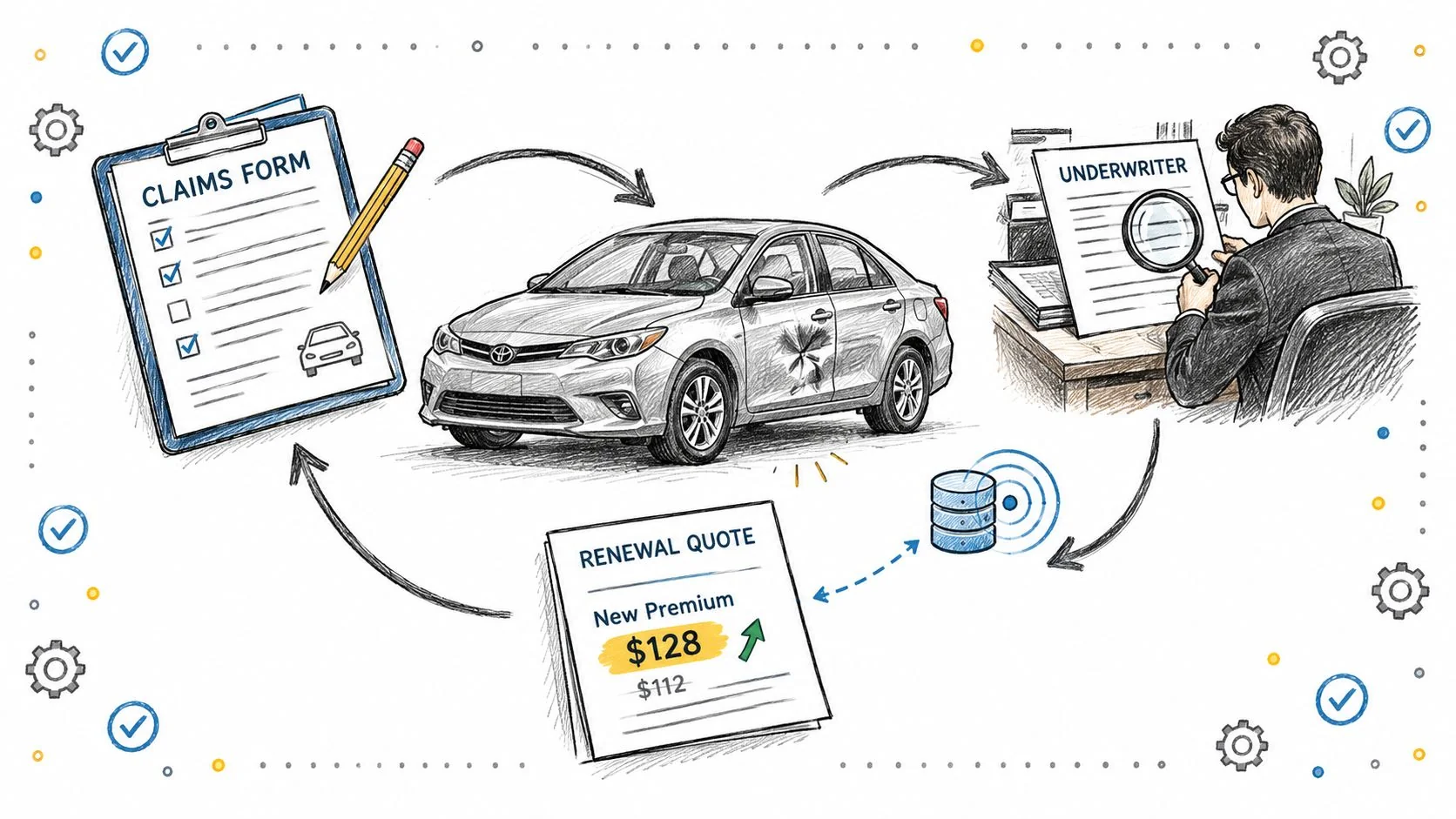
At quote, the applicant supplies history. The insurer validates it against shared records. During the policy term, a new incident becomes a claim record, even if liability remains unresolved. At renewal, the insurer may reassess the risk using the updated record. A claim might not change the premium immediately, yet still contribute to a higher price at renewal.
That creates a feedback loop:
- Application data enters underwriting.
- External and internal records validate or challenge the application.
- Coverage is priced and issued.
- Losses and changes are recorded during the term.
- Claims outcomes and history feed the next underwriting decision.
- Renewal terms alter the customer's future coverage or retention decision.
For underwriting teams, the control problem is data lineage. If an incident is duplicated, assigned to the wrong driver, left open after settlement, or recorded with the wrong fault status, the error can influence a later quote. AI can compare application answers with claims records and flag inconsistencies, but it shouldn't auto-resolve them. The insurer needs a documented correction path and a human decision-maker for material disputes.
A useful introduction to the underlying underwriting workflow is this automated risk assessment guide, particularly for teams mapping where data validation ends and underwriting judgment begins.
The same loop applies beyond motor insurance. A commercial policy's changed exposure, a new location, an endorsement, or a reported loss can all alter the evidence used at renewal. The important operational question is whether the insurer can explain how an event became part of the next decision, not merely whether a model predicts risk accurately today.
<iframe width="100%" style="aspect-ratio: 16 / 9;" src="https://www.youtube.com/embed/B6KkNGkfDxg" frameborder="0" allow="autoplay; encrypted-media" allowfullscreen></iframe>
Where AI Fits at Each Lifecycle Stage
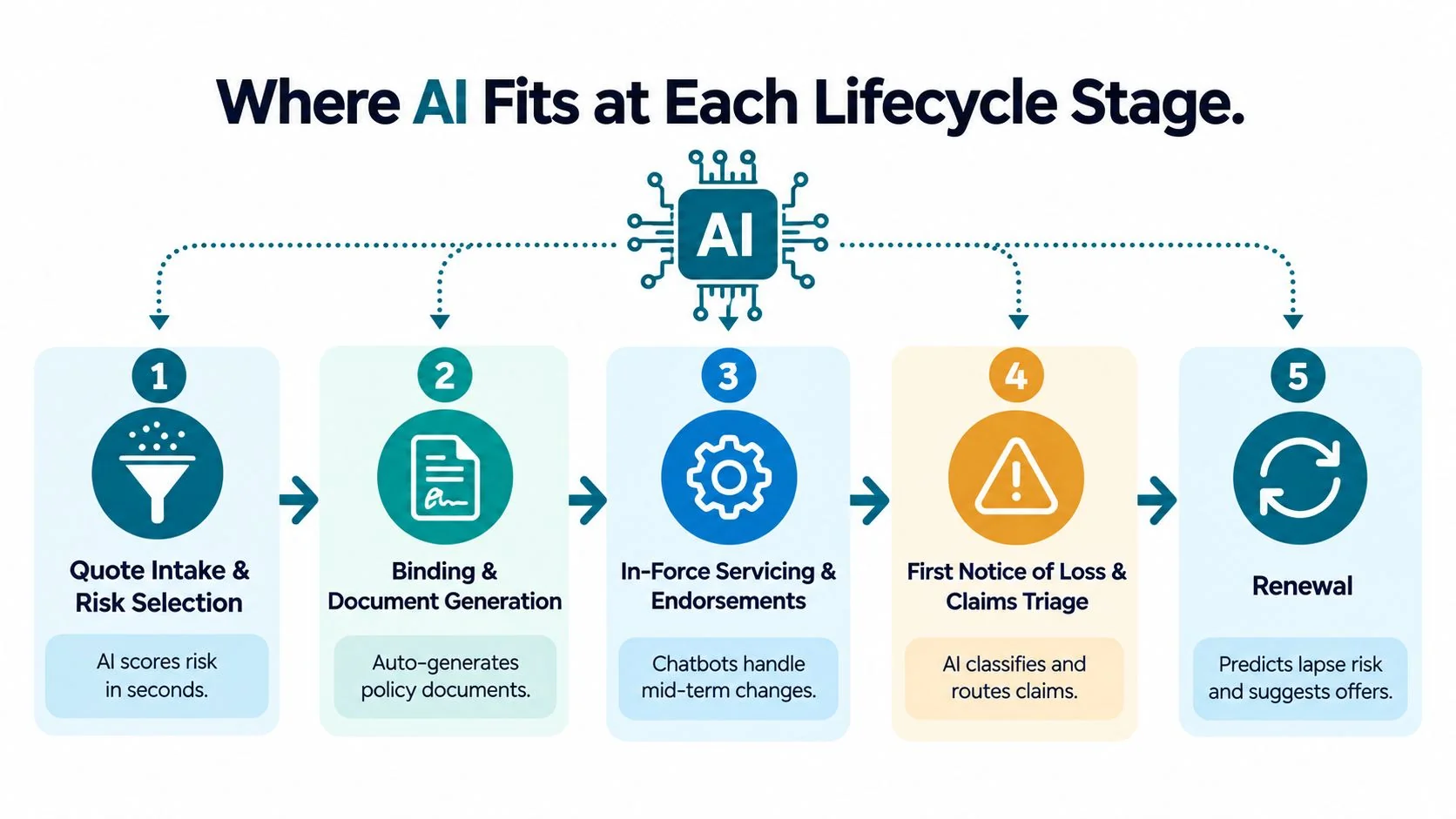
AI works best when each intervention is tied to a specific transaction, evidence set, and human checkpoint. “AI in insurance” is too broad to guide implementation. The useful question is narrower: what changes in the policy state, what does the system recommend, and who can approve or reverse it?
Quote intake and risk selection
Document and language models can extract applicant information from forms, emails, schedules, and supporting records. Predictive models can prioritize submissions, identify missing fields, compare answers with available history, and route straightforward risks for rules-based processing. The human checkpoint is eligibility and materiality. An underwriter should be able to see the extracted fields, source documents, validation warnings, and reason for escalation before accepting or declining a risk.
Binding and document generation
After acceptance, automation can populate policy records, produce schedules, calculate billing instructions, and generate documents from approved terms. The control is reconciliation. The issued wording, effective dates, limits, premium, commissions, and billing schedule must match the bound transaction. A fast document process that produces an incorrect contract has increased operational risk, not reduced it.
In-force servicing and endorsements
Conversational systems can collect requests for address changes, additional insureds, locations, limits, or exposure information. AI can classify the request and prepare an endorsement, but material changes need underwriting and policy-services review. The system must preserve the prior state, record the effective date, and show which terms changed.
For broader context on document understanding, extraction, and workflow design, see this discussion of generative AI in insurance.
First notice of loss and claims triage
At first notice of loss, AI can structure the narrative, identify missing information, classify likely severity, detect potential duplication, and route the claim to the appropriate queue. It can support image or document review where the evidence is suitable, but ambiguous, high-severity, or potentially contentious claims require human handling. The system should retain the submitted evidence, its classification, confidence or uncertainty signal, and the reason for escalation.
Renewal decisioning
Renewal models can identify likely lapse risk, surface changes in claims or exposure history, and suggest which accounts need earlier review. They shouldn't become a hidden nonrenewal engine. The renewal record should show the information considered, the applicable rules, the proposed terms, the human approval, and the customer-facing explanation where an adverse outcome occurs.
What End-to-End Automation Actually Delivers
Point automation improves an isolated task. Straight-through processing changes the elapsed time across connected tasks. McKinsey reports that a European insurer reduced policy-issuance cycle time from approximately three weeks to three minutes after deploying mobile quotation and underwriting capabilities. The same source reports that a separate U.S. insurer reduced claims-processing time by up to 20% through a mobile workflow covering quotations, damage reporting, and repair-center coordination. McKinsey's analysis of modernizing insurance technology attributes the operational value to connected capabilities, not to a prediction model operating alone.
A quote model can identify an eligible risk quickly. It won't produce the promised result if the decision cannot populate the policy record, generate accurate documents, trigger billing, update commissions, and support later servicing. The same principle applies to claims. Classification has limited value if the result doesn't reach the right adjuster with the evidence needed to act.
| Lifecycle stage | Representative AI use case | Primary metric | Required control |
|---|---|---|---|
| Quote intake | Extract fields, validate completeness, and prioritize submissions | Submission-to-quote elapsed time and exception rate | Source-linked extraction, validation rules, and underwriter override |
| Binding | Populate policy records and generate approved documents | Quote-to-bind and bind-to-issue time | Reconciliation of terms, dates, premium, and documents |
| In-force servicing | Classify requests and prepare endorsements | Request-to-completion time and rework | Effective-dated transaction history and approval thresholds |
| First notice of loss | Structure loss details and route claims | Notice-to-decision time and escalation rate | Evidence retention, uncertainty routing, and claims audit trail |
| Renewal | Identify review needs and propose terms | Renewal completion, appeal outcome, and nonrenewal rate | Drift monitoring, adverse-action review, and documented rationale |
The deployment benchmark should therefore measure every important handoff, not just the first visible improvement. Track submission to quote, quote to bind, bind to issued documents, and first notice of loss to claim decision. Pair those measures with manual touchpoints, exception rates, rework, errors, leakage, and the share of decisions requiring intervention.
The shortest workflow is not automatically the safest workflow. The target is fast processing for clear cases and deliberate escalation for uncertain or consequential cases.
The Governance Gap Most Lifecycle Diagrams Miss
Insurance leaders often ask whether a model is accurate. That's necessary, but it isn't enough. The harder question is who owns the decision after the model enters production, when input data changes, policies are already active, and customers need an explanation.
Recent industry research identifies security, cost, legacy infrastructure, talent shortages, supplier lock-in, and governance gaps as barriers to scaling AI across underwriting, claims, distribution, and servicing. A separate 2026 survey found that only 11% of insurers believed they had the data foundations and governance needed to scale AI beyond pilots, while just 3% had fully redesigned policy servicing and claims management around AI. McKinsey's research on the future of AI in insurance supports a contrarian conclusion: the bottleneck is often operational ownership after deployment, not model performance in a test environment.
Accountability follows the transaction
At quote, who is responsible if the model uses stale or biased data? At bind, what evidence supports the price or eligibility result? During servicing, who approves an automated change to coverage? At renewal, who tests whether the model still behaves appropriately after customer behavior and risk conditions shift?
A practical control map should answer four questions at each event:
- Data responsibility: Who owns source quality, consent, freshness, and correction?
- Decision responsibility: Who can approve, override, or stop the automated outcome?
- Explanation responsibility: Who communicates the reason for a decline, repricing, delay, or nonrenewal?
- Monitoring responsibility: Who reviews drift, complaints, overrides, and adverse outcomes?
Security belongs in the same map. Teams evaluating an AI data path security guide should connect access, lineage, retention, and supplier controls to actual policy events, rather than treating security as a separate technology workstream.
The operational risk becomes visible when an insurer has a strong pilot but no production owner. A model can route claims efficiently while producing unexplained exceptions. A renewal model can identify lapse risk while amplifying historical data errors. A document model can extract terms while missing a revised exclusion. Governance has to travel with the transaction.
For insurers building a broader risk management framework, model cards and approval committees are useful, but they don't replace event-level controls. The policy record should show what happened, which model or rule participated, what evidence was available, whether a human intervened, and how the final customer outcome was reached.
Renewal Cancellation and the New Coverage Question
Renewal is often treated as a calendar task. That view is becoming inadequate because the next policy period may introduce new wording, revised underwriting requirements, or explicit treatment of risks that were previously implicit.
In commercial insurance, reporting on the 2025 to 2026 professional-liability market describes movement from implicit “silent AI” coverage toward explicit warranties or exclusions. Firms without documented AI governance may face coverage denials at renewal. A separate ISO form effective January 2026 permits exclusions for bodily injury, property damage, and advertising injury arising from generative AI under standard commercial general liability policies. The reported professional-liability and generative-AI coverage developments make renewal a governance event as well as a pricing checkpoint.
Commercial renewal
A commercial underwriter may need to ask whether the insured uses generative systems, how those systems are governed, whether human review remains in place, and whether the controls match the representations made at inception. The answer can affect wording, exclusions, warranties, pricing, or eligibility.
That means the renewal file needs more than loss history. It may need evidence of documented controls, incident handling, access management, vendor oversight, and changes in use. If those questions appear only at renewal, the insurer has missed an opportunity to monitor material changes during the policy term.
Consumer correction and cancellation
Consumer treatment can require a more proportional response to disclosure mistakes. New Zealand's forthcoming rules distinguish careless errors from deliberate misrepresentation and can require an insurer to adjust terms rather than automatically void a policy. Treatment for life policies can also differ according to how old the original answer is.
The operational implication is significant. A correction workflow should distinguish error type, intent, materiality, applicable wording, notice obligations, and available remediation. Cancellation shouldn't be the default automation outcome because a data inconsistency is detected.
Renewal is where the insurer tests whether the policy still means what both parties think it means.
The right lifecycle metrics therefore include nonrenewal rates, appeal outcomes, remediation time, and coverage gaps. A renewal process that improves risk selection while leaving customers unable to understand or correct the result is efficient only in a narrow system sense.
Metrics That Reveal Customer Impact
Processing time and model accuracy are useful starting points. They don't show whether policyholders receive fair treatment, whether staff can correct errors, or whether automation creates coverage gaps. A mature measurement framework separates efficiency metrics from outcome and governance metrics.
Efficiency shows movement
Measure elapsed time at each handoff:
- Quote intake: Submission-to-quote time, completeness rate, and manual preparation effort.
- Binding: Quote-to-bind time, bind-to-issue time, and document correction rate.
- Servicing: Request-to-completion time, endorsement backlog, and rework.
- Claims: First notice of loss to decision time, escalation volume, and manual touchpoints.
- Renewal: Review completion, offer issuance, and unresolved cases near expiry.
These measures reveal where work waits. They don't explain whether the system made the right decision or whether customers could challenge it.
Governance shows control
Track override rates by product, channel, model version, decision type, and reviewer group. A high override rate can indicate poor model fit, weak data, unclear thresholds, or a workflow that forces human review without useful recommendations. A very low rate can be equally concerning if employees lack authority or visibility to challenge the system.
Monitor drift at renewal and after material portfolio changes. Compare input distributions, referral patterns, outcomes, and error types over time. Pair drift testing with complaint rates, appeal outcomes, correction requests, and the time needed to remediate an error.
Coverage gaps need their own measure. Record cases in which a change, exclusion, cancellation, or renewal decision left the customer without expected protection, whether temporarily or permanently. Review those cases alongside nonrenewal rates and appeal outcomes, not in a separate customer-service report.
Finally, segment results. A portfolio average can conceal concentrated harm by product, geography, customer type, distribution channel, or claim severity. The steering committee should ask not only whether automation is faster, but also who receives more referrals, more adverse decisions, more corrections, or longer waits.
Building a Lifecycle Map That AI Can Be Measured Against
A useful policy life cycle map has three layers. The first is the event layer, covering intake, underwriting, binding, servicing, loss notification, claims settlement, renewal, correction, and cancellation. The second is the control layer, covering validation, effective dates, evidence retention, human review, reconciliation, explainability, drift testing, and appeal handling. The third is the outcome layer, covering speed, errors, overrides, complaints, remediation, coverage gaps, and customer decisions.
That structure turns an AI project into an operational test. For each proposed use case, ask:
- What policy state does the system change?
- Which source records support the recommendation?
- Who owns approval and correction?
- What happens when confidence is low or evidence conflicts?
- Which customer-impact metric will show success or harm?
An AI-insurance database such as AI for Insurance can help teams compare documented implementations by use case, insurance line, technology category, and disclosed outcome. The database can inform research and vendor evaluation, but each insurer still owns its data quality, controls, customer communications, and post-deployment monitoring.
The strongest lifecycle strategy preserves a defensible chain from evidence to transaction to customer outcome, including the moments when a human must intervene, rather than maximizing the number of automated steps.
Map your current quote, bind, servicing, claims, and renewal workflows as dated state changes. Then assign an owner, evidence requirement, escalation rule, and customer-impact metric to every handoff. This week, select one high-volume lifecycle path and test whether your policy, billing, documents, claims, and reporting records reconcile after an automated decision. If they don't, fix that operational foundation before expanding the model.
