OCR Deep Learning: A Practical Guide for Insurance Teams
Learn how OCR deep learning transforms insurance documents, from CRNN and transformer architectures to accuracy trade-offs and real claims extraction metrics.
Written by AI for Insurance
Maria's Monday starts with four monitors full of scanned PDFs, handwritten physician notes, ACORD forms, photographed estimates, and a recorded claimant statement waiting to be transcribed. Before lunch, she needs to triage eight claims, but much of her morning disappears into rekeying policy numbers, vehicle identification numbers, procedure codes, dates, and loss details into the core system.
That's the practical problem behind modern OCR deep learning. The question isn't whether a model can recognize one printed character. It's whether the system can turn a mixed, damaged, multilingual, and often poorly structured document set into reliable fields that claims, underwriting, finance, and customer-service teams can use.
A system can produce readable text and still fail operationally. It may read a line item correctly but attach it to the wrong column, separate a policy number from its label, or flatten a table so completely that a downstream parser can't tell which amount belongs to which coverage. The most useful OCR evaluation therefore starts with structure and key-information extraction, not character recognition alone.
Table of Contents
- Why OCR Is the Unsung Bottleneck in Modern Insurance Workflows
- From Character Recognition to Sequence Learning
- Core Deep Learning Architectures for OCR Explained
- Preprocessing Choices That Decide Your Accuracy Floor
- Where Deep Learning OCR Still Wins and Where It Breaks
- Insurance Document Extraction in Practice
- Choosing the Right OCR Approach for Your Document Mix
Why OCR Is the Unsung Bottleneck in Modern Insurance Workflows
The work hidden behind a “digital” claim
A claims file may look digital because it arrives as a PDF. That doesn't mean the information inside it is searchable, ordered, or ready for a claims platform. A scanned declaration page, a mobile photograph of a repair estimate, and a handwritten medical note all require different visual interpretation before an adjuster can query them.
Older pipelines usually depend on fixed templates, coordinates, regular expressions, and document-specific rules. Those methods can perform well when a form is clean and stable. They become fragile when a carrier changes a field position, a broker submits a newer revision, a claimant photographs the page at an angle, or a medical provider writes outside the expected region.
The operational consequence is a queue of exceptions. Adjusters correct fields manually, underwriters search through attachments, and finance teams reconcile extracted values against source documents. The OCR engine may appear to be a small component, but its failures create work throughout the process. Insurance teams evaluating document automation can see how this connects to broader insurance document processing use cases.
Why extraction matters more than readable text
Consider a loss-run report with several columns. The model might recognize every word in “paid,” “reserved,” and “incurred,” yet still place the values in the wrong row. A claims form creates a similar problem when a label such as “date of loss” appears near several dates, including the report date and treatment date.
That's why an insurance OCR pipeline needs more than a text string. It should preserve:
- Text content, including characters and words.
- Coordinates, so the system knows where each item appeared.
- Reading order, especially in multi-column documents.
- Regions, such as tables, signatures, stamps, and handwritten notes.
- Confidence signals, so uncertain fields can enter a review queue.
- Relationships, such as a label paired with its value.
Practical rule: If the extracted text can't support the next business decision, the OCR step hasn't finished its job.
Deep learning changes the problem by learning visual and sequential patterns from examples rather than relying only on manually authored rules. It doesn't eliminate the need for validation or human review, but it can make the recognition layer more adaptable across document types. The strongest implementations measure field reliability, table preservation, review rates, and downstream decisions, not just whether the raw transcript looks plausible.
From Character Recognition to Sequence Learning
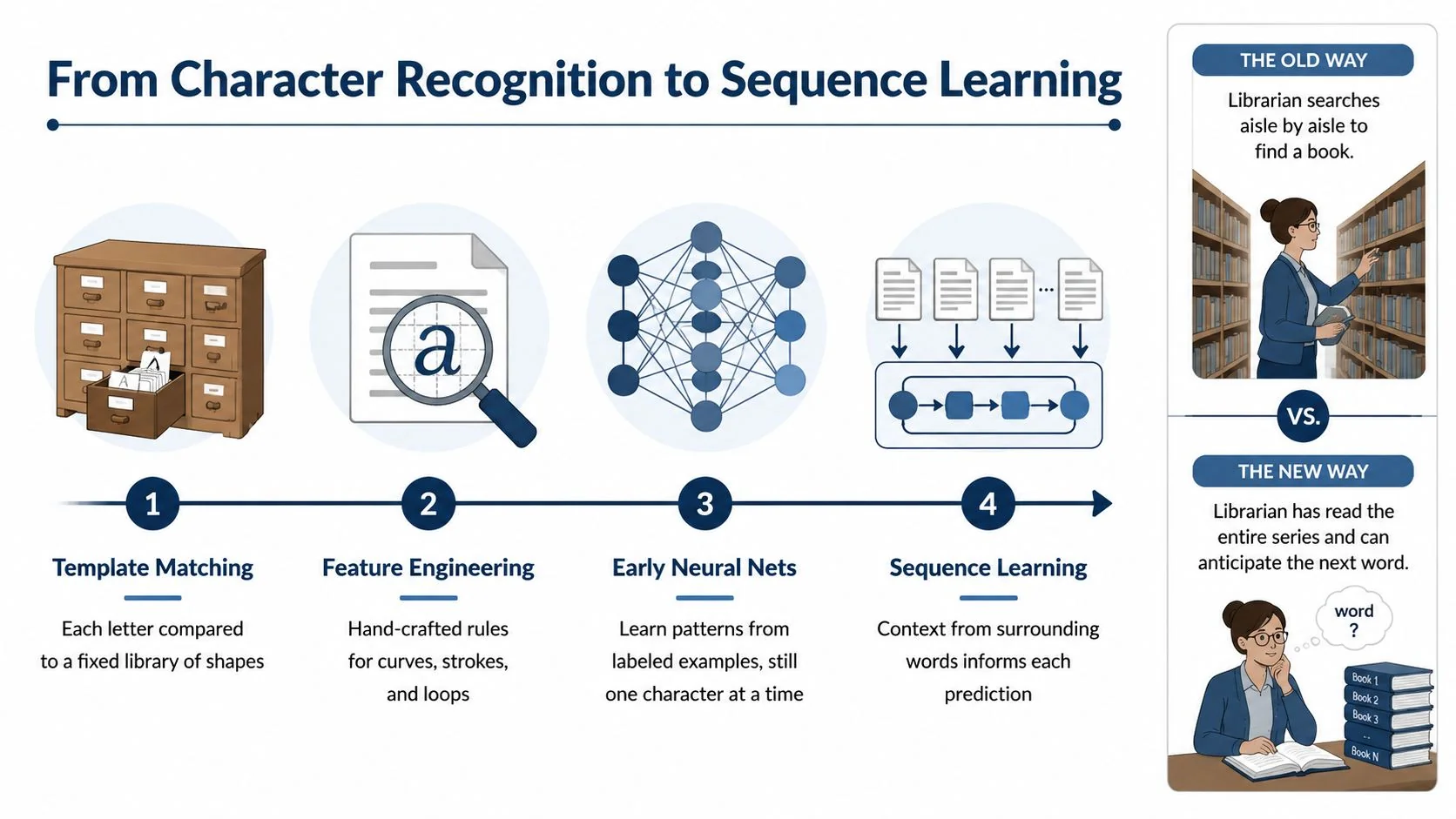
A useful analogy is a library catalogue. Classical OCR behaves like a librarian who walks aisle by aisle, isolates one book spine, compares its lettering with a fixed collection of shapes, and records the result. That process works when every book has a clean, familiar spine. It struggles when the label is worn, curved, rotated, or split across neighboring objects.
Early systems treated OCR as isolated character classification. They used engineered visual features, such as curves, intersections, and strokes, to decide whether a small image represented a particular letter or digit. Sliding-window methods then searched across a line, but they still relied heavily on segmentation and local decisions. A character touching the next character, or a form field printed over a line, could disrupt the entire sequence.
The shift to ordered text
Sequence learning changed the unit of recognition. Instead of asking, “Which character is this crop?” the model can ask, “What ordered text does this image region represent?” A convolutional network extracts visual features from the line, a sequence model captures context across those features, and a decoder produces the text in order.
The 2010s brought a major milestone with end-to-end systems such as CRNN-style models, which combine convolutional feature extraction with recurrent sequence decoding. Connectionist Temporal Classification, commonly called CTC, lets the model learn a transcription without requiring the training data to mark the exact image position of every character.
For an insurance example, a line containing a vehicle identification number can be treated as a sequence even when spacing is uneven. The model learns that neighboring visual evidence helps distinguish similar symbols, rather than treating every glyph as an independent island.
Context becomes global
Attention mechanisms and Transformer encoders extend this idea. They allow a model to weigh relationships between distant parts of an image or text sequence, which helps when local evidence is ambiguous. A rotated claim form, a curved identification card, or a multilingual document can benefit from broader context instead of a strict left-to-right character pipeline.
The benchmark shift reflects that broader capability. On OCRBench v2, an older CRNN baseline scored 38.1%, while Qwen2.5VL-7B reached 73.0%, according to the OCRBench v2 benchmark paper. The benchmark spans recognition, extraction, parsing, calculation, and reasoning across 23 task types and 31 scenarios, so it evaluates more than isolated character reading.
That distinction matters in insurance. A model that reads a policy number is useful. A model that also identifies the policy-number field, preserves its relationship to the insured entity, and flags an uncertain character is much closer to production value.
Core Deep Learning Architectures for OCR Explained
Two architecture families provide a practical mental model for insurance teams: CRNN with CTC and Transformer-based OCR. Neither is universally superior. The right choice depends on the document's visual regularity, the required output, and the available compute.
CRNN plus CTC
A CRNN pipeline usually has three conceptual parts:
- A convolutional backbone converts pixels into visual feature maps.
- A bidirectional recurrent layer, often based on LSTM units, reads those features across the text direction and captures neighboring context.
- A CTC decoder maps the sequence of predictions to a final transcription without character-level alignment labels.
This architecture fits documents where text lines are reasonably ordered and the visual task is mostly recognition. A typed auto-policy schedule, a clean loss run, or a standard declaration page may be a good match. The model can process many similar lines efficiently, and the surrounding workflow can use coordinates and rules to locate fields.
Its weakness appears when the page itself is the problem. Skew, rotation, curved text, mixed reading order, and overlapping regions can make the sequence representation harder to construct. A CRNN may recognize a line well while still depending on a separate detector and layout stage to decide which line belongs to which field.
Transformer-based OCR
Transformer OCR uses attention to model relationships across image patches and generated tokens. Depending on the design, a visual encoder creates representations of the page or text regions, while a decoder generates the transcription with broader context.
This approach is better suited to handwritten medical notes, multilingual identity documents, damaged first-notice-of-loss forms, and pages where text regions don't follow a simple arrangement. TrOCR is an important example of this direction. Its Transformer encoder-decoder, pretrained on large text and image corpora, outperformed prior state of the art across printed, handwritten, and scene-text recognition tasks, as described in the TrOCR research paper. The same paper reports 99.3% accuracy on CUTE, compared with a previous 89.6% state of the art, illustrating the value of global context on a difficult scene-text dataset.
A Transformer generally costs more memory and compute, and autoregressive decoding can add latency. A CRNN is often lighter and easier to deploy under modest hardware constraints. A Transformer is more tolerant of visual variation, but teams need stronger cost controls, batching, confidence calibration, and review routing.
| Dimension | CRNN + CTC | Transformer OCR |
|---|---|---|
| Best fit | Clean, ordered text lines and predictable forms | Mixed layouts, handwriting, distortion, and varied scripts |
| Insurance example | Typed schedules, declarations, and loss runs | Handwritten notes, photographed forms, and multilingual packets |
| Context model | Recurrent sequence context | Attention across visual and token representations |
| Alignment | CTC avoids character-level alignment labels | Decoder learns relationships through attention |
| Deployment profile | Usually lighter and faster | Usually more compute-intensive |
| Primary risk | Degrades with rotation and irregular reading order | Higher inference cost and more complex operations |
Hybrid designs combine convolutional visual efficiency with attention-based decoding. The architecture decision should follow the document mix, not the model's marketing label.
Preprocessing Choices That Decide Your Accuracy Floor
Preprocessing isn't a cosmetic step before OCR. It determines what evidence the model receives. A deep network can infer missing patterns, but it can't reliably recover text that a blur, fold, glare, or crop has removed.
Deskewing and denoising
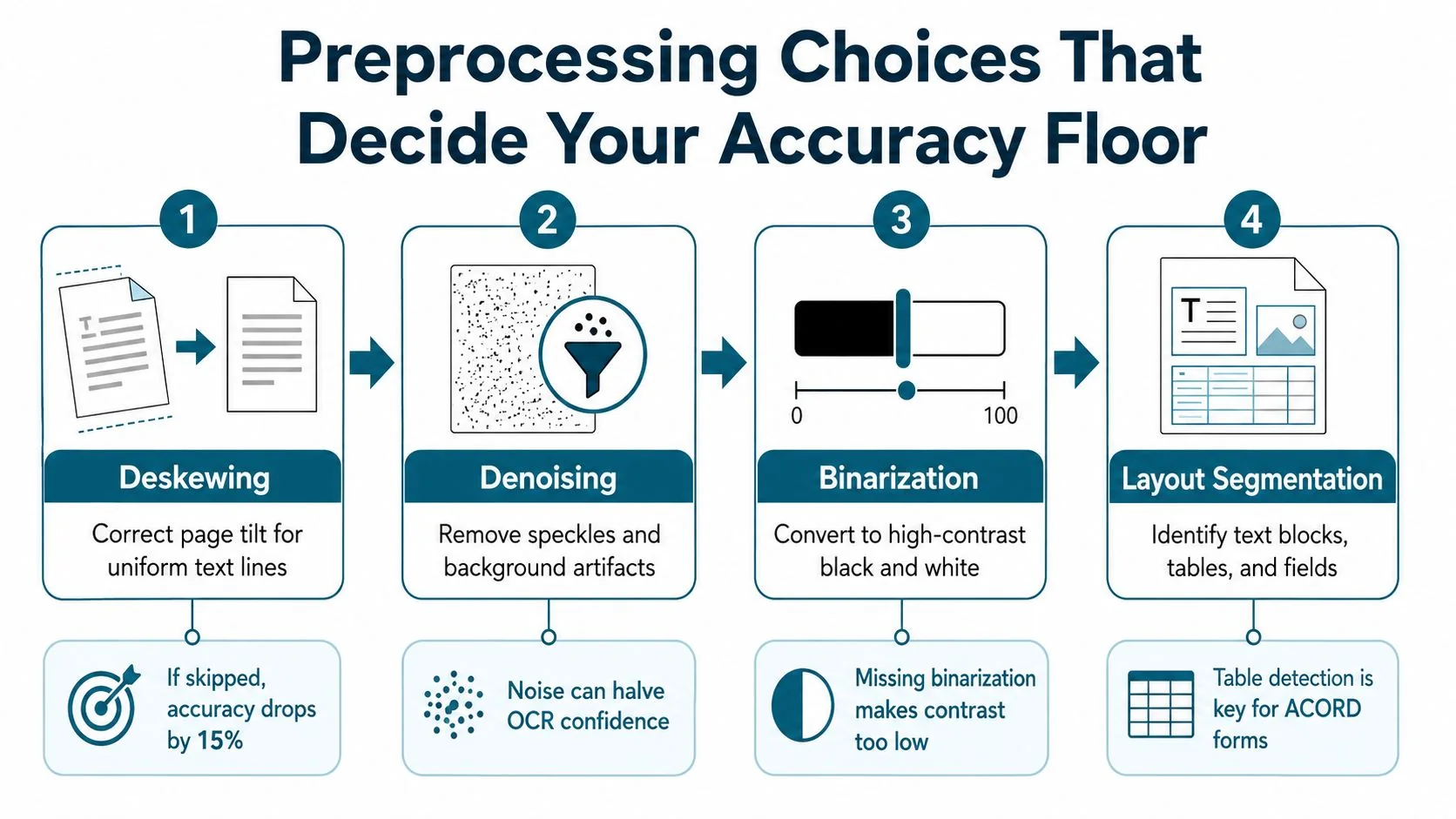
Start with deskewing. Mobile uploads often show tilted pages, while automatic feeders can introduce small rotations. A line that should be horizontal becomes a sloped visual pattern, making both detection and sequence recognition harder. Deskewing estimates the page orientation and rotates it into a more consistent position.
Next comes denoising. Fax speckles, scanner streaks, compression artifacts, and photographic backgrounds can resemble punctuation or character marks. A denoising stage should remove irrelevant variation without erasing thin strokes, decimal points, or handwritten accents. Over-smoothing a medical note can be as damaging as leaving the noise in place.
Contrast and page structure
Binarization converts a grayscale image into a high-contrast representation. It can help with faded thermal receipts, low-contrast photocopies, and uneven backgrounds, but it shouldn't be applied blindly. Adaptive methods are often more appropriate when lighting or paper quality varies across the page.
Then segment the layout. A medical record may contain narrative text, tables, stamps, and embedded images. An ACORD form may depend on boxes and field boundaries. Layout segmentation tells later stages where text blocks, tables, signatures, and other regions begin and end.
A practical preprocessing policy should preserve the original image and record every transformation. That makes failures easier to diagnose. If the extracted VIN is wrong, engineers should be able to determine whether the issue began with capture, rotation correction, thresholding, detection, recognition, or parsing.
The broader computer vision foundation for insurance workflows includes these image-level decisions, but production OCR needs document-specific validation. Test each transformation against representative claims, not only clean samples.
The video below provides a visual introduction to document preprocessing:
<iframe width="100%" style="aspect-ratio: 16 / 9;" src="https://www.youtube.com/embed/E9bbgJUyGQs" frameborder="0" allow="autoplay; encrypted-media" allowfullscreen></iframe>Engineering checkpoint: Keep preprocessing modular. A single “enhance image” switch hides the cause of errors and makes safe tuning difficult.
Where Deep Learning OCR Still Wins and Where It Breaks
Character recognition and document extraction measure different things. A model may transcribe a page accurately while failing to answer the business question, such as which reserve amount belongs to which claim, which date is the actual loss date, or whether a signature is present.
The newer benchmark literature makes that gap explicit. OmniDocBench evaluates diverse PDF page types and reports end-to-end text recognition with edit distance across 9 page types, while later benchmark work indicates that large OCR models perform more poorly on parsing and key information extraction than on text-only recognition, as summarized in the discussion of OCR benchmark limitations.
Four different failure layers
A claims team should separate these failure modes:
- Recognition failure: The model reads “8” as “B” in a policy number.
- Detection failure: The system misses a faint line of text near a page edge.
- Layout failure: The system merges two table columns into one sequence.
- Extraction failure: The system reads the right text but assigns it to the wrong field.
The last two often create the greatest operational risk. A loss-run report can contain correct numbers in an unusable order. A rotated notary stamp may be mistaken for a text region. A label and its value may share similar visual features, especially on a poorly scanned form.
What to measure instead
A useful evaluation separates text quality from field quality. Track character error rate or edit distance for recognition, then measure field-level precision, recall, and F1 for the information the business consumes. Add table-cell alignment, document classification, confidence calibration, and human-review outcomes when those affect the workflow.
| Document type | Character accuracy or error measure | Field extraction measure | Main failure mode |
|---|---|---|---|
| Clean printed schedule | Recognition is usually strong | Field pairing remains relevant | Similar labels and values can confuse rules |
| Multi-column loss run | Text may be readable | Row and column assignment is harder | Table structure collapses |
| Handwritten medical note | Recognition varies sharply | Medical entities need validation | Ambiguous strokes and abbreviations |
| Photographed claim form | Image quality controls results | Coordinates and labels may drift | Skew, glare, and cropped regions |
| Multilingual packet | Script coverage affects output | Cross-page field normalization is difficult | Mixed scripts and reading order |
The leaderboard evidence supports a cautious message. Handwriting performance remains in the low 70s overall for top systems, while digital-diacritic text can reach about 99%, showing that clean digital text and handwriting are very different operating environments, according to the OCR benchmark analysis.
The practical question isn't “Can OCR read this page?” It's “Can the system preserve the evidence needed for the next insurance decision?”
Insurance Document Extraction in Practice
A production pipeline usually has more stages than a model diagram suggests. It receives a file, classifies the document, renders or captures the page, detects regions, recognizes text, reconstructs layout, maps fields, validates values, assigns confidence, and routes uncertain results to a person.
A typed schedule
A clean auto-policy schedule may suit a lightweight recognition model paired with a rules-based parser. The parser can use stable labels, coordinates, expected formats, and cross-field checks to identify policy numbers, vehicle details, coverage limits, and effective dates.
That combination is often easier to operate than a large general model when the document family is predictable. The important safeguard is not the architecture alone. It's validation. A policy number should match its expected pattern, a date should be plausible for the workflow, and a coverage amount should be checked against the field context.
A first-notice-of-loss packet
A multi-page first-notice-of-loss file requires stronger layout handling. The same packet may contain typed fields, narrative descriptions, tables, signatures, and attachments. A Transformer-based recognizer with layout-aware token tagging can represent relationships that a simple line reader would lose.
The parser should preserve page and region coordinates, identify key-value pairs, and distinguish claimant statements from adjuster notes. If the model's confidence is low for the loss date or injury description, the system should show the source crop to the reviewer rather than inserting an uncertain value into the claims platform without feedback.
Handwritten clinical material
Handwritten physician notes are a different risk category. A fine-tuned vision-language or Transformer-style model can assist with recognition, but human review may remain necessary for ambiguous terminology, medication names, dates, and procedure details. The workflow should make review selective, fast, and traceable.
That means reviewers need the original image, the extracted text, highlighted uncertainty, and the field-level reason for escalation. Teams can explore documented insurance implementations through the claims data extraction case study, but they should still validate performance against their own document distribution.
| Document | Model approach | Accuracy or F1 | Latency per page | Human review rate |
|---|---|---|---|---|
| Typed auto-policy schedule | CRNN plus rules-based parsing | Validate field accuracy on the local corpus | Measure in the target deployment | Route exceptions by confidence |
| First-notice-of-loss packet | Transformer OCR with layout-aware tagging | Measure key-value F1 | Measure full-page processing time | Review critical uncertain fields |
| Handwritten physician notes | Fine-tuned Transformer-style recognition | Measure character error and entity quality | Measure with the required decoding settings | Review ambiguous clinical content |
These examples illustrate a central trade-off. A faster model may be appropriate for high-volume, clean documents, while a slower model can be justified when a missed field creates downstream payment, reserve, or compliance risk. The review loop is part of the system design, not evidence that the OCR project failed.
Choosing the Right OCR Approach for Your Document Mix
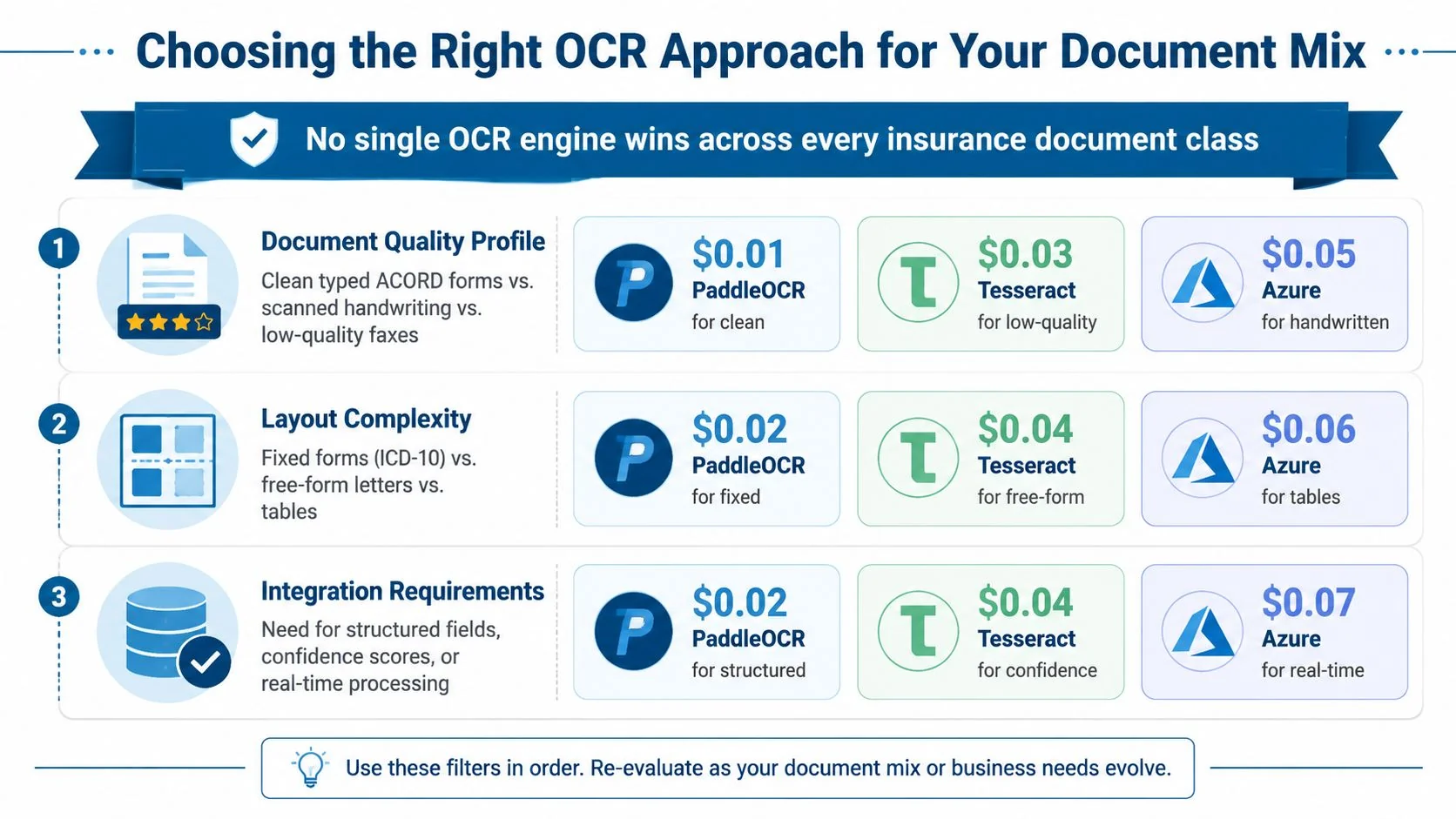
No single OCR engine wins across every insurance document class. The decision should begin with the document distribution, then account for layout, latency, integration effort, and the cost of reviewing errors.
Three filters for a defensible choice
Document quality comes first. Clean typed declarations may work well with conventional recognition and format validation. Handwritten notes, multilingual injury reports, photographed estimates, and low-quality faxes usually justify deep learning because visual variation is part of the input, not an exception.
Layout complexity changes the architecture. A fixed form can use coordinates and known regions. A free-form letter needs region detection and semantic extraction. A table-heavy packet needs cell, row, and column relationships preserved through the pipeline.
Integration determines business value. Ask whether downstream systems need plain text, bounding boxes, field confidence, table structures, real-time responses, or human-review tasks. A model that produces impressive text but incompatible output can create a costly rewrite of the extraction layer.
Use this checklist before selecting an approach:
- Recognition target: Which fields must be nearly exact, and which can tolerate review?
- Layout burden: Are documents fixed, multi-column, table-heavy, or free-form?
- Handwriting exposure: Does handwriting appear occasionally, or does it define the document class?
- Latency tolerance: Is the workflow batch-oriented, queue-based, or interactive?
- Integration cost: Can the current parser consume regions, coordinates, confidence, and structured relationships?
A mixed insurance estate often needs a tiered stack. Conventional OCR and validation can handle predictable typed pages. A deep learning recognizer can take noisy or multilingual documents. A layout and extraction layer should sit above both, with confidence-based routing to human reviewers.
AI for Insurance provides a searchable database of documented insurance AI implementations, including use cases, technologies, and disclosed outcomes. It can support market and implementation research, but your model decision still needs a labeled sample from your own claims or underwriting queues.
Start with one document family, collect representative originals, and label the fields that drive a real workflow. Measure recognition, field pairing, table preservation, review effort, latency, and downstream corrections before expanding to the next class. That evidence will tell you whether conventional OCR is sufficient, where deep learning adds value, and which extraction failures deserve engineering attention first.
