10 Insurance Technology Services Explained: A 2026 Guide
Explore 10 insurance technology services for carriers and MGAs, from IDP and claims automation to core platforms, with verified case studies and outcomes.
Written by AI for Insurance
A commercial submission lands at 4:45 p.m. on Friday, packed into a 60-page PDF bundle. The underwriting queue looks healthy until someone opens the file and starts re-keying applicant details, loss history, coverage requests, and exposure data by hand. One difficult submission can delay several decisions, create transcription errors, and force underwriters to spend Monday repairing an intake problem instead of assessing risk.
That's where insurance technology services fit. The category includes consulting, implementation, managed services, data products, and software platforms that support specific stages of the carrier workflow. The right choice depends less on whether a vendor uses AI and more on which operational constraint is slowing intake, claims, fraud review, underwriting, pricing, core administration, property assessment, customer service, or external-data enrichment.
The ten categories below follow that workflow. Each explains how the service is used day to day, where it falls short, what implementation usually requires, and which measures help distinguish a useful deployment from a polished demonstration.
Table of Contents
- 1. Intelligent Document Processing and Submission Intake
- 2. AI Claims Automation and Computer Vision Damage Estimation
- 3. AI-Powered Insurance Fraud Detection and Anomaly Analytics
- 4. AI Underwriting Decision Support and Risk Selection Platforms
- 5. Pricing, Rating, and Actuarial Modeling Platforms
- 6. Core Insurance Platforms with Embedded AI Modules
- 7. Aerial Imagery and Property Risk Analytics
- 8. Telematics and Usage-Based Insurance Platforms
- 9. Generative AI Assistants and Conversational Agents for Insurance
- 10. Third-Party Data, Risk Intelligence, and Claims Databases
- Top 10 Insurance Tech Services Comparison
- Choosing an Insurance Technology Partner Without Buying Hype
1. Intelligent Document Processing and Submission Intake
Intelligent document processing, or IDP, turns unstructured material into fields that insurance systems can use. OCR reads printed or scanned text, computer vision interprets layout, natural language processing identifies meaning, and machine-learning models classify documents and extract values. A commercial-lines MGA might use it to sort ACORD forms and loss runs into underwriting queues. Claims teams might extract treatment details from medical bills or line items from repair invoices.
The immediate benefit is workflow control. A submission can be classified, checked for missing information, and routed to the right team before an employee manually opens every attachment. IDP can also populate policy administration, claims, or underwriting systems, but only when field mappings, validation rules, and exception handling have been designed properly.
What usually breaks
Extraction accuracy isn't the same as operational success. A system can read a policy number correctly and still fail if it puts that value in the wrong system field, misses a contradictory date, or sends a low-confidence document straight through. Handwritten notes, unusual broker templates, poor scans, and changing forms create recurring exceptions.
Start with one high-volume document type rather than the entire archive. Establish baseline touch time, error rate, cycle time, and the proportion of documents requiring review. Then set confidence thresholds by field and measure straight-through processing, not just character recognition.
- Use a defined queue: Begin with standardized submissions, invoices, or forms.
- Route uncertainty deliberately: Send low-confidence fields to trained reviewers instead of hiding uncertainty.
- Retrain after change: Broker formats and internal forms will change, so maintenance belongs in the operating budget.
- Measure rework: Count corrections after ingestion, not only the first-pass extraction result.
2. AI Claims Automation and Computer Vision Damage Estimation
A customer uploads several photographs after a collision. The claims platform checks image quality, identifies visible damage, estimates repair components, and routes the claim according to complexity. A simple case may move toward rapid settlement, while a collision involving structural damage, unclear images, or possible injury goes to an adjuster.
Computer vision services are most useful when they support a narrow claim band with predictable inputs. They can assess vehicle damage from photos or video and can also support property claims, provided the image capture process is controlled. Computer vision with machine learning in insurance is often presented as a model problem, but the operational problem is broader. Guided capture, coverage verification, repair-network integration, and escalation rules determine whether the estimate helps.

The model shouldn't decide beyond its evidence. Measure cycle time alongside supplement rates, leakage, customer satisfaction, and the gap between the initial estimate and the final repair invoice. Audit results by vehicle type, damage type, geography, and image quality to identify drift or uneven performance.
Practical rule: Automate the claim types with stable evidence first, then expand only after escalation outcomes are understood.
A short demonstration can make this workflow look effortless. Production teams should also test photo rejection rates, adjuster override frequency, payment accuracy, and the time required to resolve exceptions.
<iframe width="100%" style="aspect-ratio: 16 / 9;" src="https://www.youtube.com/embed/TjElKFibjUk" frameborder="0" allow="autoplay; encrypted-media" allowfullscreen></iframe>
3. AI-Powered Insurance Fraud Detection and Anomaly Analytics
Fraud analytics sits between intake and investigation. A platform scores claims or applications, compares entities across policies, and looks for relationships that isolated rules may miss. Network analysis can connect claimants, repair providers, addresses, devices, or intermediaries. Entity resolution helps the system recognize that slightly different records may refer to the same participant.
The workflow is valuable only when investigators can act on it. A score that creates a large queue of weak referrals shifts the burden rather than reducing it. Claims teams need reason codes, supporting evidence, and a feedback path from the special investigation unit back into the model. That feedback should distinguish confirmed fraud, legitimate complexity, insufficient evidence, and operational error.
The measures that matter
Begin with the existing hit rate and investigation cost per case. After deployment, track precision, referral conversion, investigator handling time, and the percentage of referrals that produce a meaningful action. Detected volume alone is a poor success measure because a model can flag more claims while making the investigation team less effective.
- Explain the signal: Give investigators the relationships or anomalies that influenced the score.
- Capture outcomes: Record what happened after review, not just whether a claim was referred.
- Test group effects: Examine disparate impact across protected groups and relevant customer segments.
- Protect workflow speed: A fraud screen that delays every claim can damage service even when it finds valid cases.
Teams evaluating machine-learning fraud detection should ask whether the system integrates with claims handling, policy data, and investigator tooling. Fraud models are operational products, not detached dashboards.
4. AI Underwriting Decision Support and Risk Selection Platforms
An underwriter opens a submission and sees structured applicant details, exposure information, external risk signals, and appetite fit in one working view. The system can identify missing fields, classify the risk, recommend a queue, and highlight characteristics for review. The underwriter still owns the decision when a submission falls outside standard patterns or the available evidence is incomplete.
Appetite triage is a practical starting point. It addresses a clear bottleneck without assuming that software can replace judgment on complex commercial or specialty risks. Vendors in this category typically expose appetite rules as configurable triage logic and enrich submissions with external risk data before routing them. The operational test is whether carrier guidelines become usable rules, features, and review steps that underwriters can inspect.
Expand in controlled stages
Measure quote turnaround, queue aging, referral reasons, and hit ratio before deployment. After implementation, compare results by risk cohort and monitor loss ratio over an appropriate observation period. A portfolio change may also reflect appetite, pricing, distribution, or business mix, so teams should account for those factors before assigning an effect to the system.
Underwriters should record override reasons at the point of decision. These records show whether the model missed a risk factor, the guidelines need clarification, or staff do not trust the recommendation. They can also expose automation bias, where users accept a suggestion because it appears authoritative.
A practical rollout can begin with triage, add missing-information prompts, and then introduce structured risk summaries. Automated pricing or binding should follow only after governance, data quality, and exception handling have worked reliably in production. Measure override rates, referral conversion, decision time, and downstream loss experience by cohort to decide whether each stage deserves wider use.
5. Pricing, Rating, and Actuarial Modeling Platforms
Pricing and actuarial platforms move approved analysis into governed production rating workflows. Actuaries can develop generalized linear models, gradient-boosted models, and other approaches, then run what-if simulations, prepare filing materials, and deploy approved versions.
The trade-off is model flexibility. Complex methods may capture interactions that conventional models miss, yet they can be harder to explain, validate, file, and monitor. A pricing platform supports actuarial work; it does not transfer accountability away from actuaries. Its practical value lies in controlled experimentation, versioning, approvals, and deployment.
Keep a reference model
Maintain an interpretable baseline, such as a GLM, alongside more complex approaches. The baseline helps actuaries explain rate changes, investigate unexpected outputs, and communicate with compliance teams. Test performance on data held outside development, then monitor calibration and performance decay after launch.
Platforms in this category combine model-development environments with governed deployment into production rating engines. Compliance and actuarial teams should agree early on acceptable variables, techniques, documentation, and approval steps for each line of business. Those decisions should be recorded before a model enters production.
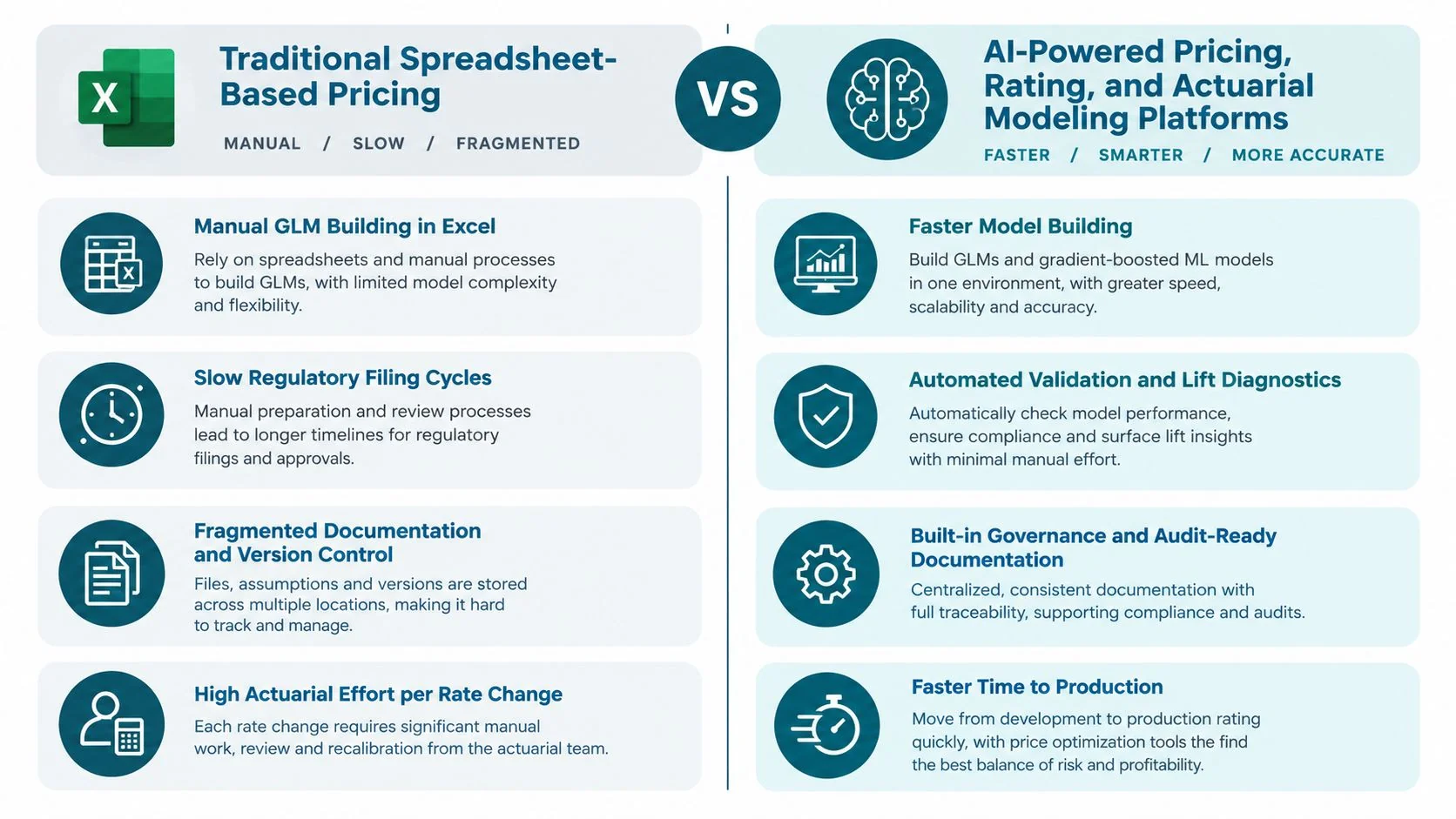
Track the model version, approval status, deployment date, prediction stability, calibration, retention, claims outcomes, and material differences between filed and implemented logic. Review those measures by product and risk cohort where possible. A faster model cycle has little operational value if governance records cannot show why a rate changed or who approved it. Include rollback procedures and an audit trail for each production release.
6. Core Insurance Platforms with Embedded AI Modules
Policy administration, billing, and claims platforms from core-system vendors hold the operational records that other services need. Cloud delivery and embedded analytics can reduce separate integrations, but they do not fix inconsistent historical data or poorly defined processes.
Embedded AI can use the platform's existing data structures and workflows, which may simplify deployment compared with connecting a standalone service to several systems. The trade-off is dependence on the platform's release schedule, data model, permissions, and feature limits. A separate service may provide more specialized capability, while adding integration, security, monitoring, and vendor-management work.
Modernize around usable data
Start with use cases supported by data already available in the core. A claims-summary assistant, for example, may be easier to deploy than a model that needs external property attributes, historical repair records, and real-time event streams. API-first integration keeps it possible to replace or update an external model without hard-wiring it into transaction logic.
Core migrations also expose data-quality problems. Duplicate policyholders, incomplete loss histories, inconsistent product codes, and unclear ownership can disrupt later AI projects. Measure migration completeness, reconciliation accuracy, transaction failure rates, processing latency, manual workarounds, and the share of workflows completed without re-keying.
A platform upgrade becomes useful when it supports a defined workflow and a measurable production outcome. Set measures before deployment, such as processing time, exception volume, re-keying rates, and user correction rates. Review them by transaction type and business unit so a faster process does not hide new errors.
Treat embedded AI and standalone services as operating choices, not technology labels. Choose on the carrier's data access, control requirements, replacement plans, and day-to-day workload.
7. Aerial Imagery and Property Risk Analytics
An underwriting team reviewing a storm-exposed property can use aerial or satellite imagery to assess roof condition, vegetation overhang, construction features, and hazards such as wildfire or flooding. Providers in this category supply high-resolution imagery with AI-derived property attributes. The same information supports inspection triage, portfolio reviews, and requests for updated property details.
These services can reduce unnecessary site visits, but imagery is evidence rather than ground truth. A roof may have changed after the latest capture, while vegetation can be hidden by trees, shadows, or seasonal conditions. Models can also infer a characteristic incorrectly when a structure is unusual or partly obscured.
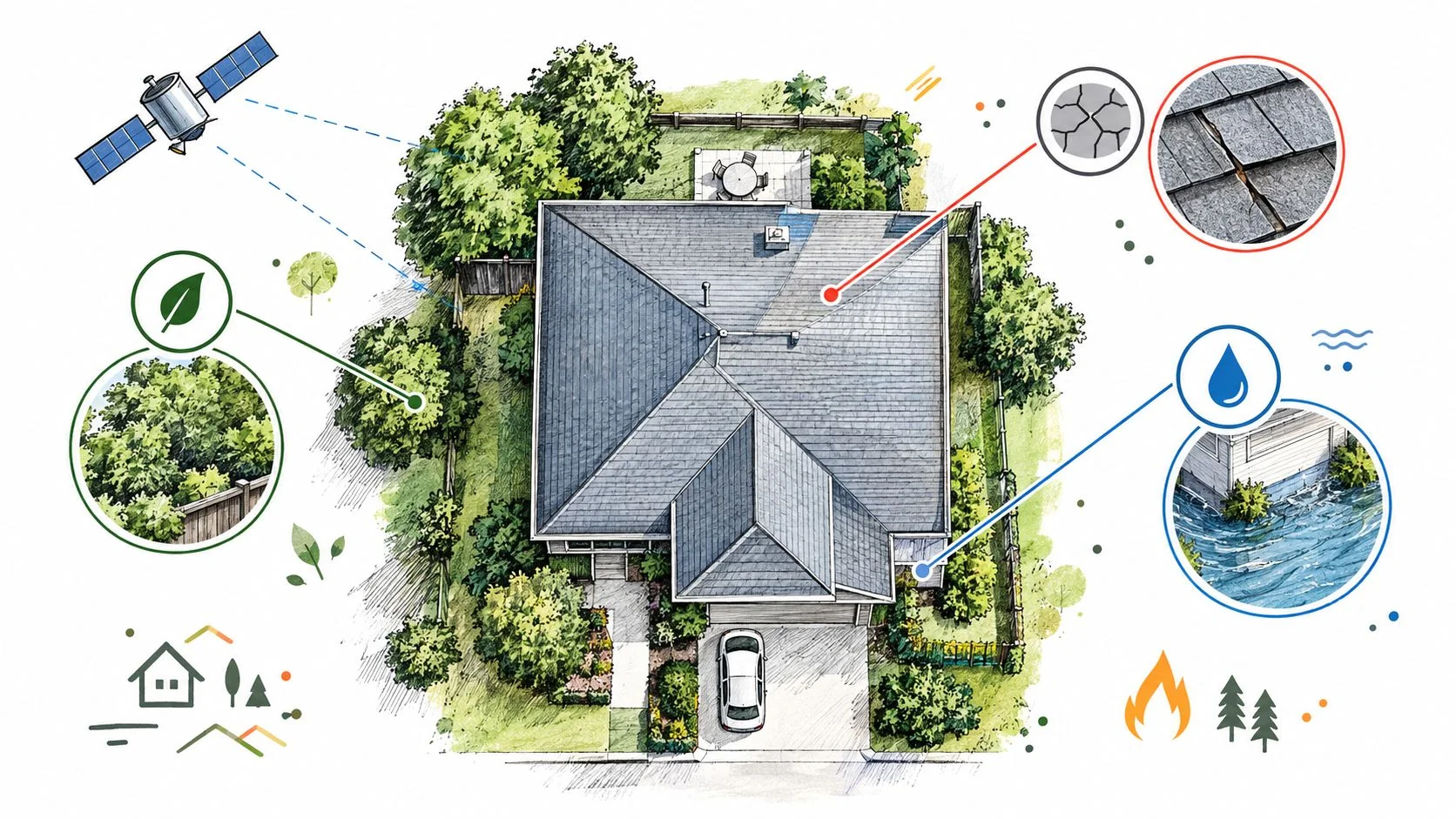
Use imagery to prioritize inspections before using it to reduce them. Select properties for physical validation, compare derived attributes with inspection findings, and record the capture or refresh date for each location. A stale image can misstate current conditions even when its original classification was accurate. Keep a review path for cases where the image is unclear or the policyholder disputes the property information.
Separate savings from accuracy
Measure inspection cost savings separately from attribute accuracy. Track referral rates, underwriting overrides, quote turnaround, portfolio concentration, and disputes caused by incorrect property data. Fewer field visits can still create more reinspection work, so measure the complete workflow rather than one efficiency result.
The service earns its place when it improves prioritization and risk visibility without hiding uncertainty. Underwriters should see the source date, confidence level, and reason for an alert before relying on it in a decision. Sample results by property type and hazard so strong performance in one segment does not conceal errors in another.
8. Telematics and Usage-Based Insurance Platforms
A driver receives a premium adjustment after an app records repeated hard braking. A connected vehicle reports a crash before the policyholder reaches an agent. Telematics links pricing and service to observed driving or usage through mobile applications, vehicle systems, or OBD-II devices. Large personal-lines carriers have run behavior-based auto programs for years, while specialist telematics providers supply driver scoring and crash-detection services.
The exchange must be clear to policyholders. Explain which data is collected, how it affects pricing or service, how long it is retained, and which choices customers have. An opaque score can create distrust even when the underlying model performs well.
Treat the data as a service channel
Calibrate scores against claims outcomes across at least one full policy cycle. Compare scores with observed loss patterns, test discount eligibility for unintended bias, and monitor participation and opt-out behavior. Measure telematics beyond premium impact. Crash detection can trigger assistance, gather first-notice information, and route a claim to the appropriate team.
Data quality depends on the device, phone placement, connectivity, and driving context. A harsh-braking event may reflect an emergency rather than careless driving. Define exception rules, review disputed events, and record how corrections affect pricing decisions.
Privacy, calibration, and exception handling determine whether the program earns trust. Drivers need understandable feedback, and claims teams need reliable event information. Track enrollment, retention, opt-outs, disputed events, score stability, claims-reporting time, assistance response, and loss outcomes by participation group.
9. Generative AI Assistants and Conversational Agents for Insurance
A claims handler asks an internal assistant to summarize a policy, identify missing documents, and draft a customer response. An underwriter uses a copilot to compare submission details with approved guidance. A policyholder asks a conversational agent about coverage, starts a first notice of loss, or requests a service update.
These systems handle language-heavy work that previously required reading, searching, and drafting. They can be useful, but fluent output isn't proof of correctness. A fabricated coverage interpretation can create a regulatory, financial, and customer-service problem.
Start with internal copilots where an employee reviews every output. Ground responses in approved policy and claims documents through retrieval-augmented generation rather than relying on model memory. The practical role of generative AI in insurance depends on retrieval quality, permissions, source freshness, and escalation design.
Establish hard boundaries
Log prompts, retrieved sources, outputs, human edits, escalations, and customer-facing actions. Measure factual error rate, edit rate, containment, resolution time, handoff quality, and the frequency of unsupported answers. Define decisions the assistant may never make autonomously, such as coverage determinations or disputed claim outcomes, unless the carrier has separately approved a controlled process.
For customer service, the agent should resolve routine requests rather than merely route them. It still needs identity verification, consent handling, accessibility support, and a reliable handoff to a person.
A useful implementation also provides AI support examples for SaaS customer service, but insurance teams should adapt those patterns to policy language, claims authority, privacy controls, and audit requirements.
10. Third-Party Data, Risk Intelligence, and Claims Databases
External data supports intake, underwriting, claims, fraud review, and pricing. Established data providers supply property attributes, claims histories, motor-vehicle records, identity signals, catastrophe information, and other risk intelligence where permitted. These feeds can fill gaps in an applicant or policy record, but they also introduce provenance, licensing, and quality risks.
An API connection is only the starting point. Underwriters need to see where an attribute came from and when it was refreshed. Model owners need error and coverage information. Compliance teams must confirm that each data element is permitted for the product, jurisdiction, and decision. Procurement should document rights for model training, production use, retention, and downstream analysis.
Make provenance part of the product
For every feed, record the source, refresh frequency, known limitations, error patterns, permitted uses, and version history. Test whether a new source improves performance on unseen cases, rather than only improving historical fit. Review fair-lending and unfair-discrimination requirements for each element, particularly when a variable could act as a proxy for a protected characteristic.
Reconciliation needs its own controls. A property address may differ from the policy record. A claims-history identity may be incomplete or linked incorrectly. A delayed feed can make a changing risk appear unchanged. Measure match rate, freshness, correction volume, downstream exceptions, and business decisions affected by disputed data.
Teams designing provider waterfalls for data enrichment should define fallback logic, precedence rules, timeout handling, and the response when providers disagree. Review these rules with operations and compliance, then test them against missing, stale, and conflicting records. External data strengthens a workflow only when the carrier can explain its origin, confirm its permitted use, and manage failure modes.
Top 10 Insurance Tech Services Comparison
| Solution | Core capability | Key metrics / UX impact | Primary value proposition | Target users / lines | Main limitations |
|---|---|---|---|---|---|
| Intelligent Document Processing (IDP) and Submission Intake | OCR + NLP extraction, document classification, human-in-loop validation, API integrations | Touch time ↓, throughput ↑, STP rate, extraction accuracy | Automate intake to cut manual keying and speed underwriting/claims | Carriers, MGAs; underwriting & claims intake; commercial & personal lines | Degrades on poor scans/handwriting; needs integration and ongoing tuning |
| AI Claims Automation and Computer Vision Damage Estimation | Image-based damage detection, severity classification, cost estimation, guided capture | FNOL→estimate time ↓, settlement speed, CSAT, estimate consistency | Rapid photo-based estimates and straight-through settlement for simple claims | Auto & property claims teams, FNOL workflows, adjusters | Photo quality and hidden damage limit accuracy; regulatory/market acceptance varies |
| AI-Powered Insurance Fraud Detection and Anomaly Analytics | Real-time scoring, network/link analysis, entity resolution, case management | SIU hit rate ↑, precision/recall metrics, false positives, investigation ROI | Surface complex fraud rings and prioritize high-risk cases for SIU | Claims, underwriting, SIUs; carriers handling fraud-prone lines | Requires labeled fraud data; false positives and fairness/governance risks |
| AI Underwriting Decision Support and Risk Selection Platforms | Submission triage, appetite scoring, external enrichment, recommendation engines | Quote turnaround ↓, hit ratio ↑, referral rate, loss outcomes by cohort | Speed triage and improve selection consistency while keeping underwriter control | Commercial & specialty underwriters, MGAs, brokers | Automation bias; needs clean historical data and guideline encoding |
| Pricing, Rating, and Actuarial Modeling Platforms | GLM/ML model building, validation, rating engine deployment, governance | Time-to-production, model lift, explainability, regulatory audit readiness | Faster, governed pricing and what-if optimization for competitive rates | Actuarial & pricing teams across personal & commercial lines | Lengthy implementations; regulatory filing limits; licensing cost |
| Core Insurance Platforms with Embedded AI Modules (Policy, Billing, Claims SaaS) | Cloud policy/billing/claims SaaS with native AI modules and APIs | Unified data foundation, reduced integration effort, faster product launches | Single system of record that accelerates AI in production with less custom wiring | Enterprise carriers modernizing core; IT, product, operations | Long, costly migrations; vendor lock-in; embedded AI may be less specialized |
| Aerial Imagery and Property Risk Analytics | Satellite/aerial imagery + CV for roof, vegetation, change detection, risk scoring | Inspection cost savings, attribute accuracy, refresh frequency, portfolio monitoring speed | Scale property assessment and event-driven monitoring without full physical inspections | Homeowners & commercial property underwriters, portfolio risk teams | Resolution/refresh limits; interior/structural blind spots; data licensing costs |
| Telematics and Usage-Based Insurance (UBI) Platforms | Driving data capture (app/device), driver scoring, crash detection, coaching | Pricing precision, opt-in rate, loss reduction, driver engagement | Enable individualized pricing and loss prevention via behavioral data | Auto insurers, commercial fleets; usage-based programs | Consumer adoption and privacy issues; noisy signals and potential bias |
| Generative AI Assistants and Conversational Agents for Insurance | LLM copilots, RAG over policies, doc summarization, chatbots, audit logging | Time saved on document tasks, response speed, CSAT, hallucination/error rates | Automate unstructured-language tasks and 24/7 service; boost employee productivity | Claims handlers, underwriters, customer service, brokers | Hallucinations, grounding & privacy needs; strong governance required |
| Third-Party Data, Risk Intelligence, and Claims Databases | External feeds: property attributes, claims exchanges, MVR, catastrophe models, APIs | Feature lift for models, data freshness, cost per record, coverage breadth | Enrich models and workflows with standardized external risk signals | Underwriting, actuarial, fraud, claims analytics teams | Data cost at scale, accuracy variability, regulatory restrictions, vendor concentration |
Choosing an Insurance Technology Partner Without Buying Hype
Begin with the workflow stage that has the clearest baseline. That may be submission touch time, claims cycle time, investigation cost, quote turnaround, inspection volume, customer-service handling time, or data reconciliation effort. If the team can't describe the current process and its constraints, it won't be able to prove that a service improved the operation.
Choose one bounded use case. A carrier might start with a defined class of commercial submissions, a narrow band of auto claims, or one property-risk attribute. The pilot should have named owners from operations, technology, compliance, data, and the affected business function. It should also define what happens when the system is uncertain.
The business case should include more than a model score. Require evidence on:
- Workflow impact: Cycle time, queue age, touch time, throughput, and exception volume.
- Decision quality: Error rate, override rate, reconciliation accuracy, and downstream rework.
- Financial effect: Cost per transaction, investigation effort, loss adjustment expense, or revenue contribution where the carrier can measure it.
- Control environment: Access permissions, audit logs, human review, model monitoring, retention, and incident response.
- Implementation scope: Systems connected, data prepared, integrations built, operating procedures changed, and internal staff required.
The market context supports careful evaluation. Gartner's forecast reported by EY puts global insurance-industry IT spending at $213.5 billion in 2023, up 7.2% from 2022 in constant U.S. dollars. IT services are forecast to reach $138.6 billion by 2027, with a 9.4% compound annual growth rate from 2022 through 2027. Infrastructure and integration delivered as a service are projected at a 23.6% CAGR, while consulting is projected at 11.4%. The insurance IT-services landscape summarized by EY shows why implementation capability matters as much as product functionality.
Claims automation offers a useful economic reference point. McKinsey reported that automation can reduce the cost of a claims journey by as much as 30%, although the realized result depends on data quality, regulation, legacy integration, and operating-model complexity. McKinsey's analysis of insurance digital transformation also places today's AI services in a longer transition driven by digitization, automation, analytics, and digitally mediated customer journeys.
Generative AI requires the same discipline. An EY survey of 100 insurers found that most respondents had already achieved up to 10% in cost savings and/or revenue uplift from generative-AI initiatives, primarily through productivity and customer-experience improvements. A substantial share expected benefits of up to 20% within the following one to two years. The survey identifies data privacy, data quality, security, and legacy integration as leading barriers, so an impressive demonstration doesn't remove production work. EY's 2025 insurance generative-AI findings provide a useful benchmark for questions about value and readiness.
Adoption is broad, but maturity remains uneven. Reuters Events reported that 86% of surveyed insurers had invested in data analytics during the previous twelve months, while 51% planned to invest in generative AI over the following three years. KPMG research cited in the same material found that 57% had integrated AI with robotic process automation, 58% had AI-enabled data-analytics platforms, only 34% had achieved system-level data integration, and 72% identified data as their primary challenge. The Reuters Events insurance technology research is the source for these figures. They point to a practical conclusion: integration architecture is often a stronger differentiator than a model offered without implementation infrastructure.
Governance must also travel with the deployment. A global survey of 200 senior insurance executives found that governance and oversight challenged 49% of respondents, data privacy affected 62%, and regulatory differences across jurisdictions affected 42%. More than half, 51%, planned to invest in data quality over the following one to three years. Genpact's 2025 research on scaling trusted AI in insurance supports a clear operating principle: insurers need jurisdiction-specific controls, documented human review, monitoring after launch, and evidence that auditors and regulators can inspect.
Before signing, ask the provider to show the production workflow, not only the interface. Request error definitions, exception handling, monitoring examples, integration assumptions, ownership of configuration, and the conditions under which a result must be reviewed by a person. Then run the pilot, compare pre-deployment and post-deployment baselines, and publish the result internally, including failures.
For documented implementations and vendor profiles, the searchable AI for Insurance database is a reasonable starting point for comparison. It organizes insurance AI implementations by use case, technology, industry line, reported outcome, and source link, which can help teams separate documented deployment evidence from broad marketing language. Use it as research input, then validate every claim against the carrier's own workflow, controls, and measurable results.
Start with the Friday-afternoon submission queue or the claims backlog your team already understands. Define the baseline, select one controlled service, assign operational ownership, and require evidence before expanding.
