Insurance Software Systems Guide 2026
Explore core insurance software systems, AI integration patterns, and vendor selection criteria backed by verified industry metrics and implementation data.
Written by AI for Insurance
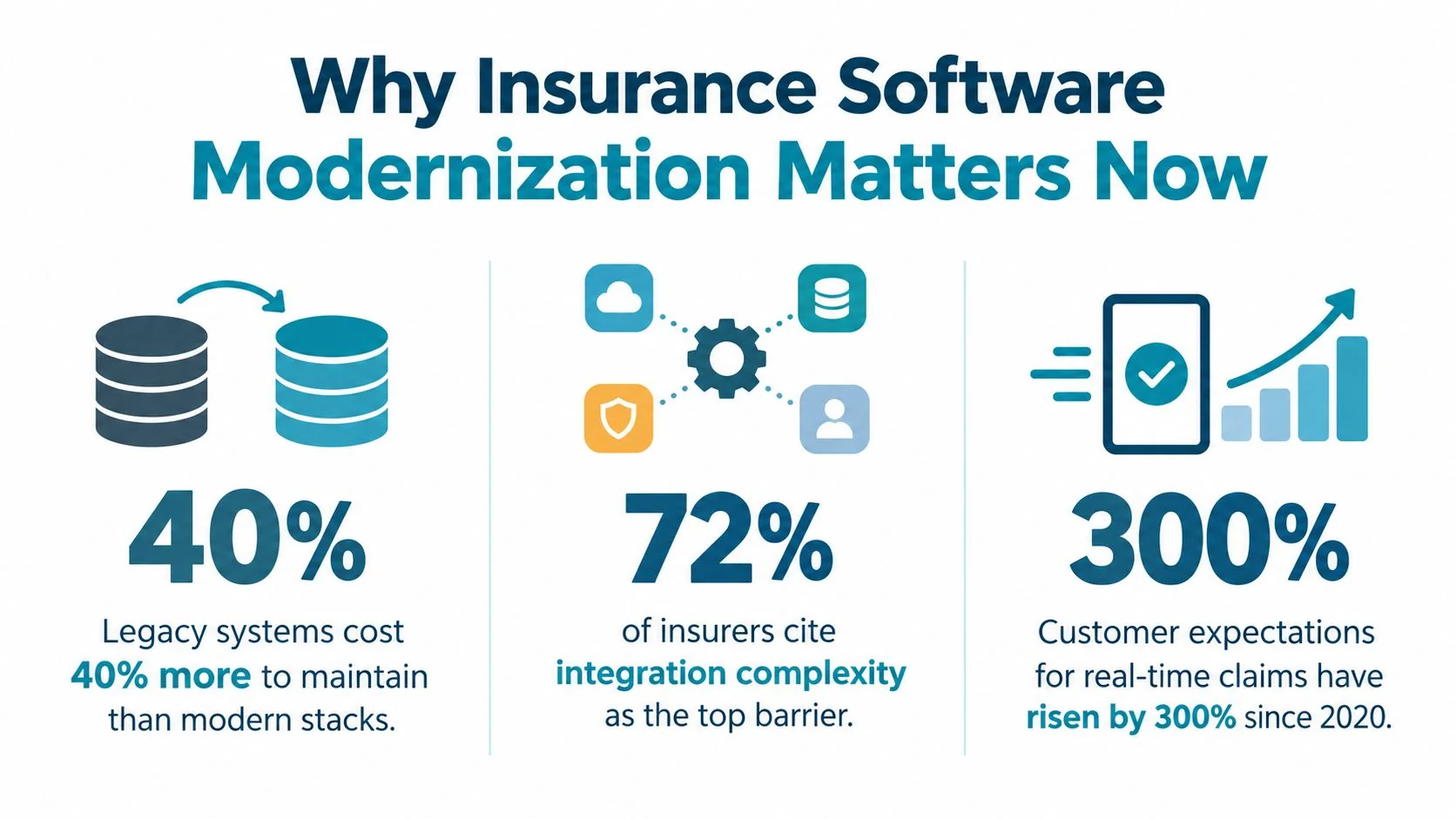
77% of insurers use more than one core system, and nearly three-quarters of those insurers plan to migrate systems within two years. Insurance software modernization is urgent because fragmented platforms now constrain data access, workflow automation, and the ability to deploy AI safely.
The issue isn't only that some policy, billing, and claims applications are old. Insurers have accumulated interconnected systems that encode products, controls, customer histories, and operational decisions. Replacing one component can therefore affect every downstream process. A credible modernization plan must evaluate data remediation, integration effort, workflow redesign, governance, and measurable production outcomes alongside software features.
Table of Contents
- Why Insurance Software Modernization Matters Now
- Market Size and Growth Trajectory
- AI Claims Processing Performance Metrics
- The Hidden Implementation Burden
- Governance as a Scaling Mechanism
- Leveraging Verified AI Case Studies for Vendor Selection
- Making the Right Software Choice
Why Insurance Software Modernization Matters Now
77% of insurers used more than one core system, according to a 2022 survey of 100 insurance professionals. The same survey of insurance core technology environments found that the average core platform had been in service for 7.7 years. The installed base varied considerably, with 31% of platforms less than five years old and 15% operating for at least a decade.
That combination creates a practical modernization problem. Insurers must connect applications with different data models, release cycles, interfaces, and ownership structures. A policy administration migration may require remapping product codes, reconciling duplicate policyholder IDs across billing and claims, preserving historical records, and testing downstream calculations. The software replacement is only one workstream. Data remediation and integration often determine whether the program improves operations or transfers inconsistencies into a new environment.
Fragmentation changes the AI equation
AI systems need usable data, stable interfaces, defined permissions, and workflows that specify when a person must intervene. Fragmented insurance software systems complicate each requirement. A model may classify a claim accurately, yet fail to trigger the correct reserve, payment, notification, or escalation process when surrounding applications hold inconsistent records.
Migration plans were widespread among insurers running multiple systems, as reported in the same survey. That pressure makes sequencing important. Deploying AI before resolving identity matching, document formats, event ownership, and access controls can speed one task while increasing reconciliation work elsewhere. Implementation governance must therefore cover data definitions, interface ownership, exception handling, and approval rights, not only model performance.
The same research found that insurers viewed back-end systems as part of their core competency and as a competitive differentiator. Those systems influence product launches, rule changes, distribution support, claims capacity, and the reliability of operational reporting. Their value depends on how consistently they connect business decisions to trusted records.
A practical starting point is to map each critical workflow from source data to customer outcome. Teams assessing digital insurance platforms should identify the authoritative system for each key field, the interfaces that move it, the controls governing access, and the human decisions that remain outside the formal workflow. Verified AI case studies can then test whether a proposed architecture has handled comparable data, integration, and governance conditions in production.
Market Size and Growth Trajectory
The insurance software market was valued at USD 14.14 billion in 2025, projected to reach USD 15.03 billion in 2026 and USD 20.41 billion by 2031, representing a 6.31% compound annual growth rate from 2026 through 2031, according to the insurance software market estimate.
For buyers, the 6.31% CAGR points to sustained investment in insurance technology, but it does not reduce the need to budget separately for data remediation, integration work, and governance. Those activities determine whether new capabilities can operate reliably across core administration, underwriting, claims, billing, distribution, analytics, and automation.
Modernization decisions cannot be reduced to selecting an AI feature: insurers are deciding how several architectural layers should evolve together, often while existing systems continue to run customer and operational processes.
Market structure matters to buyers
The estimate identifies North America as the largest regional market and Asia-Pacific as the fastest-growing region. It also reports that property-and-casualty software represented 48.8% of market spending in 2024, while health-and-accident systems were projected to grow fastest, at a 12.3% compound annual growth rate, according to the same market analysis.
The two segments likely face different implementation pressures. P&C buyers may encounter mature policy, claims, and rating workflows, but must still examine exception handling, data quality, and connections across multiple systems. Health and accident buyers may face faster changes in process design and data requirements, increasing the value of extensibility, controlled data definitions, and clear ownership of interfaces.
The practical conclusion is narrower than a regional or line-of-business ranking. Modernization priorities vary by operating context. A carrier with stable core administration may start with document intake or claims routing. Another may need to reconcile customer identities, standardize records, and define system ownership before intelligent automation can progress beyond a controlled pilot.
Market growth therefore measures investment momentum, not architectural fit. A defensible business case separates three decisions: which operational problem warrants investment, which architectural layer should change, and which measurable outcome will demonstrate production value. It should also identify the remediation, integration, and governance work required to reach that outcome.
AI Claims Processing Performance Metrics
15 days versus about 3.5 days is the clearest performance contrast in the reported claims data. A comparative study found that legacy, manually processed claims averaged approximately 15 days to resolution and had a 25% error rate in initial categorization. AI-supported processing reduced average resolution time to about 3.5 days and achieved 92% categorization and routing accuracy, according to the AI-orchestrated claims study.
| Metric | Legacy System | AI-Supported System |
|---|---|---|
| Average resolution time | Approximately 15 days | About 3.5 days |
| Initial categorization error rate | 25% | Not specified as an error rate |
| Categorization and routing accuracy | Not disclosed | 92% |
| System uptime | Not disclosed | 99.5% |
| Automated routing accuracy for standard claims | Not disclosed | 88% |
| Throughput | Not disclosed | Roughly 15,000 claims per day |
| High-priority response time | Not disclosed | Under 10 minutes |
The same claims-processing research reported 99.5% system uptime, 88% automated-routing accuracy for standard claims, throughput of roughly 15,000 claims per day, and responses to high-priority cases in under 10 minutes. The source does not disclose the claim volume or study period in these reported figures, so buyers should treat them as study-specific results rather than a universal baseline.
Accuracy is not adjudication
These metrics support a performance discussion, but they do not answer every procurement question. Categorization accuracy may describe only the initial classification step. It does not establish the correctness of coverage interpretation, reserve calculation, settlement, or payment. Processing time may also refer to routing or resolution under the study design, rather than the complete claim lifecycle.
Claims leaders should ask for definitions covering:
- The denominator: How many claims were tested, and which cases were excluded?
- The complexity mix: Were standard, high-severity, litigated, or incomplete claims included?
- Human review: How often did adjusters validate, correct, or override automated outputs?
- Peak performance: Does throughput remain stable during catastrophe or seasonal surges?
- Tail latency: What are p95 and p99 response times, rather than only the average?
- Operational scope: Does the result cover intake, routing, adjudication, payment, or the full workflow?
A system may route standard claims quickly while creating additional work in exceptions. The more useful comparison is straight-through cases versus exception cases, measured across accuracy, latency, adjuster effort, customer communication, and control quality.
For a broader process view, teams can review claims processing in insurance and convert each stated benefit into a testable acceptance criterion. A production pilot should define the claim classes in scope, acceptable override conditions, audit requirements for incorrect routing, and the operational data needed to verify results.
The Hidden Implementation Burden
72% of insurers identified data as their primary challenge, while only 34% had achieved system-level data integration, according to KPMG's 2025 insurance research, the KPMG intelligent insurance research. Those figures place implementation friction before model selection. The system must operate on records that are consistent, traceable, and available across the relevant workflows.

A capable model cannot resolve duplicate policyholders, inconsistent peril codes, missing historical documents, unclear ownership of claim status, or incompatible retention rules. Data remediation therefore determines whether a pilot becomes a dependable service or remains a demonstration.
Production costs extend beyond licensing
Budget evidence shows the organizational scale involved. Among insurers mobilizing generative-AI teams, the largest budget band during the past one to two years was $5 million to $10 million, reported by 52% of commercial P&C, 38% of personal P&C, and 31% of life and annuity respondents, according to the KPMG research. Use the $5 million to $10 million band as a reference for enterprise-scale programs, then create separate estimates for data remediation, integration, and ongoing assurance rather than treating licensing as total cost.
The main cost categories are:
- Data remediation: Define canonical fields, reconcile duplicates, normalize historical records, and document missing values.
- Integration: Build and secure interfaces between core administration, document repositories, workflow engines, customer channels, and analytics environments.
- Workflow redesign: Decide which decisions remain with employees, which can be automated, and how exceptions return to the operating queue.
- Change management: Train staff, revise controls, and assign ownership for new operational responsibilities.
- Ongoing assurance: Monitor model behavior, data drift, access, incidents, and the quality of human overrides.
A pilot may use a clean sample and narrow workflow. Production must handle incomplete submissions, unusual claims, outdated records, regulatory requests, and system outages. Insurers should therefore maintain separate financial models for pilot validation and scaled deployment.
The sequence also varies by line of business. Underwriting may require consistent exposure and risk attributes. Claims may depend more on document extraction, event ordering, and exception routing. Life operations may place greater emphasis on historical records, explainability, and long-duration servicing. The shared requirement is disciplined preparation before automation expands.
<iframe width="100%" style="aspect-ratio: 16 / 9;" src="https://www.youtube.com/embed/xFnXwTGUQI0" frameborder="0" allow="autoplay; encrypted-media" allowfullscreen></iframe>
Governance as a Scaling Mechanism
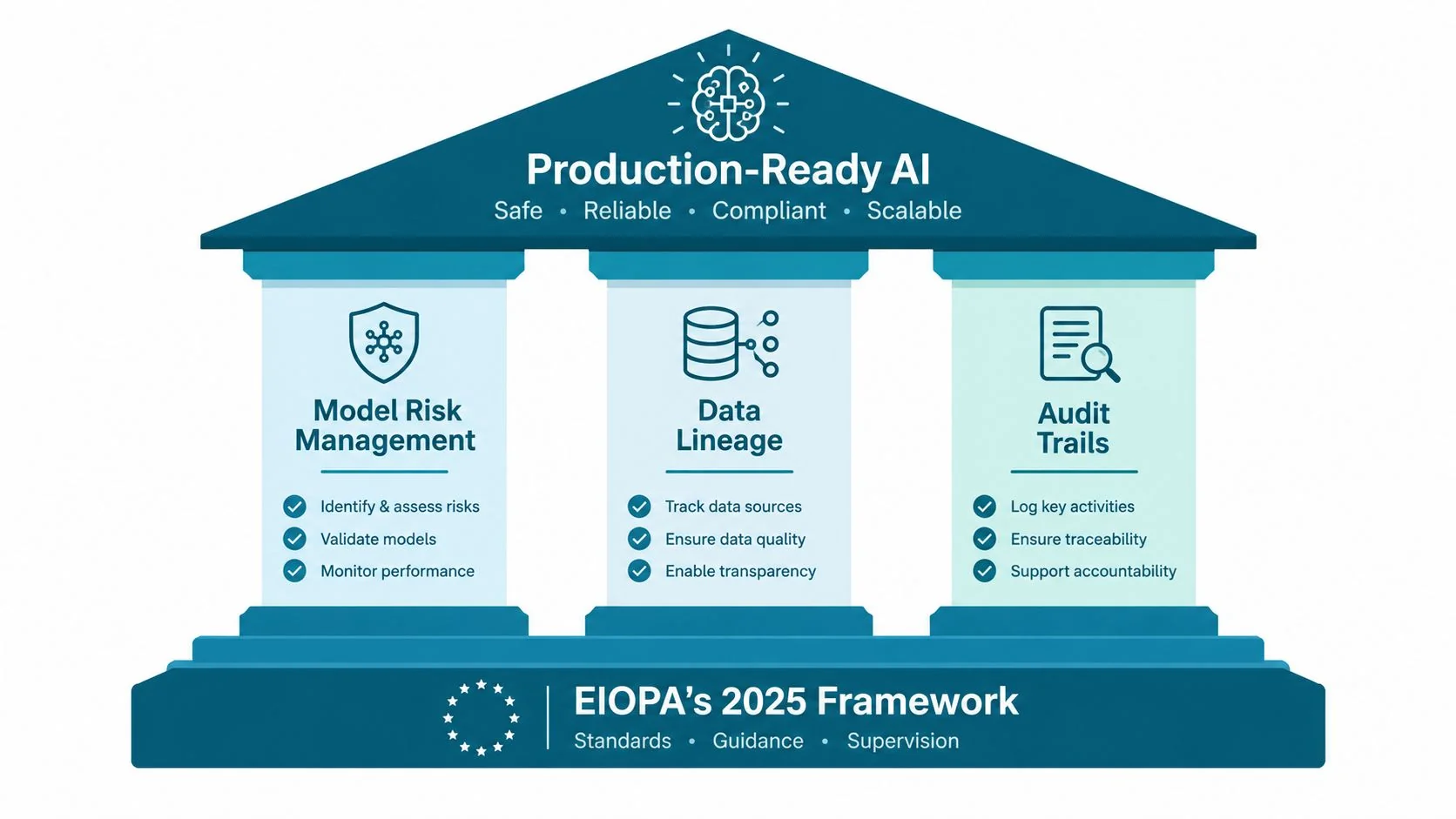
Governance becomes more valuable as an AI deployment moves from one workflow to multiple jurisdictions, products, and business units. EIOPA's 2025 generative-AI market survey identifies privacy, regulation, and talent as leading implementation barriers, including data-security concerns and GDPR compliance, according to the EIOPA generative-AI market survey.
That finding should change how insurers define governance: as the operating layer that determines whether teams can explain a decision, identify a faulty input, reverse an automated action, and prove that controls worked, not as a document produced after deployment.
Build a reusable production scorecard
A practical governance program should connect model behavior to insurance outcomes. The scorecard doesn't need to be identical for underwriting, claims, or service, but it should use consistent definitions and ownership.
- Fairness: Compare outcomes across relevant demographic, geographic, product, and customer segments where lawful and appropriate.
- Drift: Monitor changes in input distributions, data completeness, confidence, and error patterns after deployment.
- Override frequency: Record when employees reject or alter recommendations, then classify the reason.
- Customer complaints: Link complaints to automated decisions, communication failures, and delayed escalation.
- Claim duration: Track whether automation changes the time to resolution, including exceptions rather than only standard cases.
- Loss-ratio effects: Assess whether underwriting or claims changes affect portfolio outcomes, without attributing causation prematurely.
- Regulatory incidents: Log privacy events, control failures, unexplained decisions, and remediation status.
Put accountability into the workflow
Every automated decision needs an owner, an audit trail, and an escalation route. Standardized data definitions help teams compare results across systems. Lineage shows where an input came from and how it changed. Human-escalation rules clarify when a person must review a case.
Operational rule: A model isn't production-ready until the insurer can explain its inputs, decision path, override process, and monitoring response.
KPMG also identifies fragmented data, technical debt, governance, and siloed operating models as material obstacles, while its research reports the data and integration findings cited earlier. Governance therefore supports scale by reducing ambiguity between technology, compliance, operations, and business owners. It can make deployment slower at the beginning, but more repeatable afterward.
Leveraging Verified AI Case Studies for Vendor Selection
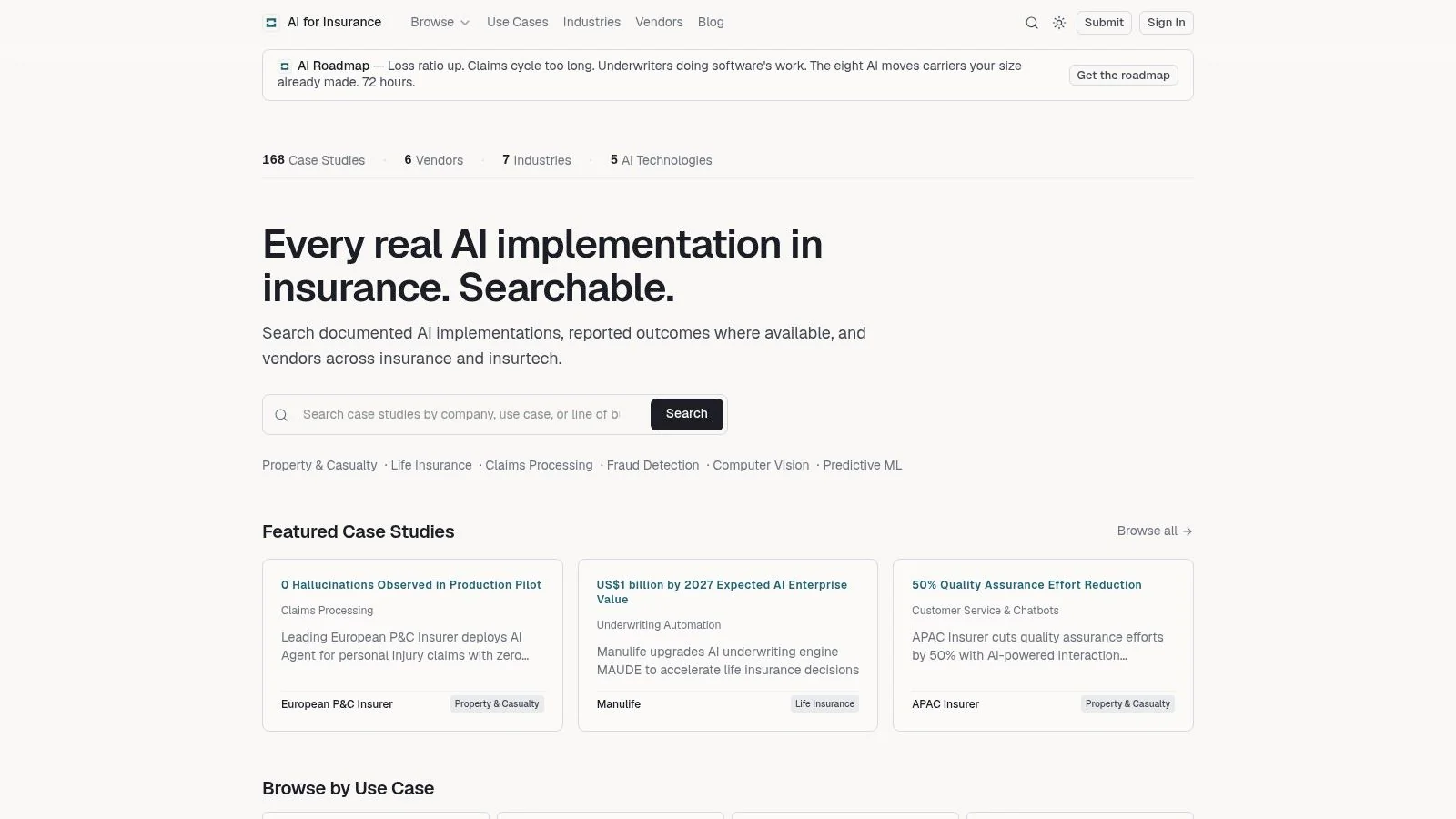
Vendor selection improves when research teams compare documented implementations rather than polished feature descriptions. AI for Insurance provides a searchable database of 175+ verified case studies covering use cases, industry lines, technologies, and measurable outcomes.
A structured case-study database is useful because it lets you narrow research by the operating problem an insurer needs to solve. A claims leader can examine claims processing or fraud detection. An underwriting team can isolate underwriting automation. An architecture group can compare computer vision and predictive machine-learning implementations without mixing unrelated workflows.
Convert case studies into comparable evidence
A useful research workflow begins with taxonomy, not vendor names. Filter by:
- Use case: Claims intake, fraud detection, underwriting, document processing, policy management, or actuarial work.
- Industry line: P&C, life, auto, health, or another relevant category.
- Technology type: Computer vision, predictive machine learning, or other documented approaches.
- Operational context: Implementation duration, throughput impact, error-rate movement, and ROI-related measures where disclosed.
- Deployment role: Whether the system supports employees, automates a handoff, or makes a recommendation within a controlled workflow.
The database also includes vendor listings with links to associated implementations, standardized taxonomies, and weekly briefings with RSS feeds. Those features address a common research problem: evidence becomes scattered across procurement notes, press releases, analyst documents, and internal conversations. A shared taxonomy gives architecture, operations, actuarial, and technology teams a common vocabulary.
Ask what the evidence omits
Verification doesn't eliminate the need for judgment. A case study may disclose an outcome without explaining the baseline, claim mix, human-review rate, integration pattern, or cost of implementation. Buyers should record missing fields rather than treating them as neutral.
A disciplined comparison sheet should include:
- The business process and decision point.
- The source systems and data condition.
- The implementation scope and duration, when disclosed.
- The outcome definition and measurement period.
- The human role after deployment.
- The controls used for exceptions, drift, and audit.
This approach turns case studies into hypotheses for due diligence. It doesn't replace reference checks or controlled testing. It does reduce research fragmentation and helps teams ask vendors for evidence that matches their own operating constraints.
Making the Right Software Choice
The right insurance software system depends on the workflow, data condition, control environment, and accountable owner. A feature that looks valuable in isolation may create little value if the insurer can't connect it to authoritative records or measure the resulting customer and portfolio outcomes.
Match evaluation criteria to responsibility
Underwriters should test whether the system fits actual underwriting decisions, including referrals, missing information, overrides, and integration with rating or policy workflows. The key question is whether underwriters can understand, challenge, and use a model's risk signal without creating an untracked parallel process.
Claims managers should prioritize routing accuracy, exception handling, queue visibility, service-level latency, and human-review design. They should ask for separate results for standard and complex claims, then validate the measurement definitions before accepting any performance claim.
Actuaries and pricing analysts need transparent inputs, reproducible calculations, controlled versioning, and a way to connect model changes with portfolio outcomes. Loss-ratio effects require careful measurement because operational improvements and changes in mix can occur at the same time.
CIOs and CTOs should treat data remediation, interfaces, identity resolution, resilience, access control, and migration sequencing as first-class selection criteria. A system that offers advanced automation but requires extensive undocumented integration may carry more delivery risk than a less ambitious system with clearer interfaces and stronger operational controls.
Data science teams should inspect API readiness, feature lineage, monitoring, retraining controls, test environments, and the ability to export decision records. They'll be responsible for detecting degradation after implementation, not just proving performance before launch.
Use an evidence-weighted decision
A practical decision matrix can score each candidate against four dimensions:
| Dimension | Evaluation question |
|---|---|
| Business fit | Does the system improve a defined workflow and customer outcome? |
| Integration effort | Can it connect to current systems without creating uncontrolled duplication? |
| Governance | Can the insurer audit decisions, manage overrides, and monitor drift? |
| Evidence quality | Are outcomes independently defined, comparable, and sufficiently disclosed? |
The result shouldn't be a simple feature ranking. It should show where implementation risk sits and which prerequisites must be funded before deployment.
The broader software for an insurance company decision is therefore architectural and operational, not merely commercial. Insurers should prioritize clean data definitions, reliable interfaces, explicit accountability, and outcome measurement before expanding automation.
Final decision test: Choose the system your organization can integrate, govern, and measure in production, not the one with the most impressive demonstration.
Define the data foundation, document the workflow, test exceptions, establish governance, and require evidence that survives independent scrutiny. If your organization is evaluating an insurance software system, build a cross-functional scorecard now, identify the three integration dependencies most likely to delay deployment, and require each shortlisted provider to demonstrate those dependencies with your own representative data.
