Insurance Process Automation Roadmap for 2026
Build an insurance process automation roadmap using AI and RPA, with practical guidance for claims, underwriting, policy admin, pilots, KPIs, and scale.
Written by AI for Insurance
Stop asking how quickly software can replace adjusters and underwriters. Planning around that question is the fastest route to a demo that can't survive production. The carriers getting durable value automate bounded tasks, keep accountable people on consequential decisions, and prove each step with baselines, audit records, and stop rules before they expand.
Table of Contents
- Why Full Autonomy Is the Wrong Target
- Map the Process Before Choosing Technology
- Prepare Data, Controls, and Integration
- Choose AI, RPA, or Human Review
- Prioritize High-Value Insurance Workflows
- Evaluate Vendors and Prove the Pilot
- Scale With KPIs and Human Control
Why Full Autonomy Is the Wrong Target
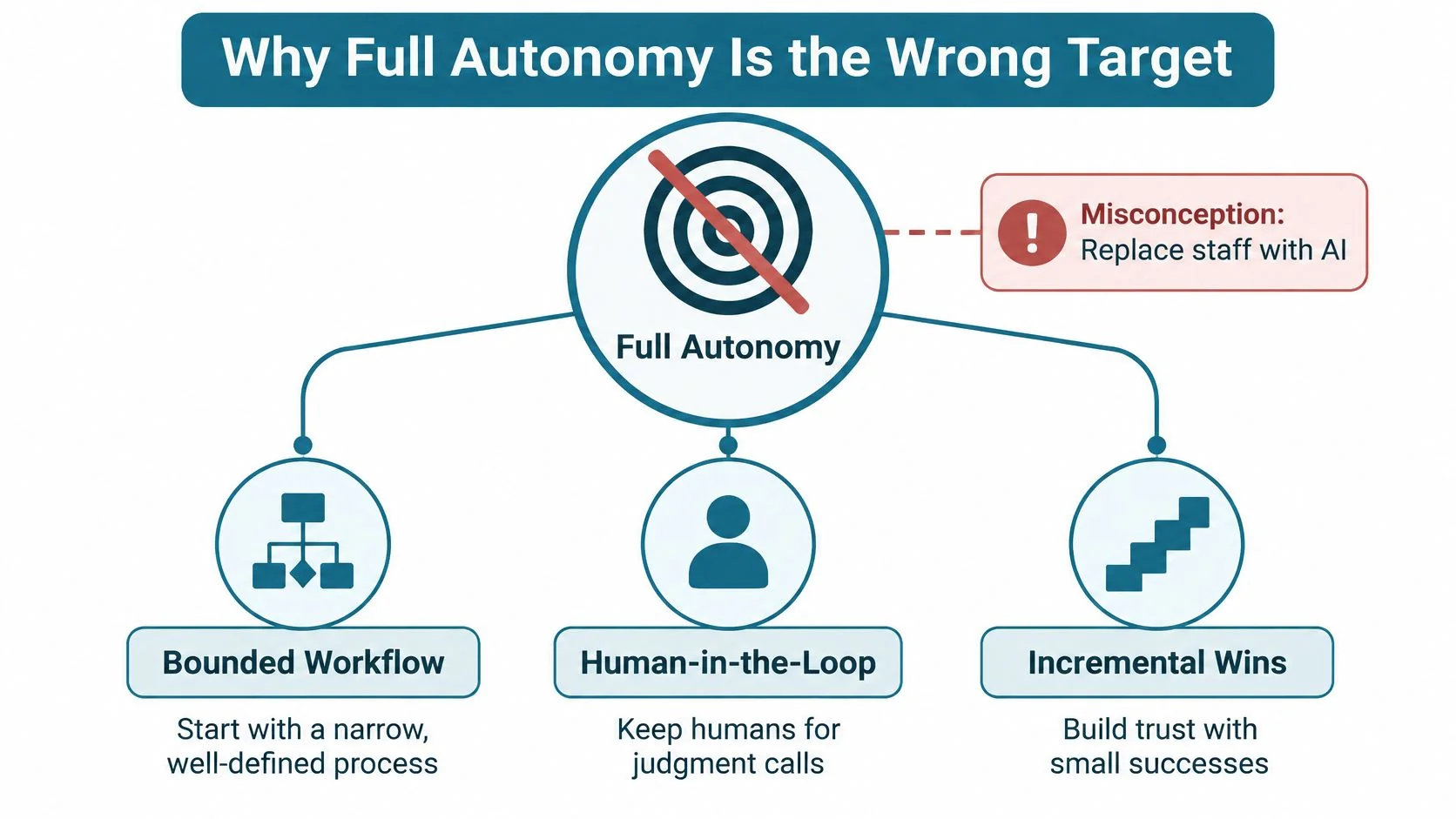
A claims leader under cost pressure hears a simple pitch. Let AI read the file, decide coverage, set the reserve, and pay. An underwriting leader hears the same story with submissions and quotes. The pitch sounds decisive, but it confuses a model's output with an operation that can defend its decisions to a customer, an auditor, and a regulator.
Adoption data tells a more disciplined story. A survey of 193 auto insurers found 88%, or 169 companies, already used, planned to use, or were exploring AI or machine learning, with 70% reporting use in claims and claims assignment as the most automated activity, while automated claims denial was not reported, in the U.S. National Association of Insurance Commissioners survey of auto insurers. Nearly half of those insurers used AI as an informational resource for adjusters. That's not end to end autonomy. It's routing, extraction, prioritization, and evidence organization inside human led work.
The decision principle
Automate first when a task is structured, measurable, and reversible. Document intake, duplicate checks, work assignment, and status updates usually fit. Keep accountable review where ambiguity, financial impact, vulnerability, or regulatory exposure is material. Disputed coverage, severe injury, suspected fraud that affects payment, and a denial don't become safe because a model produced a confident answer.
Automation should expand human capacity rather than obscure responsibility.
Model accuracy isn't operational success. A workflow can extract most fields correctly and still fail because a policy date lands in the wrong system, an exception queue has no owner, or staff don't trust the recommendation. Claims managers, underwriters, actuaries, operations leaders, and technology teams need the same practical test. Does the automation reduce cycle time and rework without increasing leakage, complaints, or unexplained decisions?
That test changes the buying question. Start with which decisions you're willing to delegate, what evidence you'll retain, and where work must stop for a person, before asking which tool can do the most.
Map the Process Before Choosing Technology
Start the map where the customer starts, not where a vendor's feature list starts.
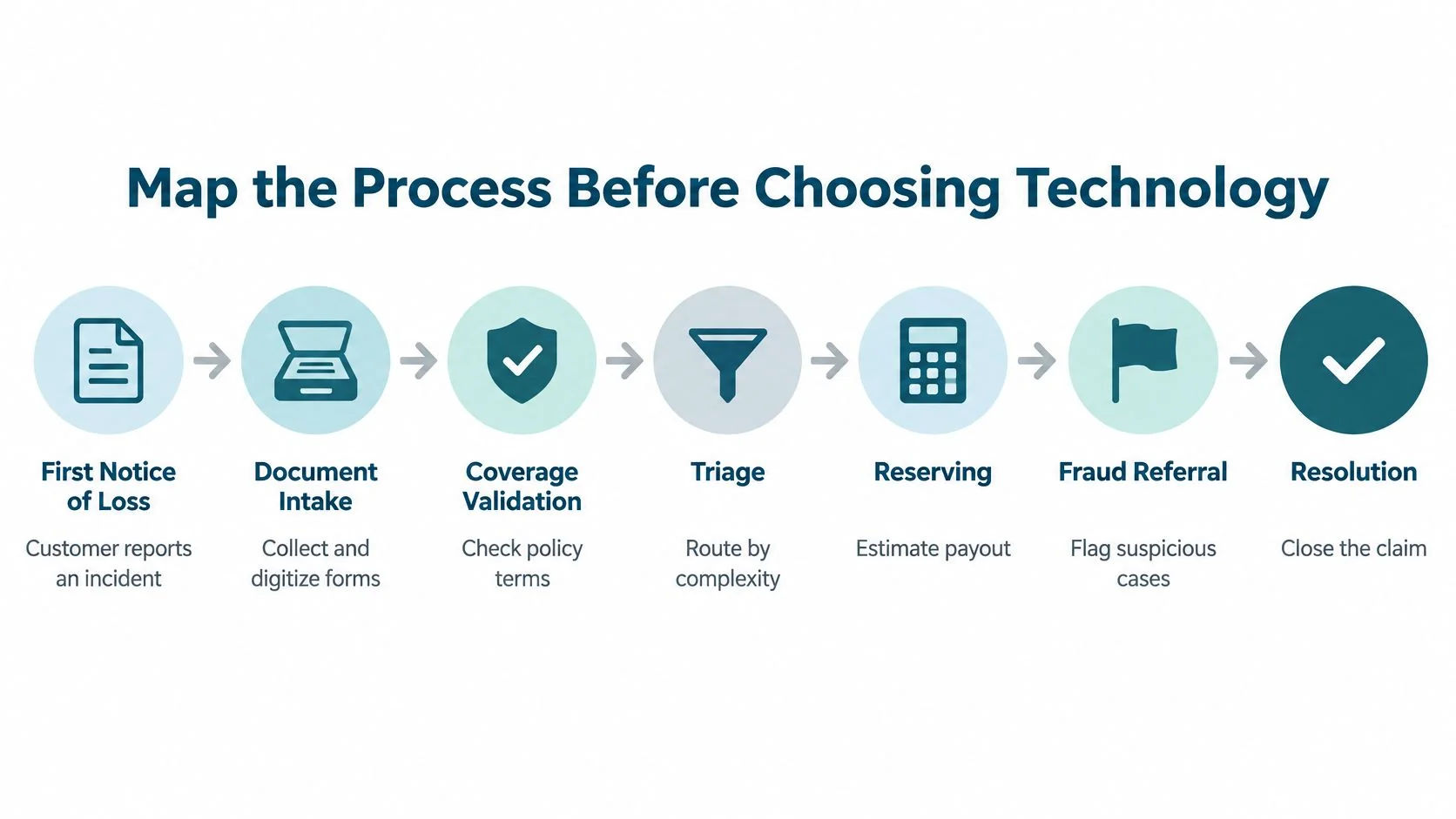
For claims, walk through first notice of loss, document intake, coverage validation, triage, reserving, fraud referral, adjudication, and payment. For underwriting, map submission intake, evidence gathering, guideline checks, referral, pricing input, and quote preparation. For policy administration, follow endorsements, renewals, cancellations, and certificate requests across the policy life cycle in insurance.
Record what actually happens
For each step, write down the owner, input, system, decision, handoff, and downstream effect. Don't accept the procedure manual as truth. Sit with the people handling exceptions and ask where they rekey data, chase missing documents, or override a system suggestion.
- Owners and handoffs: Name one accountable owner per step and every team that receives work from it.
- Inputs and systems: List forms, emails, photos, policy records, billing data, and external sources, plus the systems they must enter.
- Decisions and exceptions: Separate a data movement from a judgment, then note what sends a case off the standard path.
Baseline before you automate
Measure cycle time, cost per item, straight-through-processing rate, exception rate, rework, and customer satisfaction on the current process. Without that baseline, a pilot can only prove that software runs. It can't prove that the business improved.
Then set task level stop rules. A low severity auto claim with clear photos, an active policy, and consistent documents might move straight through triage. The same workflow should pause when coverage dates conflict, injury is reported, the loss value crosses your threshold, or extraction confidence falls. The adjuster is the control for the cases your rules can't safely settle.
<iframe width="100%" style="aspect-ratio: 16 / 9;" src="https://www.youtube.com/embed/6tYYY84nhWc" frameborder="0" allow="autoplay; encrypted-media" allowfullscreen></iframe>Use a simple readiness test at the end of mapping. Can you describe the standard path, the top exceptions, the owner for each, and the metric that would improve? If you can't, you don't have an automation candidate. You have an interesting demo looking for a process.
Prepare Data, Controls, and Integration
Most failed deployments fail because inconsistent documents, broken identifiers, and silent integration errors reach production, not because of the model.
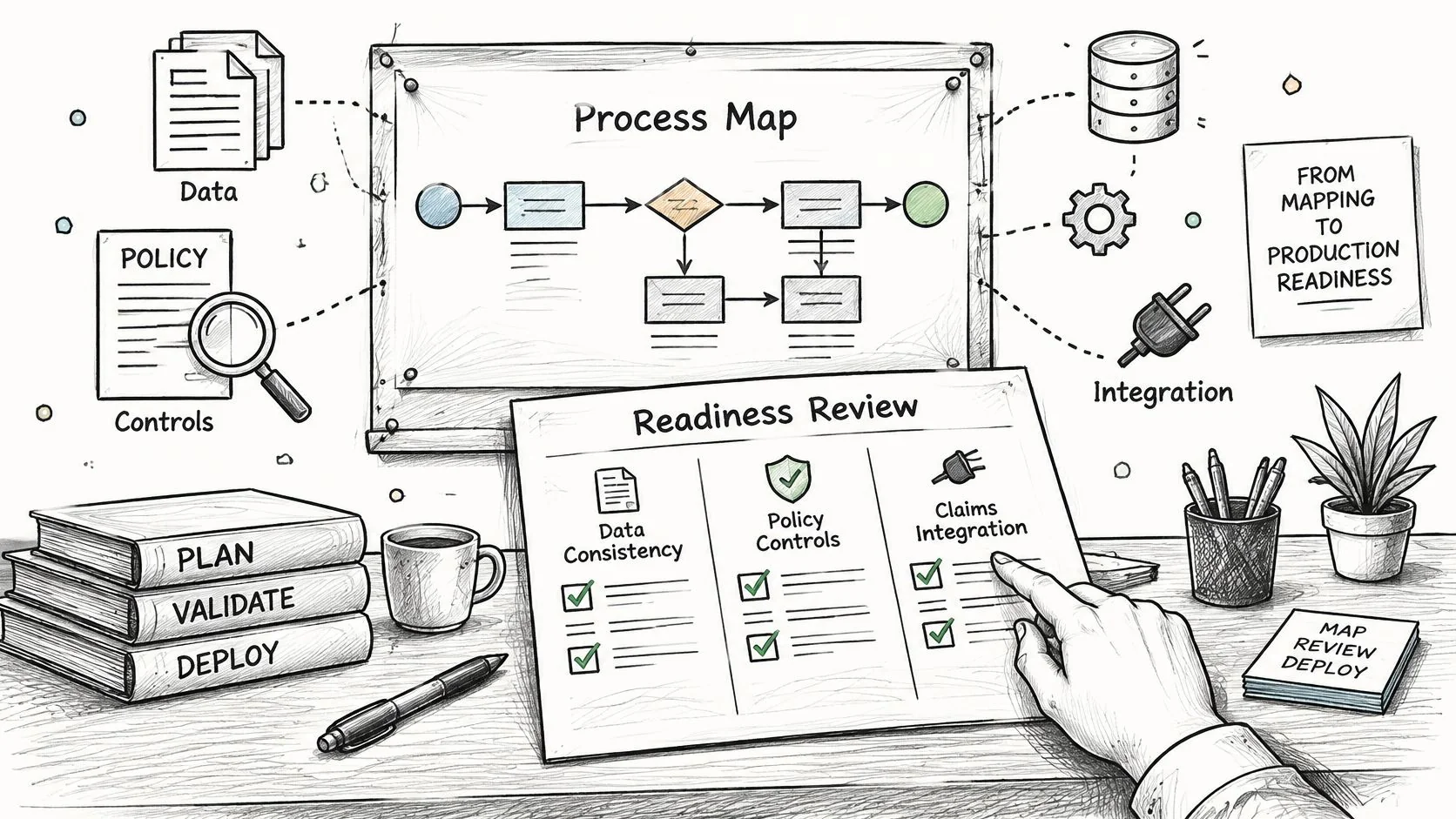
Check whether policy numbers, claim numbers, customer identifiers, and loss dates match across policy, billing, claims, and external data systems. Review historical decisions before you learn from them. If past files contain incomplete reserves, inconsistent fraud referrals, or biased handling, automation will reproduce those patterns faster.
Build controls per document class
Don't govern all documents with one confidence number. A repair estimate, a medical bill, and a death certificate carry different fields and different risks.
- Extraction schema: Define required fields, formats, and acceptable values for each document type.
- Validation rules: Cross check dates, limits, identifiers, and totals against source systems before work proceeds.
- Confidence threshold: Set the point below which a field goes to a person, and test that threshold on representative files.
- Sampling and fallback: Review a planned sample after release and give every rejected item a staffed fallback queue.
- Audit record: Retain the source document, model version, confidence scores, human overrides, and final decision.
Compare three ways to handle a weak input. A human can interpret a messy handwritten note but can't scale that effort across every file. RPA can move a verified value reliably but shouldn't guess what the note says. Document AI can propose an extraction, yet a person should confirm it when confidence is low or the field controls coverage.
That distinction matters because field level quality isn't end to end accuracy. A system might extract the claim number perfectly while misreading the loss date. The claim then fails coverage validation or, worse, proceeds under the wrong policy period. One small field can invalidate an otherwise clean workflow.
Practical rule: Block release when you can't trace a decision back to its source evidence and the person or rule that approved it.
Treat missing access permissions, unowned exception queues, unexplained historical labels, and untested system failures as release blockers. They're not cleanup tasks for after launch. They're the production process.
Choose AI, RPA, or Human Review
Pick the simplest mechanism that can do the task reliably. That discipline matters across insurance technology services, because one workflow often needs several mechanisms rather than one platform forced into every step.
RPA fits stable, deterministic actions. Copy a verified policy number between systems, create a diary entry, or generate a standard letter. When screens, rules, or inputs change often, those scripts need maintenance and monitoring.
Document AI fits unstructured intake. It can classify emails, read forms, extract fields from estimates, and organize photos or supporting evidence. It shouldn't turn a probable extraction into an unreviewed coverage conclusion.
Predictive AI fits prioritization. Use it to rank likely complexity, flag possible fraud for referral, or suggest reserve inputs. A referral is decision support. It isn't proof, and it shouldn't become an automatic accusation or denial.
Human review belongs where facts conflict, policy language is ambiguous, the customer is vulnerable, or the decision is hard to reverse. A disputed water loss, a severe injury claim, and a commercial submission outside appetite all need a named person who can explain the outcome.
Task-to-Technology Selection Matrix
| Task characteristic | Preferred approach | Automation boundary | Required control |
|---|---|---|---|
| Stable rules, structured data | RPA or workflow rules | Act only on verified values | Change testing and transaction logs |
| Variable documents, clear fields | Document AI | Extract and classify, don't adjudicate | Confidence thresholds and sampled review |
| Patterns across many cases | Predictive AI | Rank, refer, or recommend | Drift, fairness, and override monitoring |
| Ambiguous or consequential judgment | Human review | Person decides and explains | Documented rationale and escalation SLA |
| Multiple systems, long running case | Orchestrated workflow with humans | Pause at defined gates | State tracking, retries, and audit trail |
Resist automating just because a model is available. Unsupported thresholds create false confidence. Silent integration failures drop work without a visible error. Biased or incomplete history turns yesterday's shortcut into tomorrow's standard. Ask whether your team can detect, correct, and explain a wrong answer before the customer pays for it.
Prioritize High-Value Insurance Workflows
There's no universal priority list that fits every carrier. Rank candidate workflows against your own volumes, systems, risk appetite, and staffing.
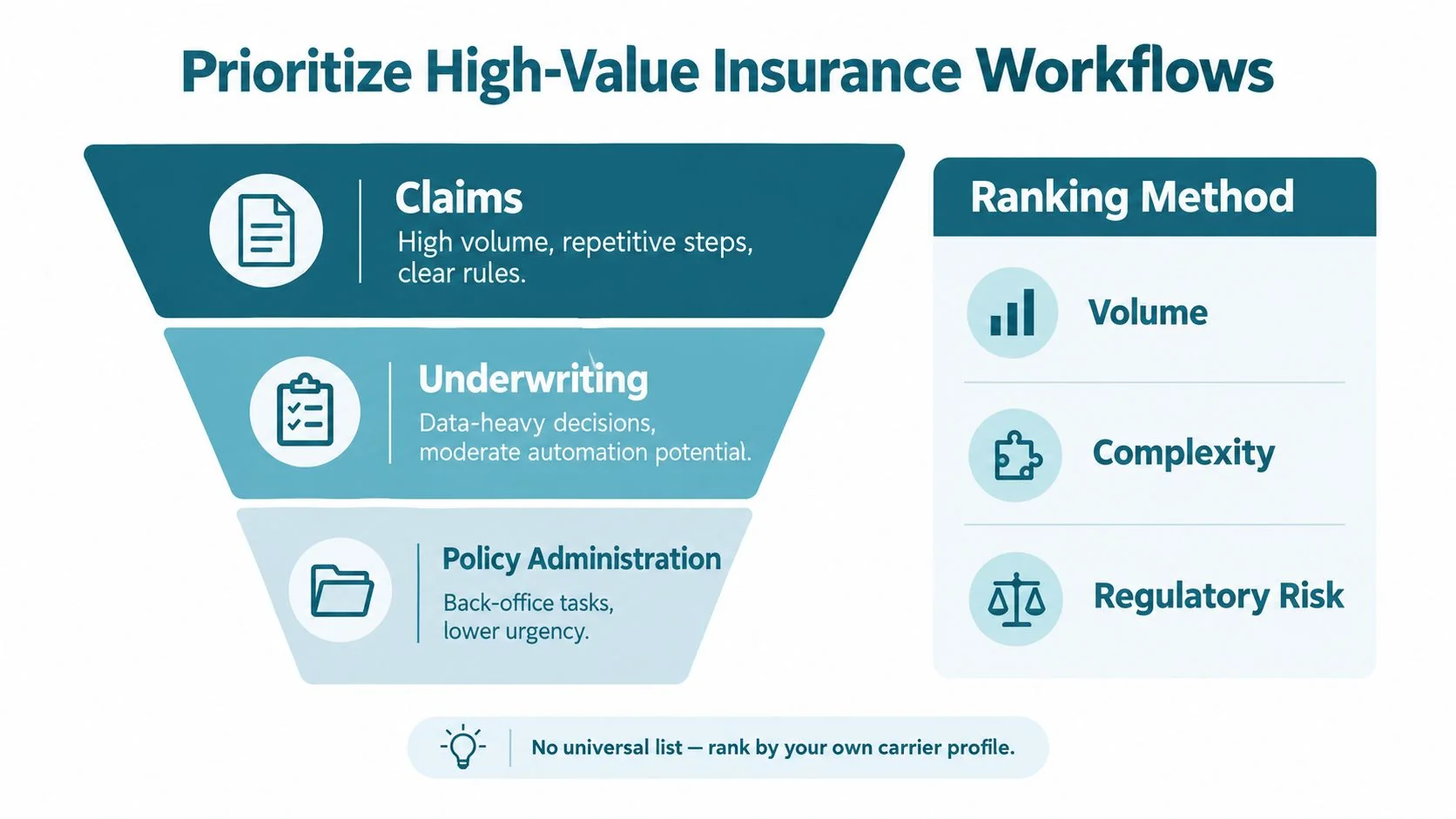
Score each candidate on volume, standardization, structured data availability, feedback speed, operating cost, customer sensitivity, reversibility, and regulatory exposure. High volume alone doesn't make a workflow first. A frequent task with unclear rules and severe customer impact may belong in decision support, while a smaller standardized task can be a safer first release.
Line of business changes the answer. Adoption or intent reached 88% among personal auto insurers, 70% among homeowners insurers, 58% among life insurers, and 84% among health insurers, while claims use reached 80% for auto, 60% for homeowners, and 54% for health, in the NAIC cross-line AI and machine learning survey summary. Those figures combine current use, planned use, and exploration, so they don't prove completed production deployment. They do show why automation tends to scale first where transactions are frequent and evidence is more standardized.
Research comparable implementations
Use published implementations as research inputs, not as promises. AI for Insurance provides a searchable database of insurance AI case studies and vendor listings that can be filtered by use case, line of business, and technology. When you review an entry, separate disclosed duration, throughput, error, and ROI related metadata from broad marketing language, then verify scope and results directly.
For each shortlisted workflow, document five items before you fund a pilot.
- Business case: State the delay, cost, error, or customer problem you're solving.
- Owner: Name who owns outcomes after launch, not just delivery.
- Baseline: Record current cycle time, exception rate, rework, and cost per item.
- Boundary: Define which cases can proceed automatically and which must stop.
- Stop condition: Set the result that triggers a pause, redesign, or rollback.
Choose pilots that test different operating constraints. One might test document variability, another system integration, another human adoption. Three copies of the easiest use case won't tell you whether your operating model can scale.
Evaluate Vendors and Prove the Pilot
Make vendors prove performance on your messy work, not their cleanest sample.
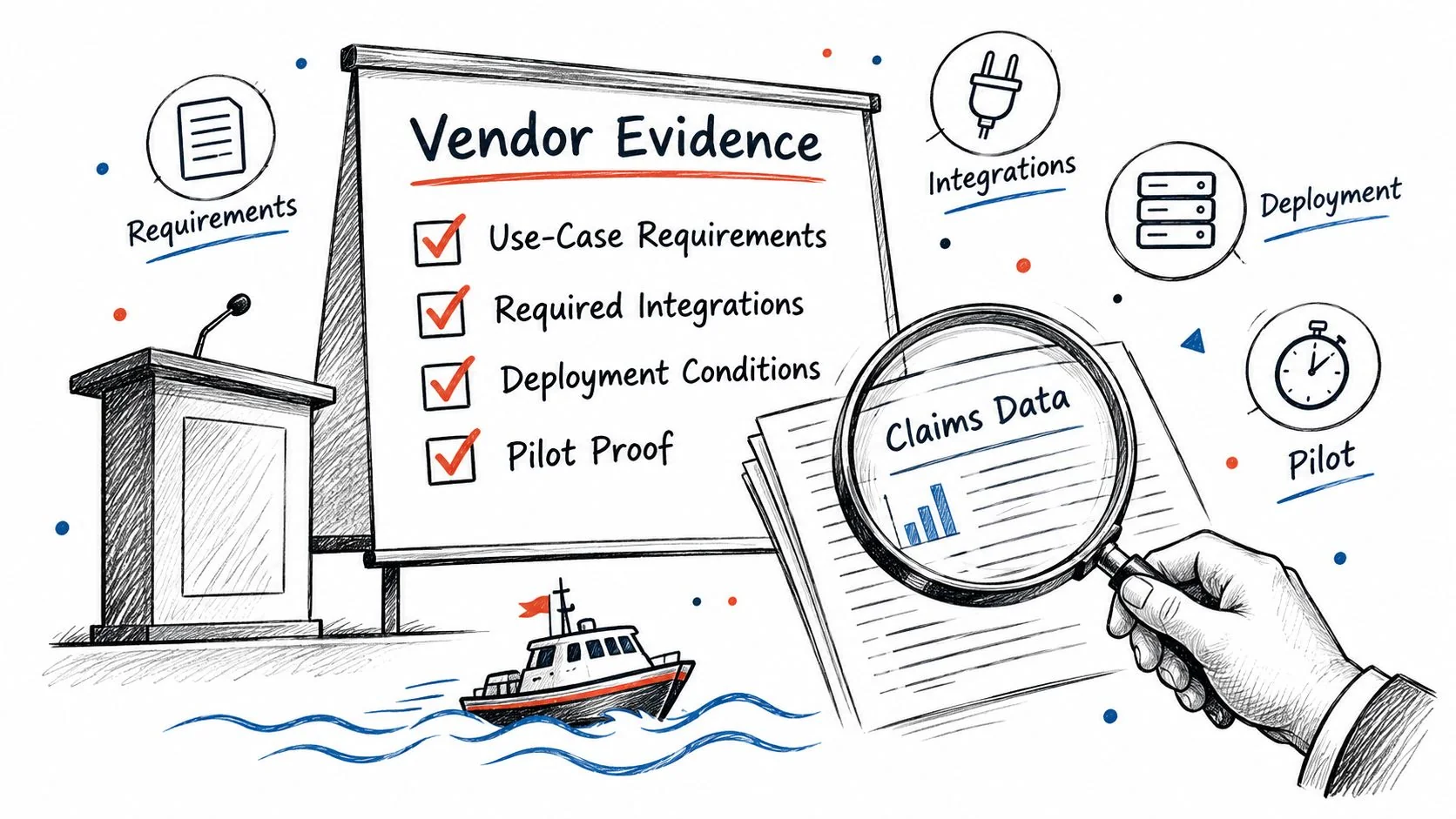
Start with use case specific requirements. Name the document types, systems, security conditions, exception routes, reporting needs, and decisions the product must never make alone. Ask for comparable implementation evidence and inspect what was deployed, especially when you're comparing options for claims processing software. A document extraction result isn't evidence of successful adjudication, and a pilot in another line may not transfer to yours.
Reported results need context. Industry reporting cites approximately 98% classification and extraction accuracy, more than 90% reduction in manual document processing time, and STP rates above 70% in reported deployments, in the State of AI Adoption in Insurance 2025 report. Don't generalize those numbers. Ask whether accuracy means exact field extraction or human accepted output, then check document mix, claim complexity, and fraud prevalence.
Design a pilot that can fail honestly
Keep the scope narrow but representative. Include standard files, poor quality scans, conflicting documents, missing fields, and cases that should escalate. Run the human fallback during the pilot, because you'll need it in production.
Define acceptance criteria before the first file is processed.
- Flow measures: Cycle time, straight-through processing, exception rate, queue age, and integration reliability.
- Quality measures: Field level precision and recall, end to end accuracy, rework, overrides, and customer satisfaction.
- Control measures: Audit completeness, escalation response, adverse impact testing, and rollback readiness.
Require model cards, escalation SLAs, rollback procedures, and periodic independent validation in the evaluation. Ask who can change a threshold, how you'll know it changed, and what evidence remains if a customer disputes the result. If a vendor can't answer those questions clearly, you don't have a production partner yet.
Watch for cherry picked samples, shadow deployment outside normal controls, and success reports that ignore staff adoption. Adjusters and underwriters who don't trust the queue will build workarounds. Your measured pilot result will then describe a workflow nobody uses.
Scale With KPIs and Human Control
A successful pilot proves a bounded workflow under known conditions. Production asks a harder question. Can you keep that workflow accurate, explainable, and useful when volumes spike, documents change, staff rotate, and systems fail?
That gap explains why 31% of insurance organizations surveyed were still experimenting through pilots or proofs of concept without deployment, with data privacy, unclean data, and integration named as scaling barriers, in the Genpact Harness the Winds of Change insurance research. The same source reports 58% of executives in a related Responsible AI survey said responsible AI practices improve ROI and efficiency, yet half said turning principles into scalable operating models was their biggest hurdle. Governance therefore belongs inside the build and the daily operation, not after launch.
The administrative burden is large, and reducing it has to happen process by process. Underwriters can spend up to 40% of their time on non-core administrative work, representing an estimated $160 billion efficiency loss over five years, in the Accenture report on AI in insurance claims and underwriting. Removing that work should give underwriters more time for risk judgment. It shouldn't transfer judgment to an unowned model.
Assign ownership before expansion
Create a cross functional operating model with named accountability.
- Process owner: Owns cycle time, customer outcomes, exception design, and the decision to pause or expand.
- Automation owner: Owns workflow and model changes, thresholds, releases, and incident response.
- Data steward: Owns source quality, identifiers, retention, access, and drift investigation.
- Risk and compliance: Own fairness, explainability, adverse impact, and regulatory evidence reviews.
- Human reviewers: Own escalated decisions, overrides, and feedback on where recommendations mislead staff.
Workforce readiness belongs in that model. Only 30% of carrier respondents and 41% of agency or third-party respondents had progressed beyond speculative generative AI exploration, while only about 60% of the workforce had the skills to implement generative AI and 29% were still developing a workforce strategy, according to the Wolters Kluwer 2025 insurance technology trends analysis. Training therefore can't be a launch announcement. Reviewers need authority to disagree with a recommendation, clear deviation rules, and time to handle the harder cases automation sends them.
Monitor outcomes, not activity
Track workflow measures and business outcomes together. Cycle time and STP rate show speed. Exception rate, rework, overrides, and queue age show friction. Leakage, complaints, audit findings, customer satisfaction, and loss ratio where relevant show whether speed created value or merely moved cost downstream.
A deployment isn't successful because more cases touched automation. It's successful when customers get faster, fairer outcomes and your team can prove why.
Use champion versus challenger testing before replacing a working rule or model. Monitor drift by geography and line of business, because document quality, regulation, repair costs, and customer behavior don't change uniformly. Review fairness and explainability before automated underwriting expands, and don't permit automated denial until you can produce a clear, evidence based explanation for every affected customer.
Escalation rules should be visible in daily work. Low confidence extraction goes to a reviewer. Suspected fraud goes to investigation as a referral, not a verdict. High value losses, injury, conflicting coverage facts, and vulnerable customer circumstances move to an accountable person with a response SLA. Every escalation should carry the source evidence, confidence score, model version, override, and final rationale in one audit record.
Expand in phases with explicit gates
A practical sequence is controlled FNOL, then document AI, then reserve support, then fraud analytics, then policyholder self service. Each phase earns the next by meeting its baseline comparison. If exception rates rise or audit findings cluster around one document type, narrow the workflow. If integration failures lose work or reviewers can't explain outcomes, pause and redesign. Rollback is a control, not an admission of defeat.
Use this production gate before broadening scope:
- Broaden: KPIs improve, exceptions stay staffed, overrides are understood, and audit samples pass.
- Narrow: One segment, geography, or document class drives errors while the rest performs safely.
- Pause: Customers are harmed, evidence is incomplete, drift is unexplained, or a system failure can't be detected quickly.
- Redesign: Staff work around the workflow, rework erases the gain, or the process itself no longer matches the map.
Your next planning cycle should produce decisions, not a longer use case list. Select one process with a named owner. Document the baseline, exceptions, data gaps, and human stop points. Research comparable case studies by claims processing, underwriting, fraud detection, vendor, and disclosed metrics, then verify each claim before you use it in a business case. Run one bounded pilot with acceptance criteria and a rollback plan, and judge the vendor only after real staff have handled real exceptions.
Start this week by mapping one high volume workflow, recording its baseline, and marking the decisions you won't delegate. Then build the pilot around those boundaries and require evidence before you scale.
