Insurance Line of Business Guide for AI Implementation
Learn how insurance line of business segmentation shapes AI strategy, with real case studies and metrics from P&C, Life, Auto, and Health implementations.
Written by AI for Insurance
The global insurance market generated an estimated EUR 7.0 trillion in premium income in 2024, after rising from about EUR 5.6 trillion in 2022 to EUR 6.2 trillion in 2023. That expansion makes one point unavoidable: insurance isn't a single technology market. Life, property and casualty, health, auto, workers' compensation, and commercial liability each convert risk into revenue through different underwriting, claims, pricing, and reserving mechanics. (Allianz Global Insurance Report)
For AI decision-makers, insurance line of business is therefore the first investment filter. The right model, data set, workflow, and success metric depend less on the label “AI” than on the economic behavior of the portfolio where the system will operate.
Table of Contents
- Why Insurance Lines of Business Matter
- The Major Lines and How They Differ Economically
- How Lines Shape Underwriting, Pricing, and Reserving
- Why AI Use Cases Must Be Designed by Line
- Where AI Is Actually Working in Each Line Today
- Finding Comparable Implementations by Line of Business
- Building a Line-First AI Evaluation Framework
- Key Takeaways for Insurance AI Decision-Makers
Why Insurance Lines of Business Matter
Insurance lines of business are economic categories, not merely labels in a policy administration system. Each line groups risks with broadly related exposure patterns, claim behavior, policy duration, pricing constraints, and capital requirements. Those differences determine whether an AI initiative should focus on rapid triage, deeper risk selection, long-duration forecasting, or operational control.
The scale of each pool explains why line-level decisions matter. Life insurance was the largest global line, with premium income of EUR 2.902 trillion in 2024, while property and casualty generated EUR 2.424 trillion in the same year, according to the Allianz global insurance market data. These aren't niche operating categories. They are major revenue pools that shape underwriting capacity, claims expenditure, reserve adequacy, and investment allocation.
The economic filter comes first
An AI system that accelerates document classification may be valuable in a high-volume personal auto book because staff process many routine claims. The same system may have a smaller direct effect in a commercial liability portfolio where a limited number of claims require extensive legal, medical, and factual development. The technology can be similar, but the economic lever changes.
A line-level assessment should answer four questions before a team selects a model:
- Where does cost accumulate? Claims handling, acquisition, fraud, reserving, or service may dominate different lines.
- How quickly does risk develop? Shorter cycles support rapid feedback, while long-tail claims require assumptions about future development.
- What evidence supports a decision? Photos, telematics, medical records, financial statements, and mortality data produce very different feature sets.
- What outcome matters most? Combined ratio, persistency, reserve adequacy, pricing adequacy, and medical loss performance aren't interchangeable measures.
| Line of business | Approximate global premium volume | Typical loss ratio range | Claim frequency |
|---|---|---|---|
| Life | EUR 2.902 trillion in 2024 | Varies by product and portfolio | Generally lower frequency, long-duration exposure |
| Property and casualty | EUR 2.424 trillion in 2024 | Varies materially by line and period | Ranges from frequent personal claims to infrequent commercial losses |
| Health | Included within broader global insurance pools | Depends on utilization and coverage design | Often high-volume and service-intensive |
| Auto | A major component of P&C | Highly sensitive to severity, frequency, and pricing | Typically frequent relative to many commercial lines |
The table's most important message is not a universal ratio. It's that industry averages conceal the economics that determine AI return. A useful implementation begins by identifying the bottleneck within the relevant line, then connecting that bottleneck to a measurable portfolio outcome.
The Major Lines and How They Differ Economically
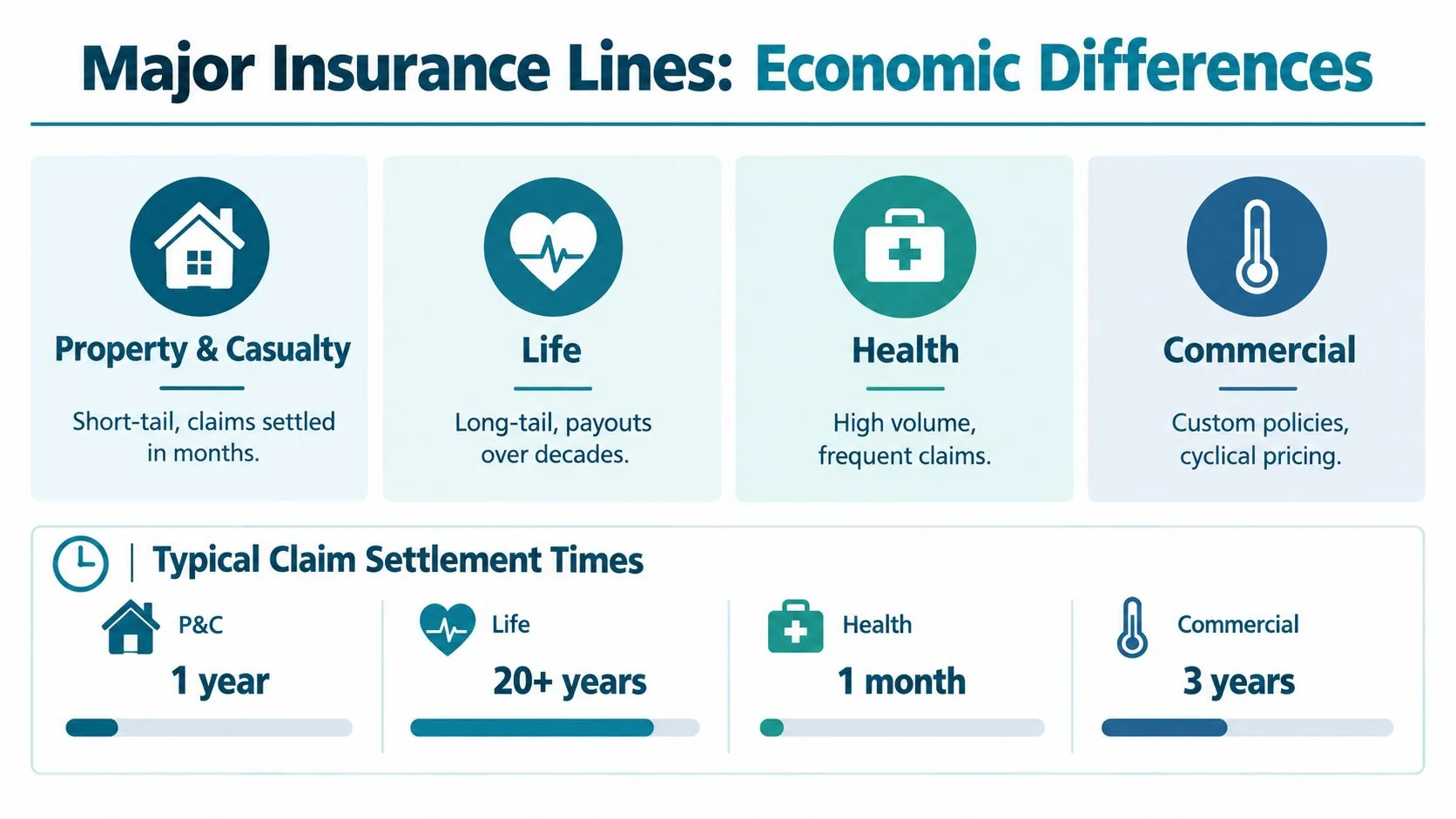
The four major categories often discussed in insurance technology, property and casualty, life, health, and auto, don't share a common operating model. Even when they use similar machine learning techniques, their data, decision horizons, and control requirements differ.
Property and casualty
P&C combines personal and commercial risks with different exposure bases. The global P&C premium pool reached EUR 2.424 trillion in 2024, while worldwide non-life premiums were about $4.30 trillion in 2023, according to global insurance figures from Allianz and the U.S. Treasury Federal Insurance Office annual report. P&C therefore isn't one homogeneous line. Personal auto, homeowners, commercial property, workers' compensation, and liability all behave differently.
Shorter-tail property claims can support image analysis, automated intake, and structured settlement workflows. Long-tail casualty claims require more cautious development because the final cost may depend on litigation, medical progression, reopened claims, or changing legal conditions.
Auto
Auto often produces a large flow of claims, with recurring repair, injury, theft, and liability decisions. The U.S. market reached a record $1.06 trillion in P&C direct premiums written in 2024, and the sector recorded its third consecutive year of annual growth of 10% or more, as reported by the Federal Insurance Office.
That scale makes first notice of loss, repair estimation, fraud screening, and renewal pricing attractive AI targets. Yet pricing remains closely tied to jurisdictional rules, filing processes, fairness requirements, and the quality of driving or vehicle data.
Health
Health insurance is shaped by utilization, provider relationships, medical coding, authorization, and regulatory oversight. Its workflows can involve frequent interactions and substantial documentation, but a high-volume process isn't automatically a simple process. Medical necessity, incomplete records, conflicting evidence, and member impact create a higher governance burden for automation.
The best systems usually support reviewers rather than replace them. They classify, prioritize, retrieve evidence, and identify inconsistencies while preserving an auditable path to a human decision.
Life
Life insurance has the longest decision horizon among the major categories. The product depends on mortality assumptions, lapse behavior, policy duration, reinsurance, and the relationship between future liabilities and invested assets. Premium income for life insurance stood at EUR 2.902 trillion in 2024, making it the largest line in the global premium pool. (Allianz market analysis)
Life AI should therefore emphasize evidence quality, underwriting consistency, persistency analysis, and scenario-based forecasting. A model optimized for immediate claims throughput won't address the central risks of a decades-long contract.
For a broader framing of the factors that differentiate these decisions, see what insurance risk means in practice.
How Lines Shape Underwriting, Pricing, and Reserving
Underwriting begins with a question that changes by line: what evidence best predicts the risk being accepted? Auto teams may evaluate driving behavior, vehicle characteristics, prior losses, and usage patterns. Commercial property teams may focus on location, construction, occupancy, protection systems, and hazard exposure. Life teams assess mortality-related evidence, while health teams work with utilization and medical information under more restrictive privacy and governance conditions.
Those inputs aren't interchangeable because they describe different causal pathways. A feature that helps explain vehicle collision risk won't necessarily explain mortality, and a medical utilization indicator can't be transplanted into commercial property pricing.

Pricing requires local context
Pricing models must reflect both risk and the rules governing how an insurer may use risk information. Personal lines often face formal filing and approval requirements, while commercial pricing can involve negotiation, bespoke coverage, and more direct underwriting judgment. Health products operate under their own rating and coverage constraints, and life products rely on assumptions that may remain relevant over extended policy periods.
That means a production model needs more than predictive accuracy. It needs explainability appropriate to the decision, reproducibility, controlled overrides, version management, and documentation that actuarial and compliance teams can review.
Reserving follows claim development
Reserving is particularly line-specific. Actuarial teams use separate approaches because data credibility, claim maturity, payout timing, and homogeneity differ materially by line. Regulatory guidance requires each actuarial line of business to connect uniquely to a financial-return class, with the aggregation basis specified as accident year or underwriting year. (Actuarial reserve guidance)
Workers' compensation, commercial auto liability, and medical professional liability may require distinct development triangles and assumptions. Their claim reopening, allocated loss adjustment expense, and payment patterns differ enough that a shared reserve model can blur rather than improve the estimate.
Practical rule: An AI reserve system should produce outputs that fit the actuary's existing line-level development and review process. A prediction that can't be reconciled to those structures creates governance work instead of reducing it.
The implementation sequence is straightforward:
- Define the actuarial line and aggregation basis.
- Map the model output to an existing reserving decision.
- Test development behavior across mature and immature periods.
- Document exceptions, overrides, and deterioration triggers.
Why AI Use Cases Must Be Designed by Line
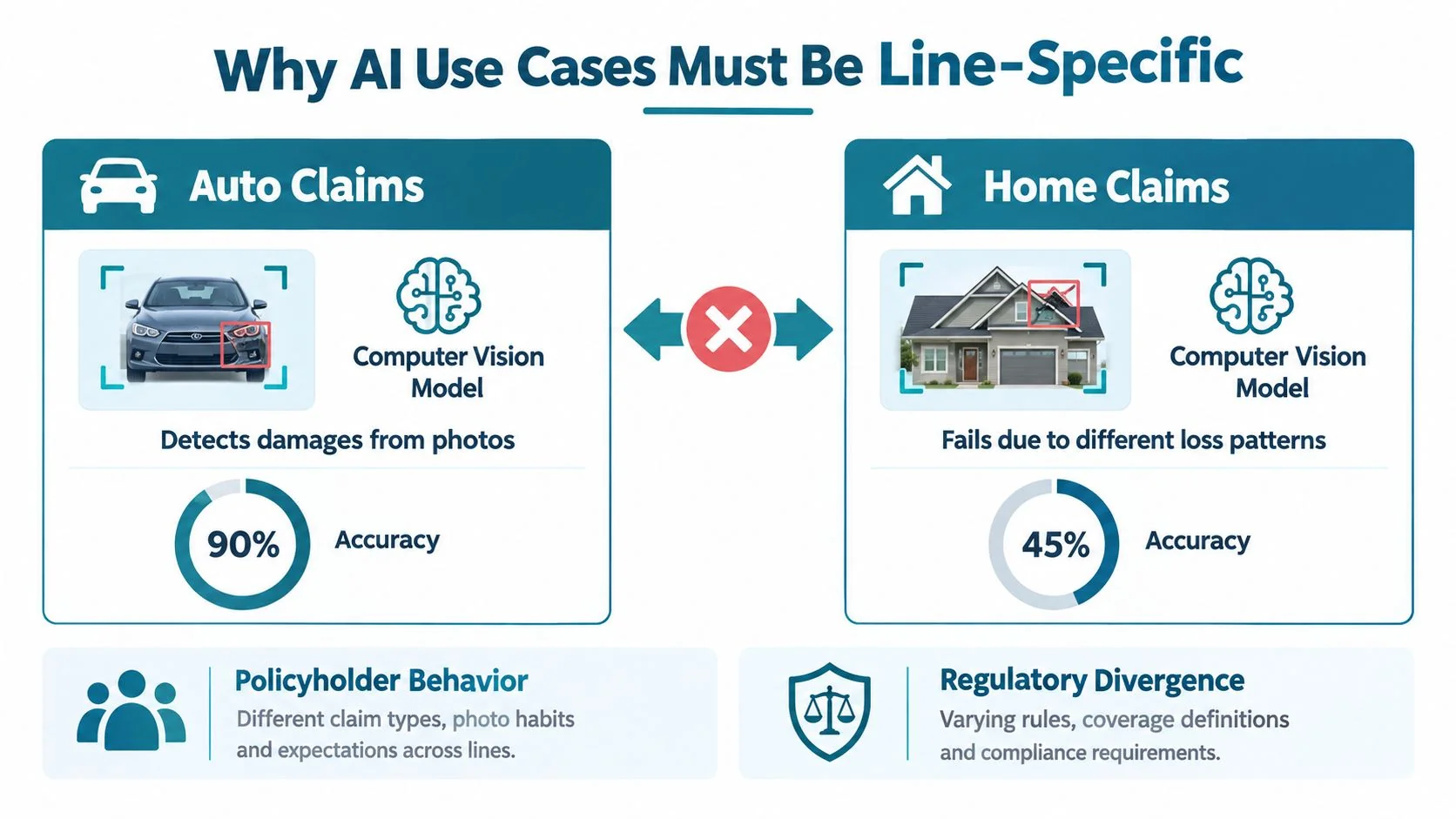
AI use cases fail across lines when teams transfer a workflow without transferring its economic assumptions. A document model trained on one class of claims may recognize language well but still misjudge relevance, severity, or required action in another. The problem isn't necessarily the model architecture. It's the mismatch between training labels, loss distributions, policy terms, and operating decisions.
A line-specific design begins with the loss process. Auto and homeowners may generate frequent claims where triage and routing are central. Commercial casualty can involve fewer but more severe claims, where early signals may be incomplete and the value of a system lies in prioritization, legal-document analysis, and reserve support rather than instant settlement.
Labels determine usefulness
A claims triage model needs labels that reflect the action the claims team must take. “Complex” can mean litigation risk in liability, repair complexity in auto, coverage uncertainty in homeowners, or medical review requirements in health. If teams reuse a generic label, the system may rank cases consistently but not usefully.
The same principle applies to underwriting. A model should be trained against the portfolio outcome that matters for its line, such as loss development, retention, mortality experience, or claim cost. Generic accuracy scores don't establish that the model improves the relevant economic result.
Governance also diverges
Regulatory scrutiny changes with the decision. Health and life systems may raise sensitive questions about medical evidence, access, and discrimination. P&C systems may face concerns about pricing transparency, claims fairness, catastrophe exposure, and the treatment of vulnerable policyholders. Human review, reason codes, appeal paths, and monitoring must reflect those differences.
The NAIC analysis of U.S. P&C results illustrates why the financial context matters. The industry recorded an $18.4 billion underwriting loss in 2023, while line performance varied significantly. A model that improves one line's selection or claims process may have little value, or even create risk, if it shifts exposure toward another line with weaker economics.
<iframe width="100%" style="aspect-ratio: 16 / 9;" src="https://www.youtube.com/embed/jaWxknkzLGo" frameborder="0" allow="autoplay; encrypted-media" allowfullscreen></iframe>A production review should ask:
- Does the training data represent the target line and jurisdiction?
- Are labels tied to an operational decision?
- Can actuaries explain the output within existing methods?
- Can claims leaders audit recommendations and overrides?
- Does monitoring detect drift in frequency, severity, policy mix, or legal conditions?
Where AI Is Actually Working in Each Line Today
The strongest AI opportunities sit where three conditions overlap: repeated decisions, abundant evidence, and a clear operational bottleneck. That pattern explains why claims intake, document processing, fraud screening, submission prioritization, and service workflows receive attention across insurance. It also explains why deployment remains uneven by line.
Recent evidence points to a shift toward core insurance work rather than generic internal productivity. Insurer AI deployments rose 87% year over year in Q4 2025, agentic AI represented 32% of deployments, and more than half of agentic use cases focused on claims management. (Insurance AI deployment trends) The deployment mix matters because insurers are assigning automation to decisions close to premium, loss, and service economics.
P&C and auto
In P&C, AI can classify submissions, extract exposure data, assess images, route claims, flag inconsistencies, and support adjuster workflows. Auto is especially suited to high-throughput triage because a claims team can act on structured signals early, while commercial property may require richer submission analysis before an underwriter decides whether to quote.
Claim volume trends sharpen the opportunity. Personal auto claims fell from 34.4 million in 2022 to 31.6 million in 2025, while homeowners claims fell 19% year over year to 5.27 million and commercial property claims declined to 0.71 million. (Insurance AI deployment trends) Lower volume doesn't eliminate the need for automation. It can make triage more important because the remaining claims may be more complex, severe, or documentation-heavy.
Life and health
Life teams can apply predictive models to underwriting evidence, lapse risk, mortality analysis, and policy servicing. The value often comes from improving consistency and directing expert attention, not from treating a long-duration decision like a high-frequency transaction.
Health teams can use language processing and workflow automation to organize medical records, support authorization review, detect coding anomalies, and route cases. Human controls remain essential because the decision may affect care access and must be explainable to members, providers, auditors, and regulators. Broader guidance on claims workflows is available in AI claims processing for insurance.
| Line of business | Primary AI use case | Reported outcome range | Data intensity |
|---|---|---|---|
| P&C | Submission intake, claims triage, image and document analysis | Varies by workflow and implementation | High, with structured and unstructured records |
| Auto | First notice of loss, damage assessment, fraud screening | Varies by portfolio and operating model | High-volume, event-level data |
| Life | Underwriting support, lapse analysis, policy servicing | Varies by product and duration | Longitudinal, sensitive, assumption-dependent |
| Health | Authorization support, claims automation, document classification | Varies by clinical and administrative workflow | High-volume, highly governed medical data |
The practical conclusion is counterintuitive. AI value follows the shape of the bottleneck, not the novelty of the model. Agentic systems may be valuable in claims where evidence gathering and coordination dominate, while a simpler predictive score may be more appropriate for renewal or submission prioritization.
Finding Comparable Implementations by Line of Business
A useful implementation comparison starts with the portfolio, not the technology category. If a carrier writes commercial casualty, comparing its proposed system with a high-volume personal auto deployment may produce an attractive but misleading benchmark. The workflows may both be called “claims automation,” yet the claim development, severity, documentation, and regulatory consequences can be entirely different.
The AI for Insurance database provides a way to examine documented implementations by line of business, use case, technology, and disclosed outcomes. Its structured entries can help research teams move from broad market interest to more comparable examples.
Apply filters in the right order
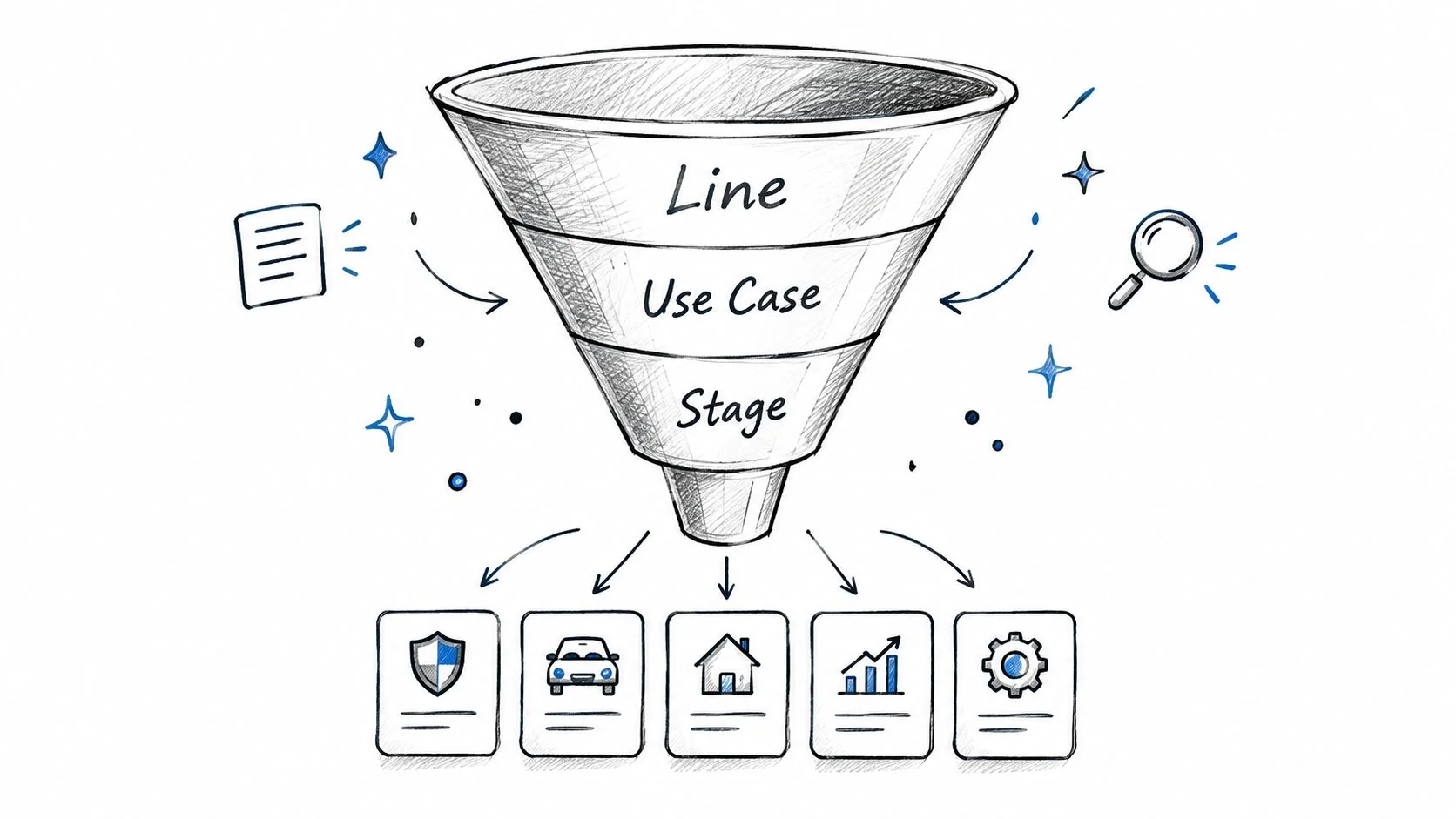
Use a funnel rather than a shopping list:
- Select the line. Match the database category to the portfolio where the initiative will operate.
- Choose the workflow. Separate submission, underwriting, policy service, claims, fraud, and actuarial use cases.
- Review deployment stage. Distinguish an early pilot from a production implementation with operational evidence.
- Inspect data requirements. Compare the source records, documentation, integrations, and labeling burden with your own environment.
- Test the outcome definition. Check whether the reported result relates to the metric your business manages.
Pressure-test similarity
Two implementations are comparable only when their underlying conditions are reasonably similar. Ask whether the policies have similar duration, the claims share similar severity patterns, the distribution channel creates comparable intake data, and the regulatory jurisdiction permits comparable decisions.
A result is only a benchmark when the loss process, data footprint, and decision authority are comparable.
Research teams should also look for missing information. A disclosed cycle-time improvement may not reveal exception rates, review requirements, implementation effort, or downstream effects on reserve and pricing decisions. Treat each entry as evidence for a hypothesis, then validate that hypothesis against internal data and line leadership.
Building a Line-First AI Evaluation Framework
Technology-first selection reverses the order of an insurance investment decision. It begins with a model or vendor, then searches for a workflow that can use it. A line-first approach begins with the portfolio economics and asks which problem deserves capital, data engineering, actuarial review, and operational change.
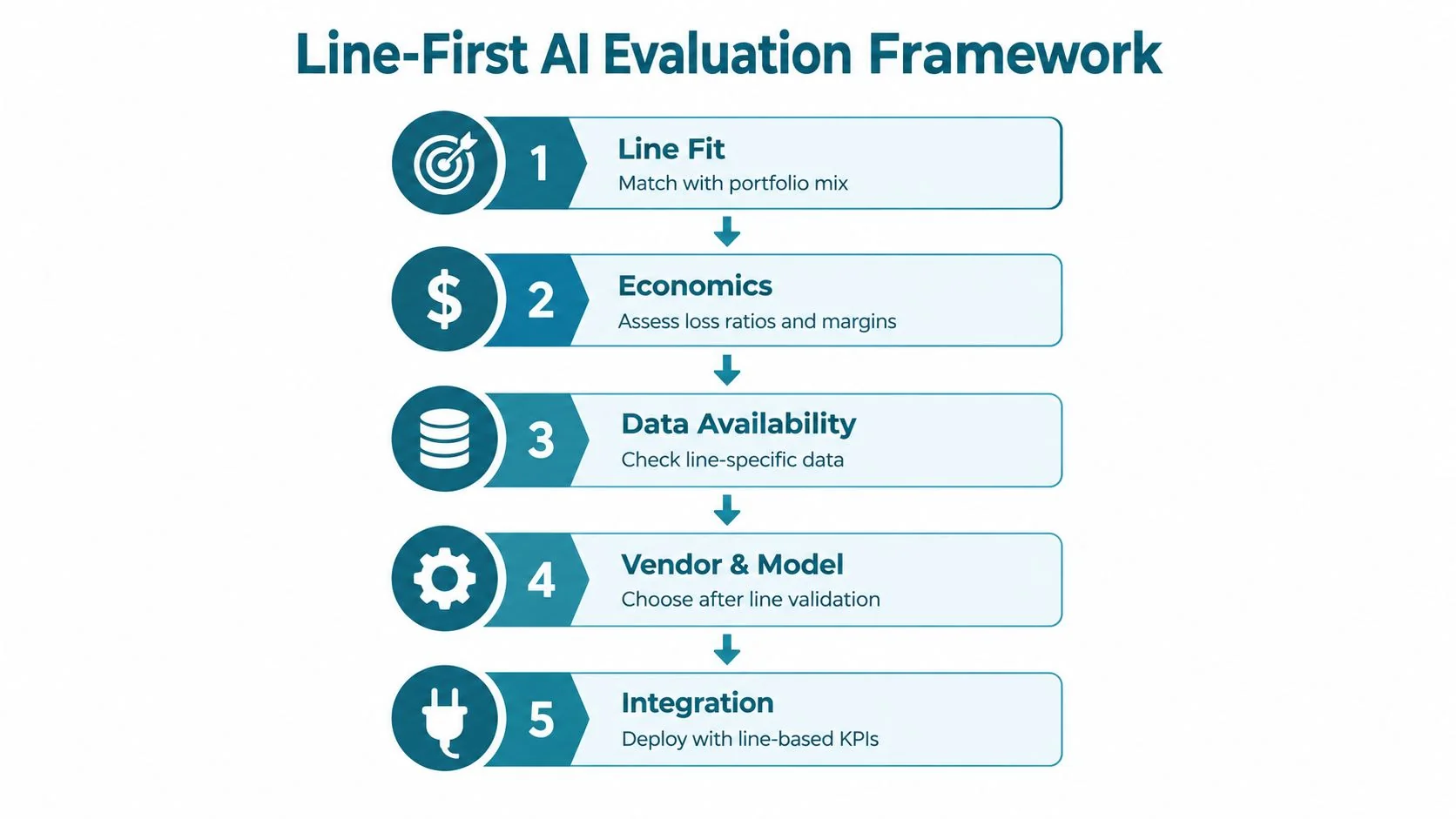
Start with line fit
First, identify the line, product, jurisdiction, and workflow. P&C initiatives may need outputs compatible with claims and reserving processes. Life initiatives may require long-duration scenario analysis. Auto depends heavily on the depth and reliability of event-level data. Health requires strong privacy, access, and clinical governance controls.
If the use case doesn't address a material line-specific bottleneck, stop before evaluating vendors. An impressive demonstration can't compensate for weak economic relevance.
Score the economics
Next, define the lever the system should move:
- P&C: underwriting result, claims expense, severity management, or catastrophe response.
- Auto: claim routing, repair decision quality, fraud detection, renewal pricing, or handling cost.
- Life: underwriting consistency, lapse management, mortality insight, or service productivity.
- Health: authorization efficiency, claims accuracy, provider workflow, or member service.
The team should set a baseline and a measurable target, but it shouldn't assume that a model metric equals a business result. Precision, recall, or extraction accuracy matters only when it changes a decision that affects the line's economics.
Validate data before choosing a model
Check completeness, historical stability, permissions, lineage, label quality, and integration points. The data may be technically available but operationally unusable if records are inconsistent, policy terms aren't machine-readable, or outcomes aren't linked to the original underwriting or claims decision.
A line-specific review also exposes hidden constraints. Privacy, fairness, explainability, human review, and actuarial sign-off can determine whether a system is deployable even when its predictive performance looks promising.
Select vendors and integrate last
Only after line fit, economics, and data readiness are clear should teams compare implementation approaches. The same provider may perform differently across lines because integration depth, training data, workflow design, and change management differ.
Teams evaluating predictive analytics in insurance should connect model outputs to line-based KPIs and establish monitoring before deployment. That includes drift thresholds, override review, escalation paths, audit records, and ownership across product, actuarial, claims, compliance, and technology teams.
Key Takeaways for Insurance AI Decision-Makers
The most important AI decision isn't which model to buy. It's which insurance line of business contains a bottleneck that AI can address without breaking actuarial, regulatory, or operational controls.
Global premium scale shows why the decision matters. Life and P&C alone represent enormous revenue pools, while U.S. P&C underwriting results demonstrate how differently individual lines can perform. A portfolio-level average can hide the exact place where automation creates value, or where it introduces new exposure.
Before approving an initiative, confirm three conditions:
- Line-specific problem: The use case targets a documented issue in underwriting, pricing, servicing, claims, fraud, or reserving.
- Matching data: The available records reflect the target line's policy terms, claim behavior, decision history, and jurisdiction.
- Relevant KPI: The outcome aligns with the line's economic lever, such as underwriting performance, persistency, claims expense, reserve adequacy, or medical operations.
Use comparable implementations as benchmarks, not promises. Filter first by line, then by workflow and deployment stage, and investigate whether the underlying data and decision environment resemble your own.
The next practical step is to assemble a line-first assessment for one priority workflow. Bring together the product owner, claims or underwriting leader, actuary, compliance representative, data team, and technology owner. Document the baseline, validate the data, define the human-control model, and approve a pilot only when the expected result can be measured in the economics of that line.
Choose one insurance line, document its highest-cost or highest-friction workflow, and build your AI business case around that specific constraint. That discipline will give your team a clearer path to a defensible pilot and a measurable production outcome.
