7 Insurance Claims Management System Resources
Compare 7 insurance claims management system resources, AI implementations, outcomes, and buyer tips for smarter claims transformation.
Written by AI for Insurance
The best insurance claims management system isn't the platform with the longest feature list. It's the system that addresses the bottleneck responsible for your slowest handoff, weakest data capture, highest leakage risk, or most difficult audit trail. Before comparing vendors, define the current process, establish a baseline, assess data quality, and map the integrations that claims teams depend on. The gap between expectation and execution makes this urgent. Policyholders expect resolution in 11 days, while the average claims cycle takes 23.9 days, according to industry claims-cycle benchmarking.
The seven resources below are organized by transformation problem, not by feature count. They cover core administration, implementation, document intake, fraud detection, process standardization, integration, and evidence-based benchmarking. The examples and outcomes supplied for named products are kept separate from general buying guidance, so a documented result isn't mistaken for a guaranteed result.
Table of Contents
- 1. Guidewire ClaimCenter
- 2. AI-Powered Claims Automation Implementation Guide
- 3. Ocrolus and AI-Powered Document Processing for Claims
- 4. Shift Technology Claims Fraud Detection Platform
- 5. Claim Processing Automation Template Library
- 6. MuleSoft and iPaaS Integration Platforms for Claims Ecosystem
- 7. AI for Insurance Case Study Database and Benchmarking Resource
- Claims Management, 7-Resource Comparison
- Turn the Shortlist Into a Defensible Decision
1. Guidewire ClaimCenter
Guidewire ClaimCenter is a core platform for property and casualty and specialty insurers that need to manage the full claims lifecycle. It supports processes from first notice of loss, or FNOL, through investigation, reserving, settlement, and closure, while connecting with Guidewire products and external systems. Its role is foundational. An insurer can use it as the operational record for claims, then add specialized services for document processing, fraud analysis, payments, or customer communications.
That architecture matters because claims transformation rarely succeeds when intake, adjudication, and settlement remain disconnected. The broader claims management market was valued at USD 5.79 billion in 2025 and is projected to reach USD 17.09 billion by 2034, implying a 12.80% CAGR, according to market data on AI claims-processing automation. The growth reflects demand for systems that coordinate high-volume operations, not merely digitize individual forms.
Where ClaimCenter fits best
Start with FNOL rather than attempting to redesign every claims process at once. A digital intake pilot can expose missing fields, duplicate data, weak validation rules, and integration gaps before those problems spread into triage and settlement. Establish measures for intake completeness, time to first action, reassignment volume, and exception rates.
Guidewire's plan notes include examples such as a global P&C insurer reducing FNOL processing time by 40%, a regional auto insurer automating 60% of routine claims, and a specialty carrier improving reserve accuracy by 22% through AI recommendations. These are supplied case-study outcomes, not universal benchmarks. Buyers should request the underlying claim type, baseline, deployment scope, and measurement method before using them in a business case.
Implementation test: Ask whether your data governance standards, policy connections, and partner ecosystem are mature enough to support AI-assisted decisions. A sophisticated workflow can't compensate for inconsistent claim histories or unreliable policy data.
Use implementation partners carefully. Their experience can reduce delivery friction, but governance, ownership of business rules, and acceptance criteria should remain with the insurer. The strongest evaluation focuses on the complete claim journey, including exceptions that require human judgment.
2. AI-Powered Claims Automation Implementation Guide
An implementation guide matters when an organization must move from a promising pilot to a controlled production process. The framework should connect process mapping, use-case prioritization, model validation, change management, compliance review, and operational measurement. It should also define which decisions always require human review.
Evidence supports that discipline, but reported outcomes need context. A 2024 insurance automation paper describes workflows that reduced processing time by 90%, from 72 hours to under 5 minutes, with reported cost reductions of 40% to 70% and 99% accuracy for standard forms. It also reports that 73% of insurance customers demand digital claims processing, while manual handling costs European insurers about €3.5 billion annually. These figures describe the paper's workflows and market conditions, not guaranteed results for every insurer. Review the insurance automation paper for its stated context and methodology.
Turn the guide into a control framework
Map the current claims flow against the guide's proposed phases. Record each manual handoff, system dependency, approval threshold, and point where an adjuster overrides a rule. Then choose a contained use case with clear inputs and measurable output, such as document classification, routine FNOL validation, or severity-based routing.
Start with a narrow pilot.
A cross-functional steering group should include claims operations, IT, compliance, finance, data science, and frontline adjusters. Each function identifies different failure modes. Claims leaders understand exceptions, IT assesses integration limits, compliance reviews explainability, and finance tests effects on reserves and payments.
For process-design guidance, consult this guide to insurance claims processing. Use it as a working reference, then translate its recommendations into pilot requirements, acceptance criteria, and review checkpoints.
The supplied implementation guide includes examples of phased deployment, prioritization for high-volume medical billing, and connections to legacy mainframe systems. These examples can shape evaluation questions, but they do not replace an insurer's own baseline. Before launch, define escalation routes, document model-change controls, and assign authority to pause automation when error patterns emerge. An advanced workflow cannot compensate for inconsistent claim histories or unreliable policy data.
3. Ocrolus and AI-Powered Document Processing for Claims
Claims teams often lose time before adjudication even begins. Medical records, repair estimates, police reports, invoices, and other evidence arrive in inconsistent formats, forcing staff to classify files, locate fields, check completeness, and re-key information into the core system. Ocrolus addresses that document layer through intelligent document processing using computer vision, OCR, machine learning, extraction, classification, and validation.
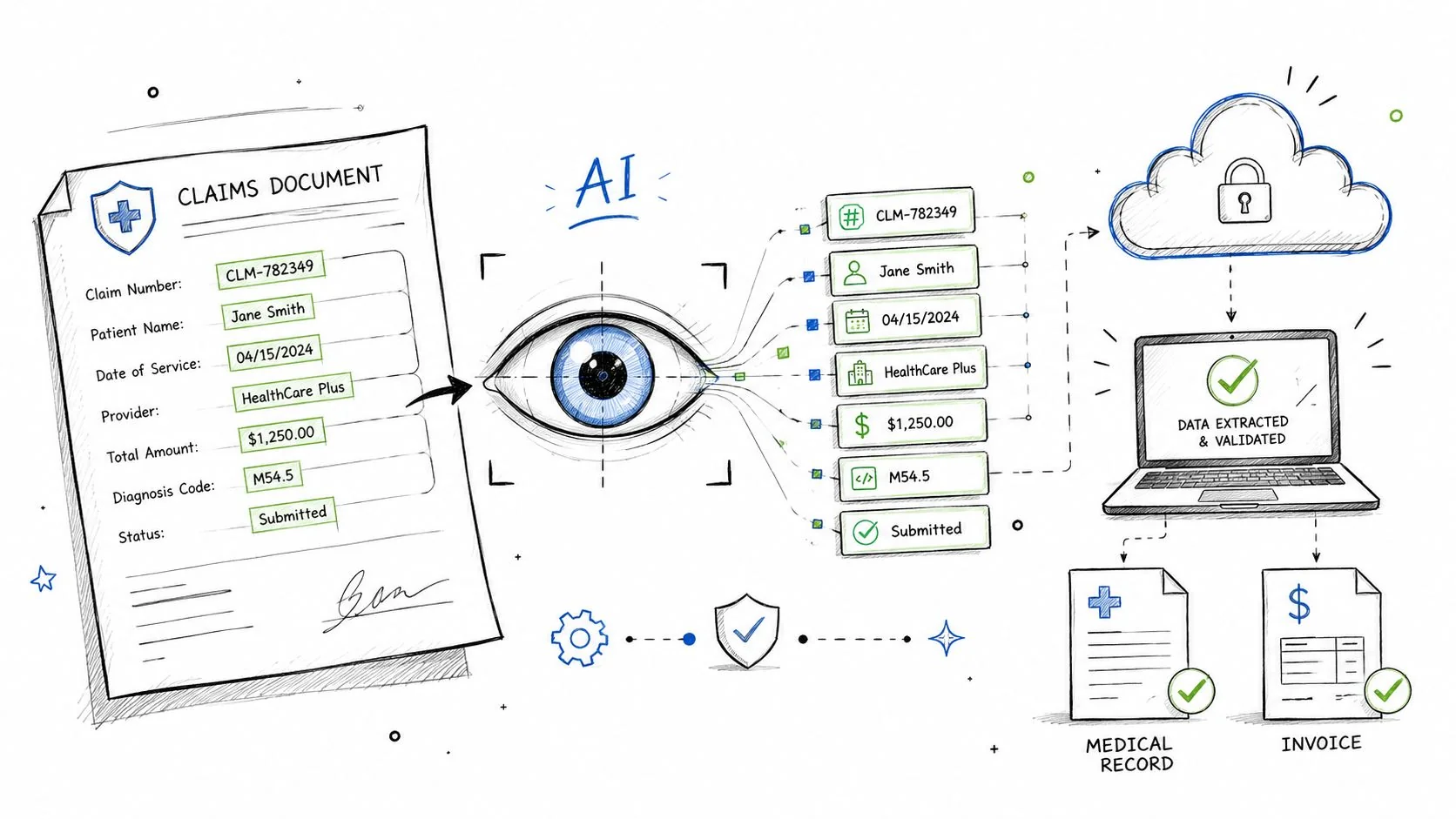
The implementation question isn't whether a model can read a document in isolation. It's whether the extracted data arrives with enough confidence, context, and traceability to support the next claims decision. A document workflow should preserve the original file, extracted fields, confidence scores, correction history, and the person or system that approved the result.
Begin with the document population
Inventory the documents that consume the most staff time. Separate clean digital forms from scans, photographs, handwritten notes, and attachments with missing pages. Start with a high-volume category where the extracted fields are stable, then measure classification accuracy, human-review rate, rework, and time from receipt to usable data.
The supplied examples include a health insurer reporting 55% less medical-record processing time, 98.5% extraction accuracy, and faster adjudication, as well as a workers' compensation insurer reporting an 18% improvement in reserve accuracy after processing medical bills and records. These are supplied outcomes for specific deployments. They shouldn't be treated as general performance guarantees.
Human-review rule: Set acceptance thresholds by document type and field criticality. A low-confidence policy number and a low-confidence descriptive note shouldn't trigger the same workflow.
Place feedback inside the claims process. When an adjuster corrects an extracted amount or identifies a misclassified record, capture that correction for monitoring and model improvement. The Shepherd Insurance case study on OCR automation can provide a documented example for research, but your RFP should still require evidence from documents that resemble your own.
A short visual explanation can help nontechnical stakeholders understand the handoff from document to structured claim data.
<iframe width="100%" style="aspect-ratio: 16 / 9;" src="https://www.youtube.com/embed/w9NkKW5ufo4" frameborder="0" allow="autoplay; encrypted-media" allowfullscreen></iframe>
4. Shift Technology Claims Fraud Detection Platform
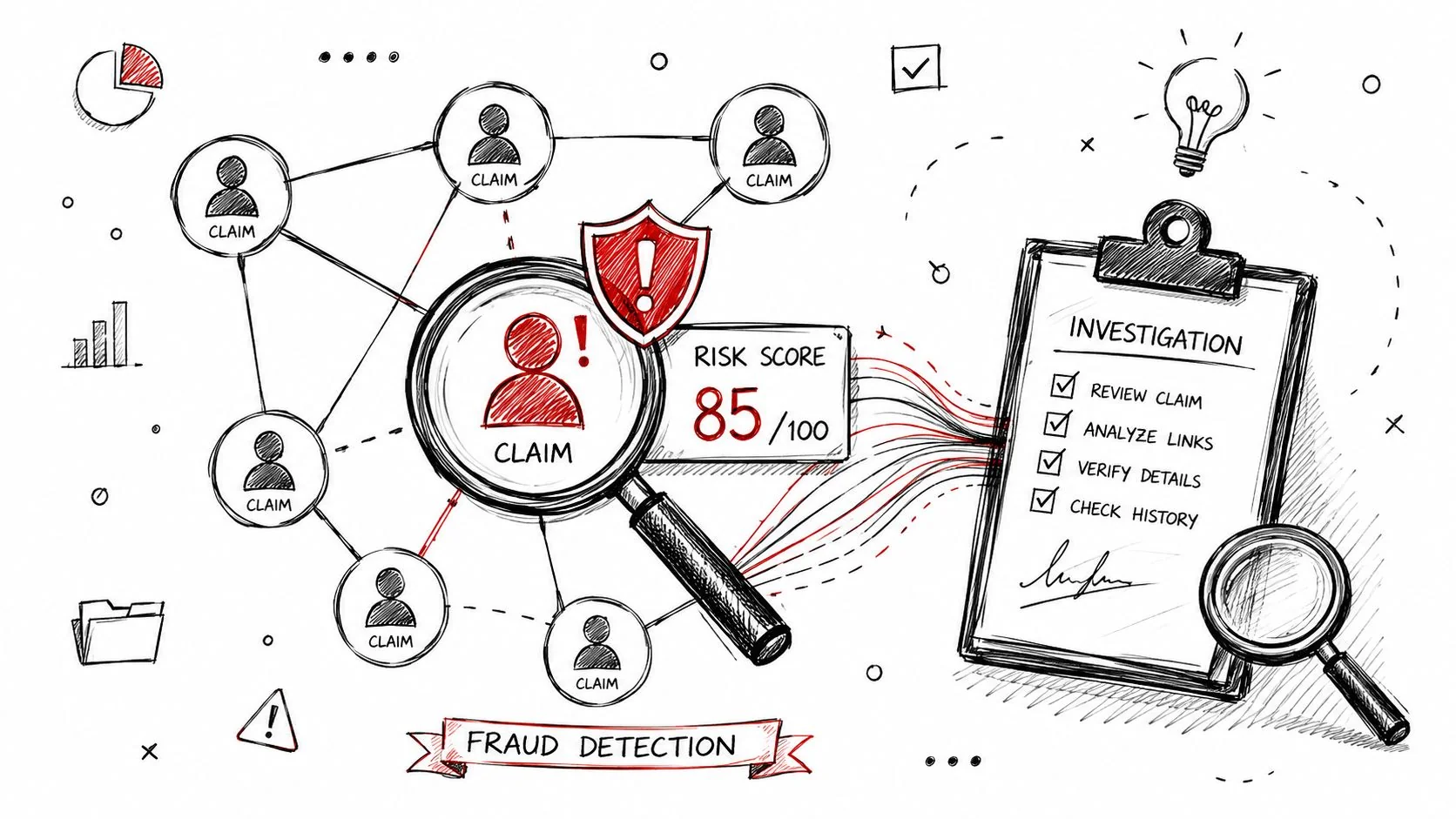
Fraud detection addresses a different claims transformation problem from administration. The core system records and routes claims, while a specialized fraud platform examines patterns associated with exaggeration, duplication, collusion, or organized activity. Its methods may combine machine learning trained on known cases with anomaly detection and behavioral analysis, which can surface patterns investigators have not previously defined.
Evaluation should focus on investigation quality rather than alert volume. Investigators need prioritized cases, interpretable indicators, feedback from resolved investigations, and controls that prevent legitimate claims from being delayed without adequate evidence.
Measure investigation value, not alert volume
Before deployment, document current detection rates, referral quality, investigation cost, false-positive patterns, and time spent per case. Select a claim type with a meaningful fraud history, then test whether investigators can act on the signals. More suspicious files have limited value if they overwhelm the special investigations unit.
The supplied examples report a European property and casualty insurer identifying 35% more fraud cases and recovering €2.1 million annually, an auto carrier reducing claim payouts by 12%, and a health insurer preventing $890,000 in fraudulent payments within an organized billing-fraud case. These results belong to specific deployments, so they require validation in their original context. The Generali France case study involving Shift Technology is a research reference, not evidence of equivalent results for every insurer.
Set human review for borderline cases. Automatic denial can create customer, regulatory, and reputational risk when evidence is incomplete or historical data contains bias. Require explanations of the indicators, documented investigator decisions, and a process that feeds confirmed outcomes back into model monitoring and governance. Assess how the platform connects to existing claim records, investigation workflows, and appeal procedures before treating model accuracy as the primary buying criterion.
5. Claim Processing Automation Template Library
Templates address a common source of waste, repeated reinvention. Claims teams often rebuild FNOL forms, triage rules, reserve workflows, settlement steps, and subrogation processes separately for each product or region. A standards-based template library can provide a starting structure for data fields, workflow stages, and integration requirements, while leaving room for local policy and regulatory rules.
The practical value isn't that every insurer should copy a template unchanged. It's that templates make hidden business logic visible. An adjuster may know exactly why a claim is routed to a specialist, but that rule can remain undocumented until a template exercise forces the organization to define it.
Standardize the predictable, preserve the necessary
Begin with process mapping. Identify steps that are legally required, steps that reflect internal preference, and steps that exist only because systems don't exchange data cleanly. Then select templates for repeatable processes and document every deliberate deviation.
A regional property insurer in the supplied examples used an ACORD FNOL template and reported 50% faster claim capture and 25% higher customer satisfaction. Another example reports a 30% reduction in manual triage work after standardizing routing, while a health insurer reports a 16% improvement in reserve accuracy after implementing a reserve recommendation template. Treat each figure as a deployment-specific outcome, not a benchmark for procurement.
Templates also need ownership. Assign responsibility for versioning, rule changes, testing, and retirement. Otherwise, different implementation teams can create incompatible variants that return the organization to fragmented processing.
Design principle: Use a template to expose the operating model, then customize only where claim type, geography, regulation, or customer need requires it.
During selection, ask whether the library supports your data model, whether the rules are exportable, and how changes are audited. A vendor-neutral pattern is most valuable when your claims ecosystem includes multiple platforms and specialized services.
6. MuleSoft and iPaaS Integration Platforms for Claims Ecosystem
Integration is where many insurance claims management system programs stall. A core platform may work in a demonstration, but production claims depend on policy and billing systems, medical-record networks, repair vendors, payment services, fraud tools, financial reporting, and legacy applications. MuleSoft and other integration-platform-as-a-service tools can provide the API and orchestration layer between those components.
MuleSoft's supplied positioning includes connectors for more than 1,000 insurance applications, but connector availability doesn't eliminate design work. Every connection still needs ownership, authentication, data mapping, error handling, monitoring, service-level expectations, and a plan for schema changes.
Design the claim data backbone
Start by identifying the claims objects that multiple consumers need. FNOL data, claimant identity, coverage, loss details, evidence, reserve updates, investigation outcomes, and payment status should have clear definitions and ownership. Reusable APIs can then serve fraud analysis, reserve recommendations, reporting, and customer communication without creating separate point-to-point links.
The supplied examples include a global insurance group connecting 15 regional claims systems to a shared fraud platform, a health insurer connecting with medical-record networks for more than 200 providers, and a P&C carrier placing an API layer over a legacy mainframe. These examples illustrate integration patterns, not guaranteed delivery times or savings.
Build monitoring before expanding the network. A failed document exchange, stale coverage record, or delayed payment message can create a claims exception that looks like an adjuster problem but is an integration failure. Alerting should identify the affected claim, the failed service, the last successful transaction, and the recovery action.
Ask vendors to demonstrate retries, duplicate-message handling, partial failures, audit logs, and access controls. A visually polished API demo isn't enough. You need proof that the integration layer can preserve claim integrity when systems are unavailable or data arrives out of sequence.
7. AI for Insurance Case Study Database and Benchmarking Resource
A case-study database can challenge unrealistic automation targets. Claims leaders need to distinguish comparable implementation evidence from vendor-reported best-case results. The AI for Insurance database is described as an open, searchable collection of 175+ verified case studies, organized by use case, insurance line, AI technology, vendor, deployment context, and disclosed outcomes.
Comparison requires more than filtering by “claims.” A health insurer assessing medical-claims automation should not benchmark against a property insurer automating repair estimates. Likewise, an organization with inconsistent historical data needs different expectations from a mature operation with established data controls. Filters for claims processing, fraud detection, computer vision, predictive machine learning, and related categories can narrow the evidence to more relevant examples.
Build a defensible benchmark
Select three to five comparable implementations using claim type, operating model, system environment, and use case as screening criteria. Before adopting a target, record the baseline, deployment duration, human-review design, data conditions, and outcome definition. A processing-time improvement from a narrow pilot does not establish an enterprise-wide cost result.
Use the database metadata to support an RFP, while preserving each result's context. Ask vendors which outcomes came from production, how exceptions were handled, what claim volume was included, and whether the measure covered the full claims lifecycle or a single task. These questions expose whether a reported result is transferable to the proposed operating model.
The resource description also includes vendor listings, standardized taxonomies, methodology pages, weekly updates, and RSS feeds. That structure supports repeated research as requirements change, rather than a one-time shortlist. Use comparable cases to define pilot measures, data requirements, review thresholds, and stop conditions.
Evidence rule: A case study should shape a question, not settle a procurement decision.
Claims Management, 7-Resource Comparison
| Solution | Core capability | Typical outcomes / metrics | Suitable for | Deployment & complexity | Unique selling point |
|---|---|---|---|---|---|
| Guidewire ClaimCenter | Enterprise claims management with integrated AI (triage, reserves, fraud) | 15–25% processing cost reduction; 40% FNOL time reduction; up to 60% routine claims automation | Large P&C & specialty insurers, digitally mature orgs | High; 18–36 months, significant IT/customization | Industry-standard platform, 500+ connectors, deep claims domain expertise |
| AI-Powered Claims Automation Implementation Guide | Standardized phased roadmap, model validation, change management templates | Reduces implementation failure ~30%+; enables rapid ROI modeling (varies by org) | Insurers planning claims automation, transformation programs | Low–Medium; guidance only but needs customization & executive sponsorship | Industry-validated blueprint, ROI templates, change-management playbooks |
| Ocrolus, AI-Powered Document Processing | Intelligent document classification & extraction (OCR, CV, ML) | 70–80% reduction in data-entry FTEs; >98% field accuracy; 40–50% faster medical claims | Document-heavy claims ops, health and workers' comp insurers | Low; SaaS, fast deployment; requires taxonomy & sample data | Field-level high accuracy with confidence scoring; quick ROI (6–9 months) |
| Shift Technology Claims Fraud Platform | ML-based fraud detection, network analysis, explainable AI | 20–40% lift in fraud detection; 200–300% ROI; SIU efficiency +30–40% | High-fraud-risk claims, SIU teams, multi-line insurers | Medium–High; needs historical data (18–24 months) and line-specific tuning | Explainable AI + network detection for organized fraud, strong recovery ROI |
| Claim Processing Automation Template Library (ACORD) | Pre-built workflows, ACORD data models, rule engine specs | 40–60% faster implementation; examples: 50% faster claim capture | Insurers seeking standardization, faster time-to-value, multi-line carriers | Low–Medium; templates require customization and process mapping | Vendor-agnostic, open standards reduce lock-in; proven workflow patterns |
| MuleSoft & iPaaS Integration Platforms | API-led integration, 1,000+ connectors, low-code workflows | 50–70% faster integration development; real-time sync, major latency reductions | Multi-system operations, organizations connecting legacy & cloud | Medium–High; requires integration architecture expertise, licensing | Extensive connector ecosystem, reusable APIs, strong security & governance |
| AI for Insurance Case Study Database & Benchmarking Resource | Searchable database of 175+ verified AI case studies, taxonomy, vendor directory, weekly briefing | Evidence-based benchmarks (e.g., 45–65% processing time reductions in similar cases); enables realistic ROI targets | Insurers evaluating vendors, claims leaders, CIOs, analysts | Low; open access with RSS, weekly updates, minimal setup | Verified, outcome-focused benchmarking enabling like-for-like vendor & approach selection |
Turn the Shortlist Into a Defensible Decision
The right insurance claims management system depends on the problem your claims operation must solve first. A core platform may be appropriate when lifecycle administration is fragmented. A document-processing layer may produce more value when staff spend their time classifying records and re-keying fields. Fraud analytics, templates, and integration services address different constraints, so comparing them as if they're interchangeable products will produce a weak shortlist.
Use a disciplined sequence:
- Define the use case: Specify the claim line, process stage, decision, and users affected. “Improve claims” is too broad to test.
- Baseline current performance: Record cycle time, pending inventory, manual touches, exception rates, document rework, investigation quality, and payment delays using definitions your team can reproduce.
- Verify data readiness: Check completeness, historical labels, document quality, policy linkage, permissions, and retention requirements before promising AI performance.
- Map integrations: List every system that must exchange coverage, claimant, evidence, reserve, investigation, settlement, and payment data. Include failure handling, not just the happy path.
- Test governance: Require human-review thresholds, explanations, audit logs, model monitoring, override controls, and a documented process for pausing automation.
- Model total effort: Include implementation partners, data preparation, process redesign, testing, training, change management, integration maintenance, and ongoing model oversight.
Market context supports treating this as a strategic software decision. One market report values the global insurance claims management software market at USD 6.2 billion in 2025 and projects USD 13.4 billion by 2034, with a stated 9.4% CAGR, as reported by insurance claims management system market research. The figures differ across market definitions, which is itself a reminder to inspect scope before using market forecasts in a business case.
Use the AI for Insurance searchable database to filter documented implementations by use case, line of business, technology, and vendor. Select comparable evidence, convert it into pilot acceptance criteria and RFP questions, and require each shortlisted provider to explain where automation stops. That process will give your team a decision it can defend to claims leadership, IT, compliance, finance, and policyholders.
