Generative AI in Insurance: A Practical Guide for 2026
Generative AI in Insurance. Explore real generative AI use cases, risks, and guardrails in insurance. See documented outcomes
Written by AI for Insurance
Generative AI has already moved into mainstream insurance operations. EIOPA found that 65% of surveyed insurers were actively using GenAI, while another 23% planned to implement it within three years. Nearly two-thirds of reported use cases were back-end productivity applications, not customer chatbots.
That adoption snapshot changes the central question. Insurers aren't deciding whether generative AI belongs in the industry. They're deciding how to place it inside claims, underwriting, servicing, and fraud workflows without weakening evidence standards, consumer protections, or accountability. The hard problem isn't producing fluent text. It's connecting probabilistic systems to fragmented data, legacy platforms, controlled decisions, and human review.
Table of Contents
- Why Generative AI in Insurance Has Moved Beyond Experimentation
- How Generative AI Actually Works Inside Insurance Workflows
- Document Drafting, Customer Communications, and Synthetic Data
- Evidence From Real Claims Handling Deployments
- Barriers Insurers Face When Adopting GenAI
- Guardrails That Keep Regulated Decision-Making Viable
- What Insurers Should Prioritize Before Scaling GenAI
Why Generative AI in Insurance Has Moved Beyond Experimentation
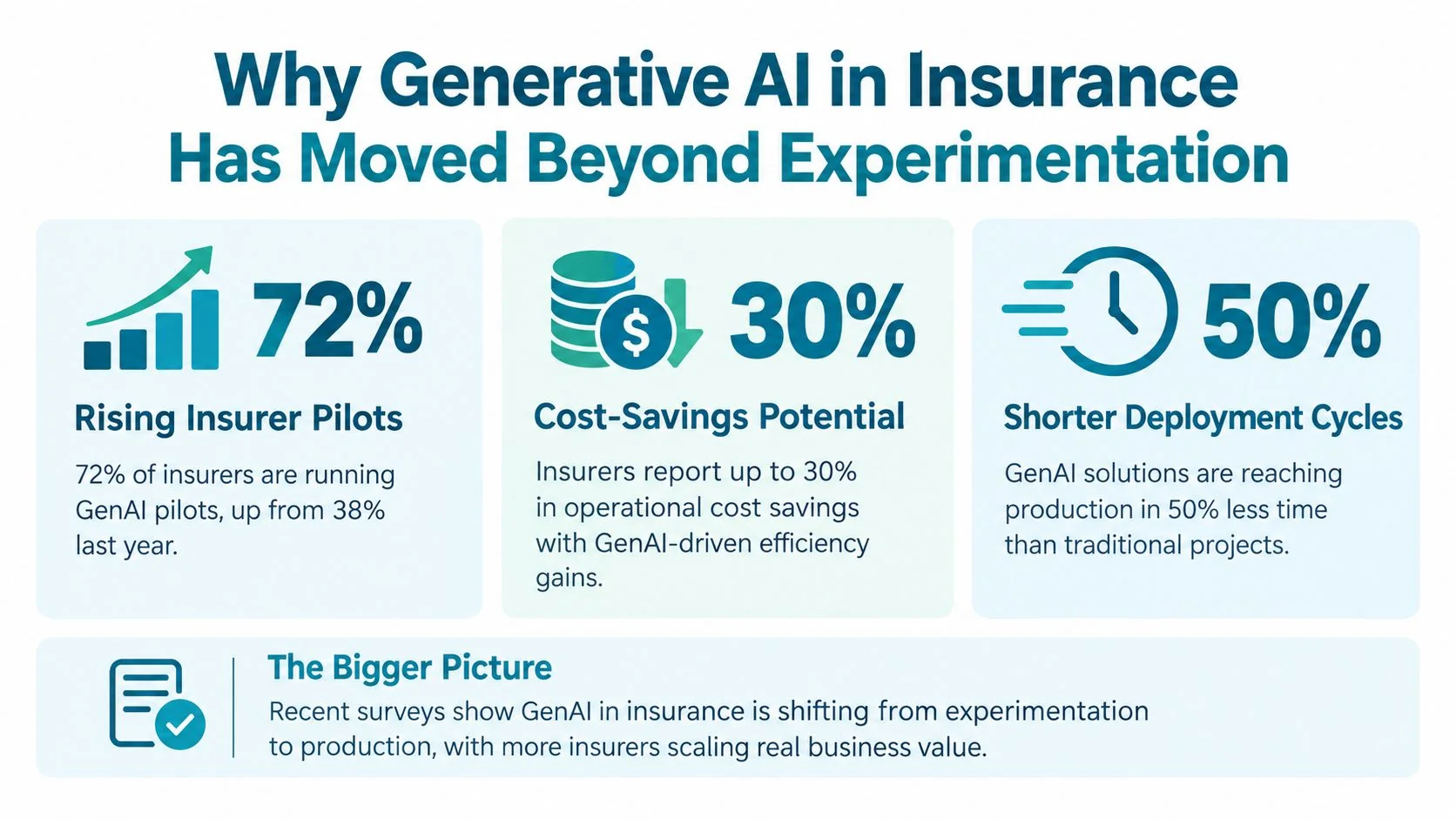
The European adoption figures are significant because they describe insurers across 25 countries and 347 undertakings, rather than a handful of innovation teams. EIOPA's survey found that 65% were already actively using generative AI systems, with a further 23% planning implementation within three years. The result is a clear shift from laboratory experimentation toward operational deployment, as documented in the EIOPA report on generative AI in insurance.
The location of that adoption matters. 64% of reported use cases were back-end productivity applications, including extracting information from invoices, audio recordings, and medical reports. Customer-facing applications, such as voice systems and chatbots, represented 36%. This pattern reveals how insurers are managing risk: they're starting where AI can assist employees with information-intensive work while leaving consequential authority with established processes.
Adoption is expanding faster than operating models
United States survey evidence points in the same direction. Deloitte reported that 76% of 200 U.S. insurance executives had implemented GenAI in at least one business function, with adoption at 82% among life and annuity insurers and 70% among property-and-casualty insurers, according to the insurance generative AI analysis.
Those numbers don't mean that insurers have solved production deployment. Implementation can mean anything from a controlled assistant to a workflow component, and the surveys don't establish that every use case operates autonomously. They do establish that GenAI has entered executive operating-model discussions, budget decisions, and risk reviews.
Governance is also catching up. EIOPA reported that 49% of undertakings had developed dedicated AI policies, compared with about one-quarter in 2023. That rise suggests insurers are no longer treating governance as paperwork that follows experimentation. Policy frameworks are becoming part of deployment infrastructure.
Operational implication: The first GenAI business case shouldn't ask whether a model can generate a useful answer. It should ask whether the insurer can verify, record, and challenge that answer inside the existing control environment.
The distinction separates a demonstration from a production capability. A model may summarize a medical report convincingly, but an insurer still needs to know which source passages supported the summary, whether confidential information was exposed, what happens when the model is uncertain, and who approves the downstream action.
Back-end adoption is therefore more than a conservative starting point. It gives insurers a practical way to build retrieval, validation, monitoring, and human-review capabilities before placing generated outputs directly in front of policyholders or allowing them to influence regulated decisions.
How Generative AI Actually Works Inside Insurance Workflows
Traditional predictive systems generally classify, score, or forecast from structured inputs. Generative AI adds the ability to produce language, structured summaries, extracted fields, draft explanations, and other content from unstructured material. In insurance, that distinction is useful because much of the operating environment is document-heavy: policies, submissions, loss notices, invoices, medical records, correspondence, and adjuster notes.
A production workflow typically combines four functions:
- Retrieval identifies the relevant policy clauses, claim records, procedures, or approved knowledge.
- Generation turns that material into a draft, summary, explanation, or structured output.
- Validation checks whether the output follows rules, contains required fields, and remains grounded in available evidence.
- Routing determines whether the result can move forward, needs employee approval, or must be rejected.
This is why an insurer shouldn't evaluate a language model in isolation. The model is one component in a controlled pipeline. A system that generates polished prose without reliable retrieval can produce an answer that sounds authoritative while using the wrong endorsement or outdated procedure.
The document-to-decision path
Consider a first notice of loss. The system can extract names, dates, locations, reported damage, attachments, and policy references. It can compare those fields with structured records, retrieve relevant coverage language, and draft a question for an adjuster when information conflicts.
The system shouldn't decide on its own that conflicting evidence is immaterial. A safer design displays the extracted field, its source document, the relevant policy passage, and the reason for escalation. That design turns generative AI from an opaque answer engine into a reviewable workbench.
Teams assessing generative AI technology for insurance should therefore test the entire path, not just prompt quality. Evaluation needs representative documents, adverse examples, incomplete records, ambiguous wording, and cases where the correct action is to say that evidence is insufficient.
The most important design choice is the boundary between assistance and authority. GenAI can draft a coverage explanation, but the insurer must define whether an employee approves it, whether a rules engine checks it, and whether the final communication records the supporting evidence. Without those boundaries, a useful assistant can become an untracked decision-maker.
Document Drafting, Customer Communications, and Synthetic Data
Document drafting is one of the most natural applications for generative AI because employees already spend substantial time converting structured and unstructured information into letters, notes, summaries, and internal records. A controlled system can prepare a draft from approved facts, identify missing information, and adapt language to the audience.
The value isn't just faster writing. It comes from separating fact selection from language production. The workflow should retrieve authoritative policy and claim information first, then generate a draft that preserves those facts. Employees can review the evidence and edit the communication without manually rebuilding the entire record.

Customer communication needs a stricter boundary
Internal drafting and customer-facing communication shouldn't share identical controls. An internal summary can flag uncertainty for an employee. A customer message needs clear wording, correct coverage references, appropriate escalation options, and protection against unsupported commitments.
A practical communication workflow can:
- Assemble the record: Collect approved claim facts, relevant policy provisions, prior correspondence, and required notices.
- Draft in a controlled style: Use approved language patterns and prohibit unsupported promises or interpretations.
- Expose evidence: Show the source fields and clauses behind each material statement.
- Escalate exceptions: Send ambiguous, disputed, or sensitive cases to a qualified reviewer.
Customer-facing systems also need a clear handoff. A chatbot that can't answer should route the interaction with its conversation context intact, rather than forcing the customer to repeat the issue. The handoff itself becomes part of quality management because repeated escalation patterns can reveal missing documentation, unclear policy language, or a flawed workflow.
Synthetic data addresses a different problem. Insurance teams often need realistic records to test extraction, train processes, validate edge cases, or develop fraud-detection approaches without exposing live personal information. Synthetic records can help create controlled variations, such as altered document layouts, conflicting fields, or unusual combinations of claim attributes.
That doesn't make synthetic data automatically representative. Teams must test whether generated records preserve the relationships that matter for the intended use and whether they introduce artifacts that a model can exploit. The purpose is controlled testing and development, not the assumption that artificial records perfectly reproduce the insured population.
A documented example of this approach appears in the synthetic-data case study on fraud detection. The case belongs in a broader evaluation process that distinguishes the use case, data generation method, validation method, and operational decision being supported.
This video provides additional context on how these applications fit into insurance workflows.
<iframe width="100%" style="aspect-ratio: 16 / 9;" src="https://www.youtube.com/embed/H1c55QHUCpg" frameborder="0" allow="autoplay; encrypted-media" allowfullscreen></iframe>The common thread across drafting, communications, and synthetic data is controlled reuse of information. GenAI is most useful when the insurer already knows which facts are authoritative and can define how generated content is checked.
Evidence From Real Claims Handling Deployments
Claims handling provides a sharper test than generic document summarization because the output can affect payment, liability, and escalation. A systematic study of LLM-powered bots found reimbursement amounts were determined correctly in over 92% of cases across insurance domains, with results varying materially by line of business, as reported in the claims-handling study.
| Insurance Line | Reimbursement Accuracy | High-Complexity Performance Trend |
|---|---|---|
| Life | 100% | Performance remained strongest in the reported comparison |
| Health | 98.8% | High accuracy, with complexity still requiring control |
| Property | 94.5% | More room for review as evidence becomes less uniform |
| Casualty | 92.8% | Lowest reported line accuracy, making escalation important |
| All domains | Over 92% | Accuracy declined from 97.9% for low-complexity claims to 95.1% for high-complexity claims |
The pattern is more important than the headline. Accuracy didn't collapse as complexity rose, but it did decline. That makes complexity a routing variable, not merely a reporting attribute.
Straight-through processing needs a confidence boundary
The study also found that the bot matched professional human-handler assessments in 94.3% of claim plausibility decisions, 90.6% of liability decisions, and 88.7% of gross-negligence decisions. Those figures describe different decision types, so they shouldn't be combined into one general automation score.
A sensible operating model would reserve straight-through treatment for cases with stable evidence, simple policy relationships, and high confidence. Cases involving multiple parties, disputed facts, unclear liability, or potential gross negligence should move to human review, even when the system can produce a fluent recommendation.
Practical rule: Use accuracy results to define routing boundaries, not to justify universal automation.
The insurance claims processing guide is useful for comparing claims use cases, but insurers still need internal testing against their own policy wording, document quality, jurisdictional requirements, and escalation rules. Published performance can inform a hypothesis. It can't replace local validation.
This evidence also clarifies what “automation” should mean. A system may extract evidence, calculate a candidate reimbursement amount, and prepare a rationale while an employee retains approval authority. That is operational automation even when the final decision remains human-led.
The error pattern gives claims leaders a more defensible business case. Instead of promising that GenAI will process every claim, they can identify which segments are suitable for assisted handling, which qualify for limited straight-through processing, and which should remain review-heavy. That approach aligns technical performance with customer protection.
Barriers Insurers Face When Adopting GenAI
The main constraint is rarely a model's ability to draft a summary. It is the insurer's ability to provide reliable context and connect the output to a process that employees, auditors, and customers can trust.
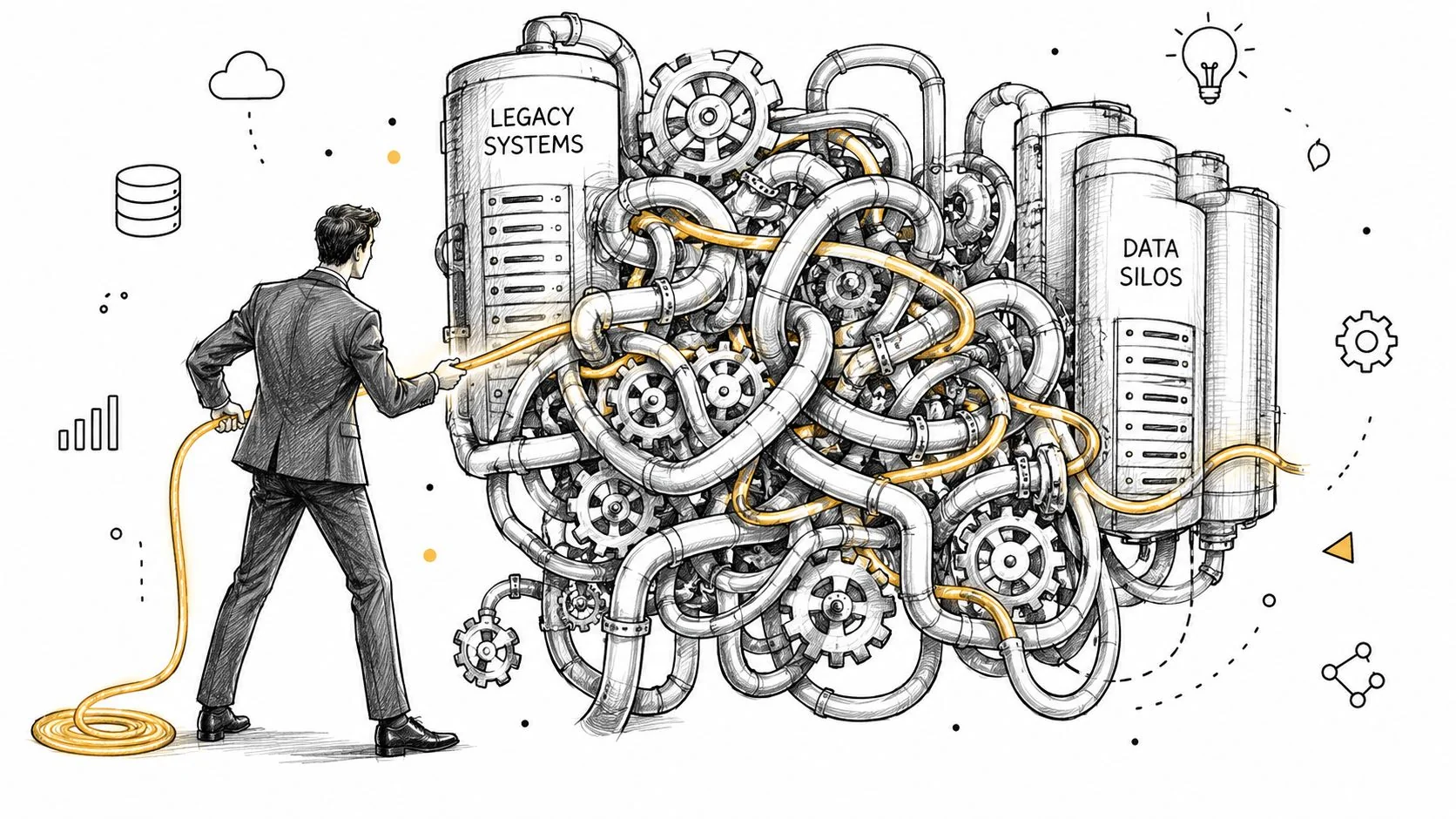
EIOPA identifies legacy IT, fragmented data, and AI skills as structural blockers. IBM reports that 52% of executives say data constraints are slowing product speed-to-market, according to the insurance survey summary. A polished demonstration can therefore conceal the work required to make GenAI dependable in a regulated workflow.
Data quality determines the ceiling
An insurer may possess the relevant evidence without storing it in a form that a workflow can use consistently. Policy terms may remain in scanned documents, endorsements may be held separately, claim records may use inconsistent labels, and correspondence may contain the only explanation for an earlier decision.
GenAI can interpret these materials, but it cannot resolve contradictions by itself. If two systems show different policy statuses, the workflow needs a resolution rule or a defined human escalation path. Allowing the model to choose without disclosure turns a data-quality problem into an accountability problem.
Integration changes the timeline
Legacy integration creates work beyond model configuration:
- Identity and access: The workflow must limit information according to role and claim responsibility.
- Record updates: Approved outputs need to return to systems of record with clear authorship and timestamps.
- Exception handling: Employees need a practical way to correct extracted fields and reject drafts.
- Monitoring: The insurer must track errors, drift, unsupported outputs, and changes in source documents.
The financial case also requires discipline. EY reported that 65% of insurers expected revenue uplift above 10% from GenAI, while 52% anticipated additional cost savings. These figures represent executive expectations, not verified realized outcomes. They can support strategic ambition, but a credible business case still depends on actual volumes, review time, error costs, and integration effort.
The same survey found that 84% of insurers without dedicated GenAI teams planned to establish one before 2025. Creating a team does not repair fragmented data. It can establish ownership across technology, claims, underwriting, legal, compliance, and operations, provided those functions have authority over the workflow.
Enterprise readiness matters more than model selection. An insurer with reliable evidence paths, defined controls, and disciplined exception handling can gain value from a bounded system. An insurer with unreliable records and no accountable owner will struggle to operationalize GenAI, regardless of model capability.
Guardrails That Keep Regulated Decision-Making Viable
Regulated decisioning requires more than a human somewhere in the process. The human needs enough evidence, context, time, and authority to challenge the system. If an employee merely approves an unexplained recommendation because the workflow makes rejection difficult, the nominal human review doesn't provide meaningful control.
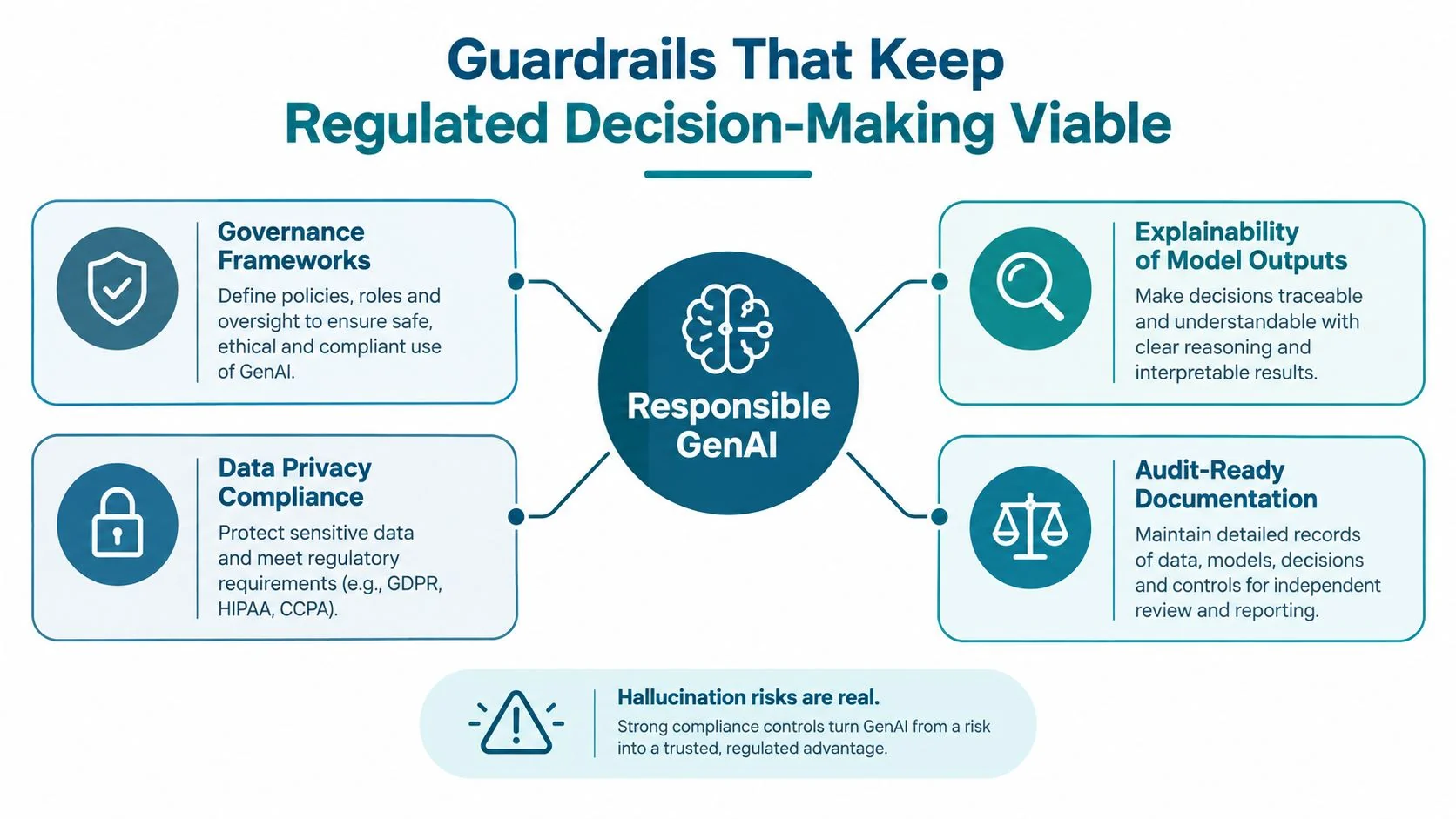
EIOPA identifies hallucinations, IT vulnerabilities, customer data breaches, and explainability gaps among the major implementation risks. DLA Piper's summary of the EIOPA survey also points to the expansion of GenAI into claims, underwriting, and fraud detection, which increases the consequences of unreliable outputs. The regulatory discussion of generative AI risk in insurance supports a practical position: controls must be designed around the decision's potential impact.
Classify the use case before selecting the workflow
A draft of an internal meeting summary and a recommendation that affects coverage don't belong in the same risk category. Classification should consider whether the output is customer-facing, whether it influences pricing or claims, whether sensitive personal information is involved, and whether an employee can realistically verify the result.
A useful control design includes:
- Source grounding: Require material outputs to reference approved documents or structured records.
- Output validation: Check mandatory fields, policy rules, prohibited language, and numerical consistency before release.
- Human authority: Define who can approve, amend, reject, or escalate an output.
- Traceability: Preserve prompts, source context, model version, output, edits, and final decision.
- Performance monitoring: Review error patterns by product, document type, complexity, and customer segment.
Explainability must support action
An explanation isn't a paragraph added after the decision. It should show the evidence that influenced the result and distinguish retrieved facts from generated interpretation. For an underwriting assistant, that might mean displaying the source submission fields and the reasoning path for a flagged inconsistency. For claims, it might mean identifying the policy provisions and evidence used to calculate a candidate amount.
Bias creates a related challenge. Sector guidance notes that insurance AI decisions already intersect with consumer-protection, privacy, and unfair-trade laws. The same guidance reports that at least 17 U.S. states advanced AI bills in 2025 addressing issues including bias, vendor practices, and explainability, as described in the insurance GenAI and agentic AI guidance.
Governance therefore needs an operating rhythm, not a one-time approval. Compliance teams should review material changes, claims leaders should examine overrides and appeals, and technology teams should monitor source-data and model behavior. The insurer's audit file should make it possible to reconstruct what the system saw, what it produced, what the employee changed, and why the final action was taken.
What Insurers Should Prioritize Before Scaling GenAI
Insurers should scale generative AI in insurance only after they can answer three questions clearly:
- Is the evidence usable? The relevant policy, claim, customer, and operational data must be identifiable, current, permissioned, and connected to the workflow.
- Is the decision boundary explicit? The insurer must define what GenAI may draft, recommend, route, or execute, and which cases require qualified human review.
- Can the result be audited? Teams need records of source material, generated output, human changes, approvals, exceptions, and performance over time.
Start with a bounded workflow where the input sources are understood and the consequences of an error are manageable. Document the baseline process, test ordinary and difficult cases, and set escalation rules before measuring value. A claims or underwriting leader should own the operational outcome, while technology, data, legal, and compliance teams share control responsibilities.
For structured market research, AI for Insurance provides a searchable database of real-world insurance AI implementations, with case-study details organized by use case, industry line, technology, and disclosed outcomes. It can support comparison work, but internal validation remains essential.
The next practical step is a controlled readiness review for one workflow. Map its data sources, decision points, exceptions, human approvals, and audit requirements. If those elements aren't clear, the insurer isn't ready to scale the model. It's ready to improve the process that the model would eventually support.
Choose one claims, underwriting, or servicing workflow and document its evidence path before approving a GenAI deployment. Book a structured readiness assessment with your technology, operations, data, and compliance leads, then use the findings to define a controlled pilot with explicit review thresholds, traceability requirements, and measurable acceptance criteria.
