Digital Insurance Platforms: Architecture and AI Impact
Discover how digital insurance platforms optimize underwriting, claims, and distribution with AI integration and practical implementation insights.
Written by AI for Insurance
Digital insurance platforms are now a USD 148.16 billion market in 2025, with one forecast placing them at USD 256.71 billion by 2030 and another projecting USD 493.23 billion by 2034. Those are not niche numbers, they describe a core operating layer that insurers are already funding because legacy stacks can't keep up with how policies are sold, serviced, and claimed in digital channels. (Mordor Intelligence market study)
The strategic mistake many carriers still make is treating the platform as a front-end upgrade. In production, the value comes from making policy, billing, claims, rating, and distribution behave like one operating system, not five disconnected tools. That shift changes how quickly a carrier can launch products, manage compliance, and absorb AI, but it only works when the architecture is disciplined.
Table of Contents
- Why Digital Insurance Platforms Are Reshaping the Industry
- Understanding the Reference Architecture
- Core Modules and the Unified Data Model
- How AI Integrates Into the Platform Stack
- Platform Models and the Inclusion Gap
- Real Implementation Outcomes and Case Study Patterns
- Making the Platform Decision
Why Digital Insurance Platforms Are Reshaping the Industry
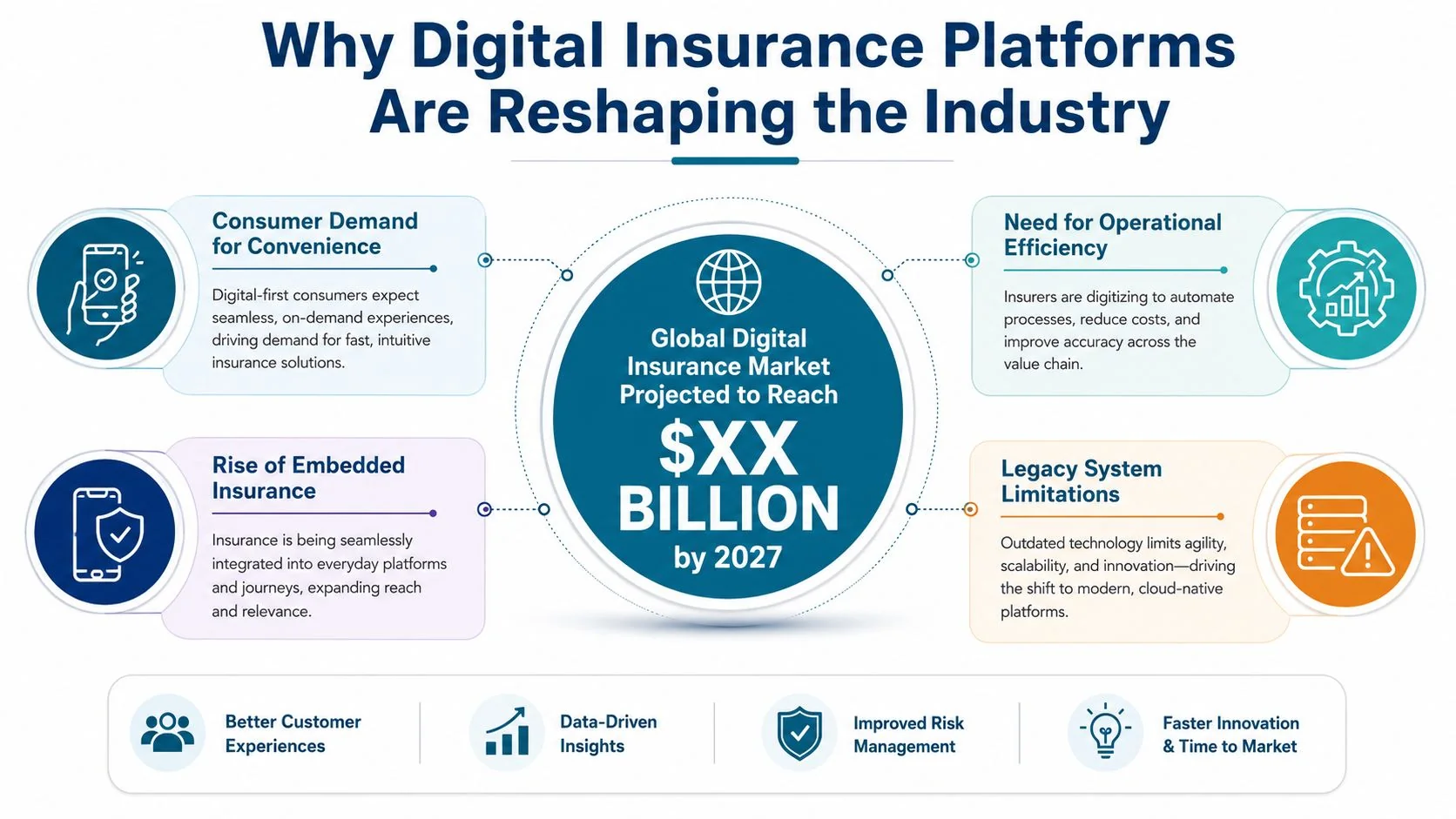
The market is already large enough to shape core operating decisions, not just innovation roadmaps. Independent forecasts differ on the exact size, but they agree on the same pattern, sustained expansion rather than a short-lived digitization cycle. That matters because it suggests insurers are budgeting for platforms as infrastructure, not as a collection of pilots or one-off modernization projects. (Mordor Intelligence market study)
Why the spend is sticking
The buying pattern explains why the category keeps attracting capital. Cloud deployment, platform software, and large-enterprise demand dominate reported revenue mix, which points to insurers moving away from isolated point solutions and toward integrated operating layers that can support underwriting, claims, billing, and distribution together. The practical signal is that buyers are funding systems that reduce handoffs, not just interfaces that look modern.
That distinction matters in production. A carrier can digitize a form, automate a queue, or add a portal and still leave the same rekeying, exception handling, and reconciliation work in place. In those cases, the business gets a cleaner front end, but the operating model barely changes. Platform spending only holds when it cuts across functions and reduces the number of places where work gets trapped.
Where adoption is concentrated
Geographic concentration shows that adoption is no longer confined to one insurance center. One set of market findings points to North America as a major share holder, while another identifies Asia Pacific as the largest or fastest-growing region depending on the forecast lens. The broader conclusion is consistent, digital insurance platforms are spreading across multiple regional markets rather than staying tied to a single hub. (Mordor Intelligence market study)
Practical rule: If a platform only looks attractive in one geography or one line of business, the architecture is probably too brittle for scale.
Enterprise economics are doing part of the work here. Carriers that can change products faster usually carry less manual processing, less operational drag, and fewer service bottlenecks, while carriers that cannot modernize keep paying for workarounds in underwriting, claims, and distribution. That is why the strongest spending cases tend to come from large insurers that need repeatable change across the enterprise, not only from newer entrants looking for a fast launch path.
Understanding the Reference Architecture
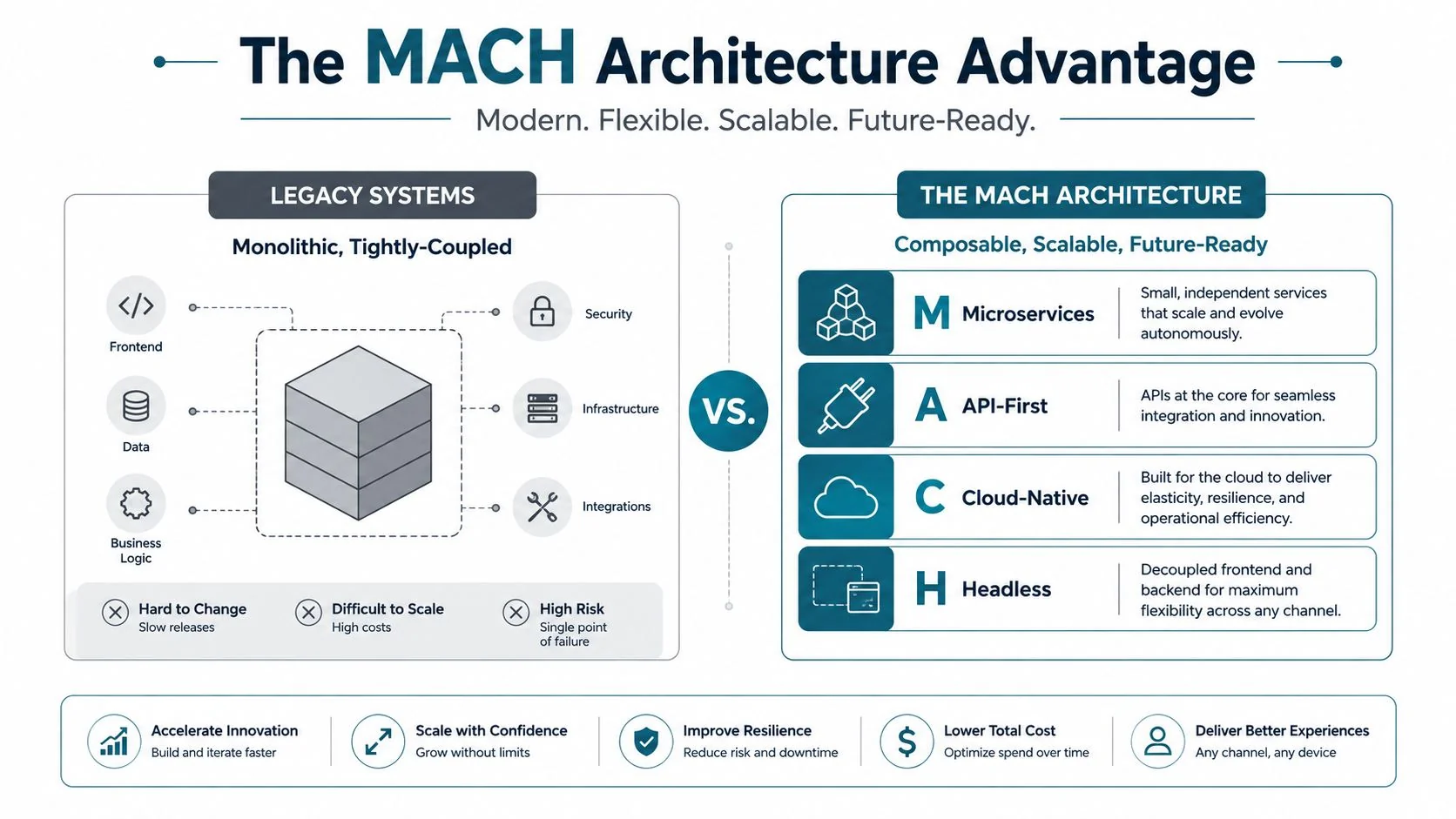
A modern digital insurance platform uses modular design to separate change from collapse. In a monolithic setup, a change in policy administration, claims, billing, or rating can ripple through the entire stack. In a composable setup, each capability can be upgraded or replaced on its own, so teams change one module without rewriting the operating model.
What MACH means in insurance
The common architecture pattern is MACH, which means microservices, API-first, cloud-native, and headless design. In insurance terms, that means core services are exposed through documented interfaces instead of being buried in a tightly coupled core, and the user experience can stay separate from back-end logic. That separation lets product, operations, and engineering teams move in parallel instead of waiting on one release train. (Decerto on digital insurance ecosystems)
The useful part is not the acronym itself. It is the operating discipline behind it. A carrier can isolate high-change functions like distribution or claims intake while keeping regulated core systems stable. That lowers release risk, supports ecosystem integration, and makes parallel development realistic across teams.
The trade-off CIOs should watch
Composable architecture sounds simple in vendor decks, but the trade-off is governance. If the shared contracts are weak, the platform becomes a collection of loosely coordinated services with inconsistent policy logic. If the contracts are strong, the carrier gets the benefit of modularity without losing control of compliance and state-dependent behavior.
A platform team should ask one question before any rewrite, can this service change independently without breaking policy truth elsewhere?
That question cuts through a lot of demo noise. A headless front end, for example, only helps if the underlying data model and APIs are clean enough to support multiple journeys without duplicate rules. Otherwise the insurer just moves complexity from the browser into the integration layer.
The right reference architecture also gives insurers a common language for investment decisions. Business teams can discuss whether a release should touch the rating engine, claims intake, or policy data model, while engineering can map that request to service boundaries instead of arguing over a full-system rebuild. For a broader operating context, see the internal overview on software for an insurance company.
Core Modules and the Unified Data Model
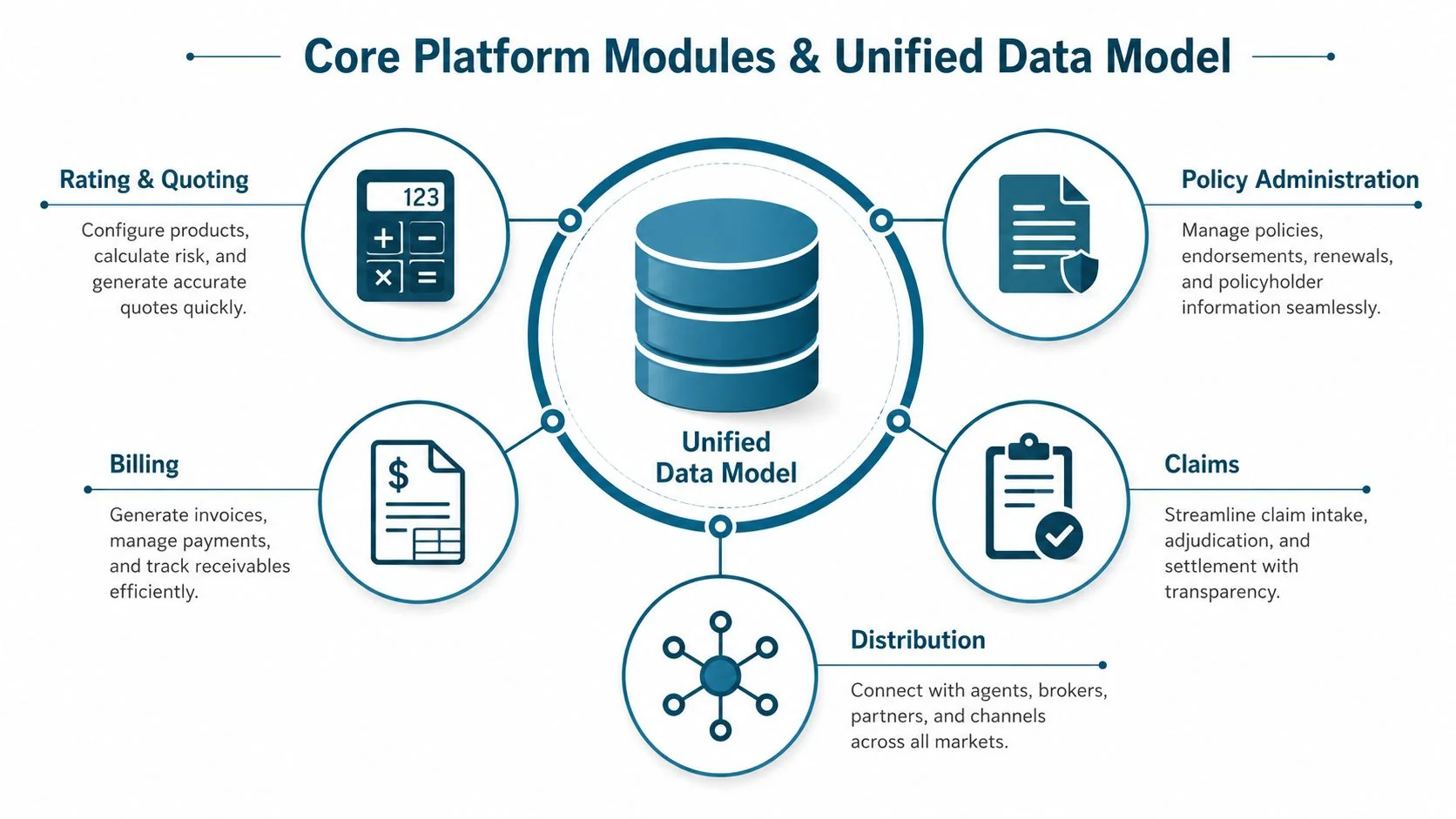
A platform only starts to matter in production when the core modules share the same policy truth. A mature digital insurance platform ties rating and quoting, policy administration, billing, claims, and distribution to a common data model and API layer, instead of treating them as separate applications linked by manual handoffs. That matters because it cuts re-entry errors, preserves policy state as a customer moves from quote to bind to claim, and gives operations teams one place to reconcile changes.
Shared data beats duplicated records
The technical blueprint usually includes an underwriting rules engine, a structured policy data model, a real-time rating API, document generation, and state-compliance management. Those components matter because they let the platform reuse the same coverage definitions, compliance rules, and policy state across channels and workflows, instead of forcing each team to maintain its own version of the truth. (Madgeek on digital insurance platform development)
A normalized model also changes what can be reused in practice. If a commercial package policy needs a jurisdiction-specific underwriting rule, the carrier can define that rule once in the core model and apply it in quote, bind, and renewal workflows without rewriting it for each channel. The same rule can also be referenced by claims intake when coverage validation is needed, which reduces manual interpretation and lowers the chance that two teams apply different logic to the same policy. That is the difference between a shared platform and a set of connected screens.
Implementation reality is less forgiving than vendor storytelling. A system can claim to “integrate” claims and policy administration, but if policy state is not machine-readable and reusable, the claim handler still has to interpret the record manually. That is not integration, it is a cleaner inbox with the same operational friction behind it.
What the unified model enables
Once the data model is normalized, insurers can automate standard underwriting, triage claims more intelligently, and apply fraud detection as an add-on layer. The sequence matters because automation depends on data structure, and a weak core turns every exception into a custom repair. In practice, teams that normalize the policy record first get cleaner handoffs, fewer reconciliation loops, and fewer downstream exceptions when a policy changes mid-life.
Operational rule: automate only after the policy record, coverage logic, and jurisdiction rules can be read and reused by machines.
That rule matters because product managers want faster launches, compliance teams want state-specific control, and claims teams want fewer exceptions. A unified model gives those groups a common substrate, so changes do not have to be rebuilt for every channel or reinterpreted by every department.
The workflow gain is easy to miss because it looks ordinary once it works. Underwriting can use the same policy context that claims and billing already trust, which reduces reconciliation work and makes downstream processing more predictable. For a broader operating context, see the internal overview on software for an insurance company. The platform then behaves less like a chain of departments and more like a single transaction layer.
For a practical product view, the internal briefing on AI for Insurance technology and generative AI can help frame how core workflows need to be structured before advanced automation is added.
How AI Integrates Into the Platform Stack
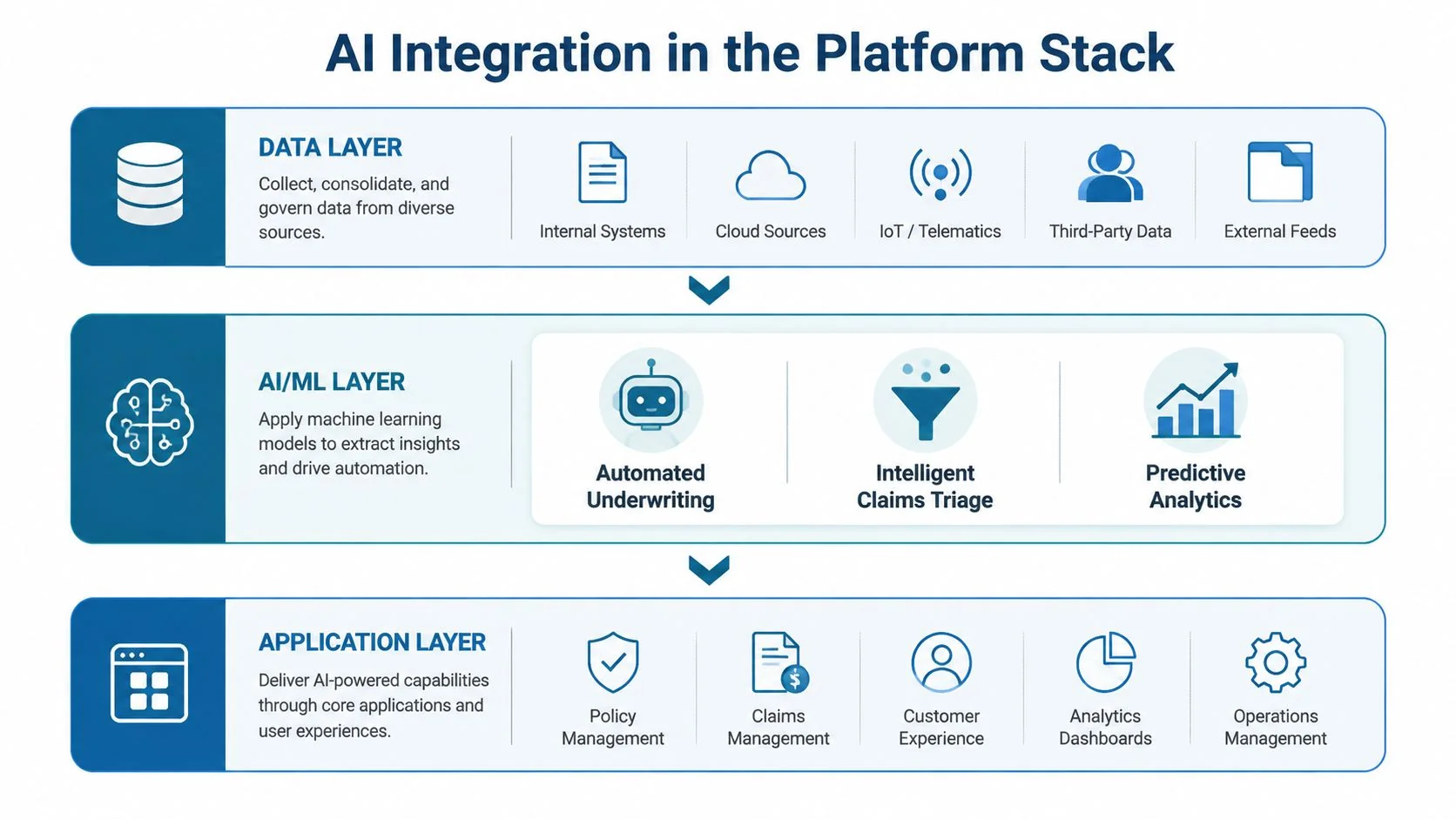
AI adds value in digital insurance platforms only after the underlying data layer is clean enough to support it. In production, it usually sits on top of a normalized transactional core and supports targeted workflows such as underwriting, claims triage, and fraud detection. The architectural order matters, because AI depends on the platform rather than replacing it.
Claims is where the proof shows up first
Industry synthesis from WorldMetrics insurance transformation statistics shows that digital claims processing has moved from an early-stage capability to a mainstream operating model. It also reports that most property insurers now offer digital claims submission through mobile apps or web portals. That shift matters because claims is usually the first place where a platform has to prove it can support digital operations at scale.
The same source indicates that AI can reduce claims processing time sharply, and that simple claims can often be resolved quickly when the workflow already has structured intake, policy, and coverage data. Those gains are real, but they depend on the platform's input quality and decision logic. A model cannot compensate for inconsistent policy records or manual exception handling that never got standardized in the core.
Distribution changed before most back offices did
Digital channels have also changed how insurance is sold and serviced. The same synthesis reports that a large share of global life insurance premium sales already come through digital channels, and that most insurance customers use digital channels for routine tasks such as queries and policy updates. For CIOs, the operational signal is clear, customer behavior moved faster than many core systems did. (WorldMetrics insurance transformation statistics)
That creates a practical design requirement. If digital journeys are already the main interface for routine service, AI should support those journeys inside the transaction flow, not sit off to the side as a separate data science experiment. The platform needs to expose events, decisions, and state changes in a form that automated models can consume and return to business users without extra translation.
Where AI fits in the stack
The strongest deployments usually follow a three-layer pattern.
- Data layer first: normalize policy, claims, and billing records so models can read them without manual cleanup.
- AI and ML layer second: apply automated underwriting, intelligent claims triage, and predictive analytics where the workflow is already structured.
- Application layer last: let users see the result in underwriting screens, claims queues, or customer service journeys.
That sequence avoids the common mistake of asking AI to compensate for a weak operating model. For a broader technology lens, the internal page on generative AI in insurance is a useful reference point for where these capabilities sit in the stack.
Platform Models and the Inclusion Gap
A digital insurance platform can widen distribution without improving inclusion. The International Association of Insurance Supervisors notes that digital channels can extend reach to underserved people, while also increasing exposure to consumer abuse if products are not designed and serviced carefully. The test is whether a customer can understand the cover, use it after purchase, and complete a claim without confusion or hidden friction. (IAIS application paper)
Access is not the same as inclusion
Low-income and first-time customers usually need products built around irregular income, simple onboarding, and claims handling that does not assume prior insurance literacy. Platform performance after distribution matters as much as the distribution path itself. If a customer can enroll quickly but cannot understand coverage or complete a claim without friction, the platform has expanded access without improving outcomes.
That gap shows up in many embedded and ecosystem-based products. The front end can look polished, yet the operating rules behind it remain hard to see. For underserved segments, that opacity often matters more than the channel used to sell the policy.
Different models fit different markets
There is no single platform model that fits every underserved market. Case evidence from the AI for Insurance case study on Allianz Direct's AI-powered digital platform transformation shows why implementation outcomes need to be checked against the operating model, not the pitch deck. Broader inclusive insurance guidance reaches a similar conclusion, success depends on product category, market maturity, and regulatory design, so a platform that works in one setting may fail in another.
The practical conclusion is straightforward. Microinsurance, embedded insurance, and ecosystem partnerships can all work, but each one needs different unit economics, different claims logic, and different conduct controls. A market with simple onboarding requirements may favor one structure, while a market with tighter consumer-protection expectations may favor another.
The hardest test is not whether a policy can be sold digitally. It is whether the customer can stay covered, understand the terms, and recover value when a claim happens.
That is the right frame for judging inclusion claims. If a platform cannot support transparency, continuity, and low-friction service, it is improving access only on paper.
Real Implementation Outcomes and Case Study Patterns
The best way to separate transformation from surface-level digitization is to look for measurable outcomes, not feature lists. Across documented implementations, the most useful metrics are processing-time reduction, error-rate change, throughput, and ROI-related impacts when disclosed. Those are the signals that tell you whether the platform changed operations or just changed the interface.
What to ask for in every case study
A credible implementation narrative should say what process changed, which workflow was automated, and what happened to the business metric that mattered. If a project claims improvement but won't identify the baseline, the time frame, or the exact workflow, it's hard to compare it with anything else. That's why standardized taxonomies matter, they let teams compare like with like instead of grading every story on its own marketing language.
The internal case-study page on Allianz Direct AI powered digital platform transformation is useful precisely because it points readers toward implementation outcomes rather than feature descriptions. For platform buyers, that's the right unit of analysis.
A simple evaluation table for stakeholders
| Stakeholder | Priority Metrics | Key Evaluation Questions |
|---|---|---|
| CIO or CTO | Architecture fit, release risk, integration depth | Can modules move independently, and can the core stay stable during change? |
| Claims leader | Cycle time, triage quality, exception handling | Does the platform reduce manual touchpoints without creating blind spots? |
| Underwriting lead | Rate accuracy, rule reuse, approval consistency | Can underwriting rules be reused across channels and jurisdictions? |
| Operations leader | Throughput, rework, queue health | Where does the process still rely on handoffs or rekeying? |
| Actuary or pricing analyst | Data consistency, model inputs, governance | Is the underlying policy and claims data machine-readable and auditable? |
The table is intentionally plain. That's the point. If a platform can't answer these questions with documentation and live process evidence, the buying team is still evaluating a demo, not an operating model.
Making the Platform Decision
A strong platform decision starts with evidence, not a feature checklist. Before committing, leaders should verify API maturity, module independence, compliance management, AI readiness prerequisites, and documented outcomes from comparable implementations. If those five areas aren't clear, the risk of buying a polished front end with weak back-end discipline is too high.
What to verify before you sign
- Scalability and performance: Ask how the platform behaves when core modules change independently, not just when user traffic increases.
- Open API and integration ecosystem: Confirm that APIs are documented, stable, and designed for standard service contracts.
- Vendor roadmap and vision: Check whether the roadmap reflects modular insurance operations or just more front-end features.
- Total cost of ownership: Review integration effort, change-management overhead, and the likely cost of keeping rules synchronized across workflows.
- Implementation support and partner network: Make sure the delivery model fits your internal team's capacity and regulatory footprint.
Decision rule: If the platform can't show a clean path from data model to workflow to measurable outcome, don't treat it as transformation software.
That rule also helps with research fragmentation. Insurance teams shouldn't have to piece together evidence from scattered marketing decks and isolated whitepapers. They need a searchable view of verified implementations, use cases, technologies, and outcomes, the kind of structure that lets a CIO compare claims handling, underwriting, and distribution investments on the same basis.
The right platform choice is rarely the one with the longest feature list. It's the one that can prove it will survive real policy complexity, support AI later, and keep compliance intact while your operating model changes. If you want a more evidence-led way to benchmark those decisions, review the case-study database and weekly briefing at AI for Insurance, then use the verified implementation patterns there to pressure-test your shortlist before procurement starts.
