Claims Processing Software Comparison Guide for 2026
Compare claims processing software for 2026. See feature breakdowns, AI integrations, ROI metrics, and which platform fits your line of business and scale.
Written by AI for Insurance
Claims processing software has moved from a back-office utility to a core operating system for insurers. Historical benchmarks reported automation rising from 15% in 2020 to 75% in 2023, with processing time falling from 72 hours to 5 hours, according to a 2024 academic review of robotic process automation in insurance claims. The implication is more important than the headline: buyers aren't choosing between manual and digital claims handling anymore. They're choosing which operating model can convert data, rules, human judgment, and customer communication into a controlled claims outcome.
The strongest platform isn't necessarily the one with the longest feature list. It's the one that fits the insurer's line of business, data condition, integration architecture, regulatory workload, and tolerance for human intervention. This comparison guide evaluates claims processing software through that lens, using measured benchmarks where they exist and treating vendor claims with caution.
Table of Contents
- The Claims Processing Software Market in 2026
- How Claims Processing Software Fits the Claims Workflow
- Comparing the Leading Claims Processing Platforms
- AI Integrations and Where ROI Shows Up
- Matching Claims Software to Use Case and Scale
- Why Implementation Failure Is Rarely About the Software
- Implementation Roadmap and Pre-Deployment Checklist
- Final Recommendation by Buyer Profile
The Claims Processing Software Market in 2026
The global claims processing software market was estimated at USD 40.84 billion in 2024 and is projected to reach USD 90.62 billion by 2034, representing an 8.3% compound annual growth rate across the 2025 to 2034 period, according to Market Research Future's claims processing software market analysis. A separate estimate places the market at USD 45.44 billion in 2025 and USD 70.41 billion by 2030, implying a 9% CAGR. The estimates differ, but their direction is consistent. Claims processing software is already a large enterprise category, and insurers continue to digitize intake, adjudication, settlement, and recovery.
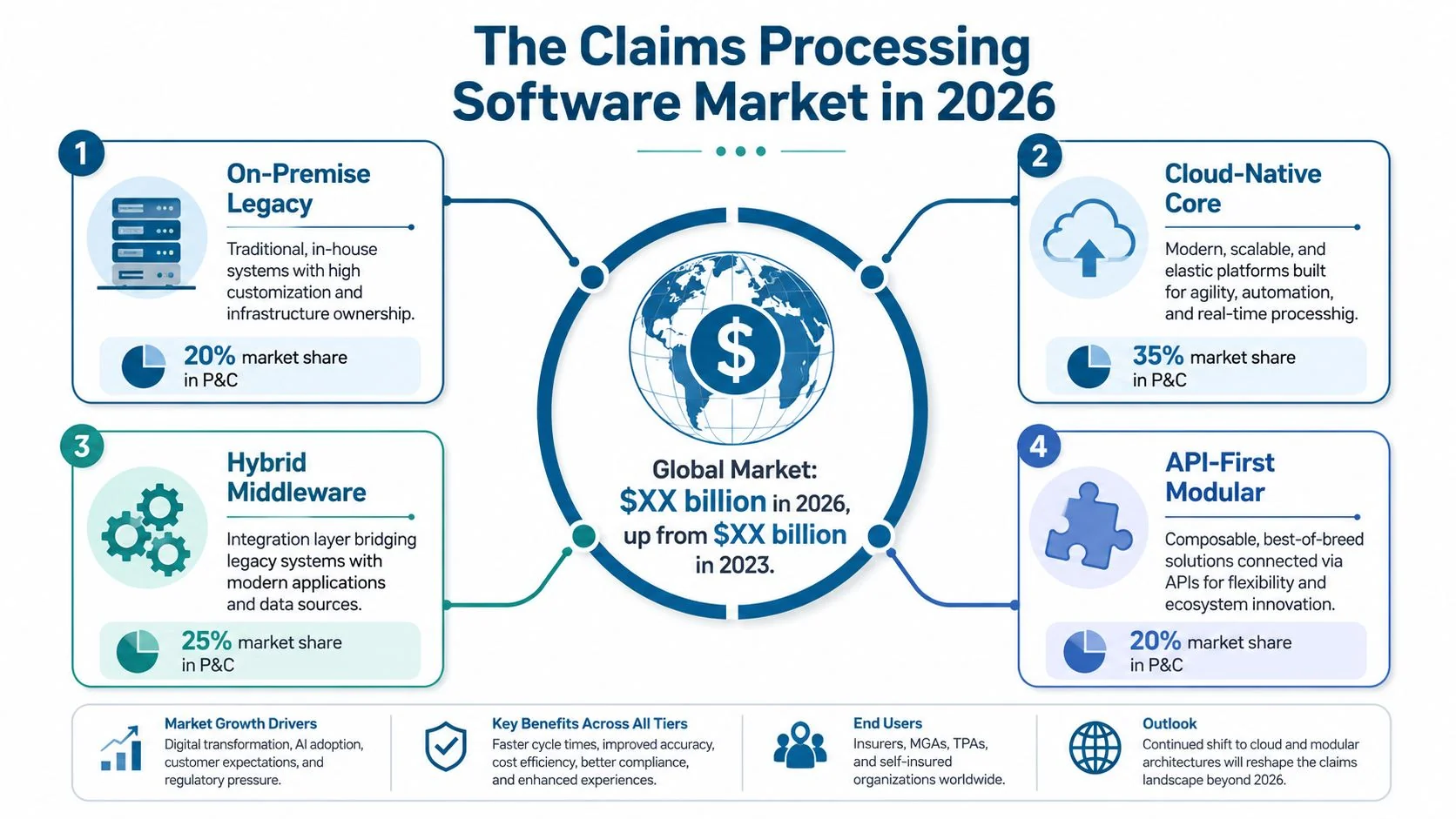
Four architectures buyers will encounter
Core-suite platforms place policy, claims, billing, workflow, and often reporting capabilities within a broad insurance operating environment. They can reduce application sprawl, but they usually create a substantial integration and migration footprint. Data tends to remain governed by the suite's canonical model.
Point-solution overlays sit above existing cores. They target intake, document classification, fraud referrals, payment, or adjuster productivity without replacing the system of record. This model preserves existing data ownership, but it can create orchestration problems if every overlay maintains a separate workflow state.
AI-native engines make machine learning, document intelligence, or decision automation central to the product rather than optional extensions. Their advantage is focused automation. Their constraint is that they still need dependable policy, customer, exposure, and historical claims data from surrounding systems.
Managed-services stacks combine software with outsourced operations. The provider may operate document intake, administrative review, payment support, or exception handling. This can reduce internal workload, but buyers must define ownership of data, audit evidence, model decisions, and service-level failures before signing.
Regulatory reporting requirements, including Solvency II reporting, IFRS 17 processes, and NAIC data calls, also influence architecture decisions. The practical question isn't whether a platform includes AI. It's whether it can produce traceable decisions, consistent data, and repeatable reporting across the claims lifecycle.
Buying principle: Treat claims processing software as an operating-model decision. Features matter only after data ownership, workflow authority, and integration responsibilities are clear.
For a broader view of how claims capabilities fit into enterprise architecture, compare the digital insurance platform framework.
How Claims Processing Software Fits the Claims Workflow
Claims software earns its value by controlling handoffs. A claim typically begins with the first notice of loss, then moves through triage, coverage verification, investigation, adjudication, payment, and recovery. Each stage needs a different type of automation, and the output from one stage becomes the input for the next.
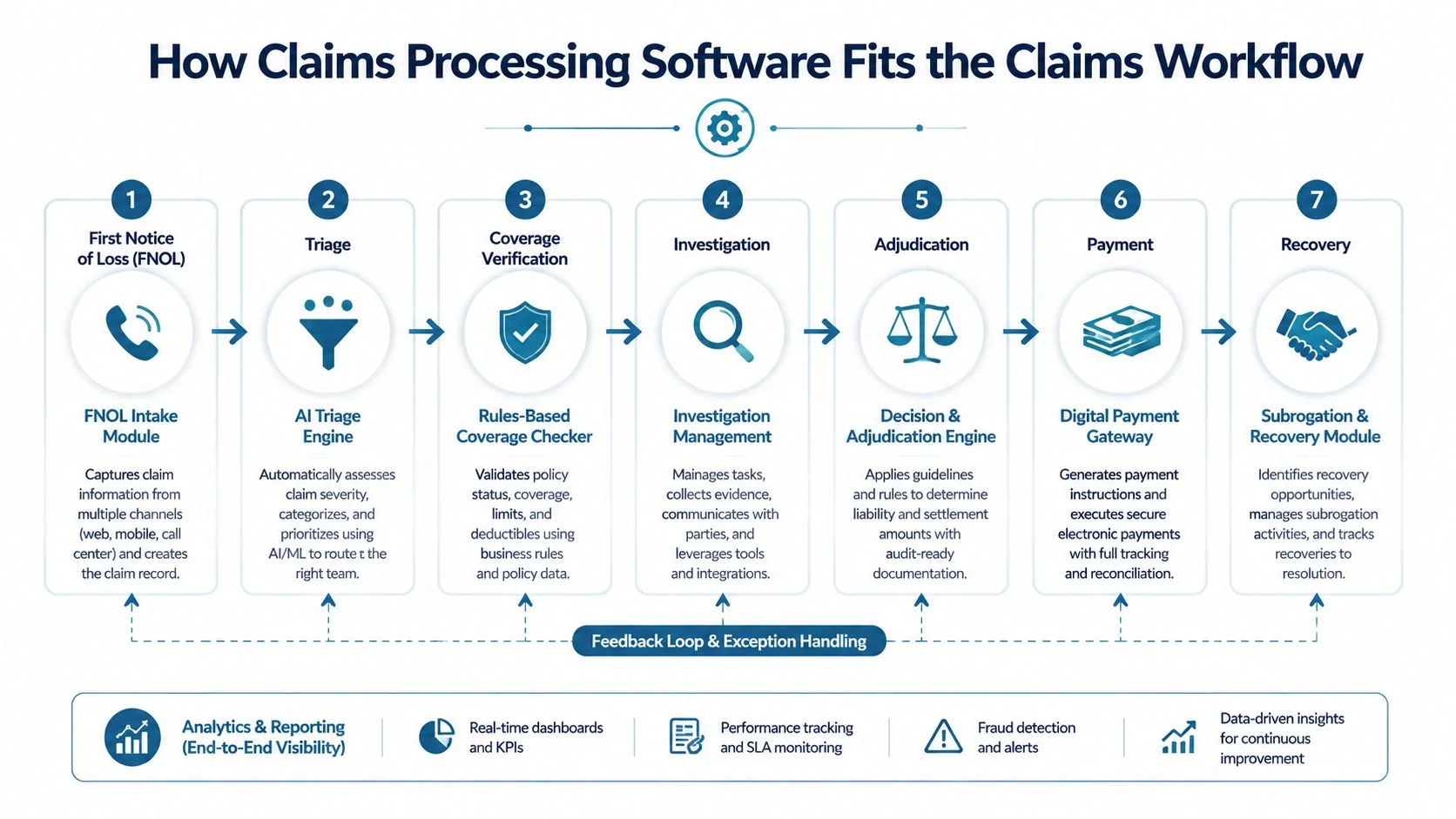
Seven stages, seven control points
-
First notice of loss captures the claim through a portal, contact center, mobile channel, or partner interface. Document intelligence can classify incoming forms, emails, photographs, and reports, creating a structured claim record instead of leaving adjusters to rekey information.
-
Triage assigns urgency, complexity, severity, and handling route. Rules engines manage predictable cases, while predictive models can identify claims requiring specialist attention. The measurable output is a routing decision, not a vague AI score.
-
Coverage verification checks policy status, limits, exclusions, deductibles, and relevant endorsements. A rules-based checker can accelerate standard validation, but ambiguous wording and conflicting records still require human review.
-
Investigation brings together statements, correspondence, external evidence, images, medical information, repair estimates, and internal history. Computer vision and anomaly detection can flag inconsistencies, but the investigator remains responsible for interpreting context.
-
Adjudication determines liability, eligibility, reserve treatment, and settlement authority. Straight-through processing works best when facts are complete, rules are stable, and the financial exposure is straightforward. Complex commercial, bodily injury, and disputed claims need escalation paths.
-
Payment connects approval to payment instructions, reconciliation, and claimant communication. Digital payment capabilities reduce administrative handoffs, but payment controls must preserve authorization and audit evidence.
-
Recovery covers subrogation, salvage, reinsurance, and related recoveries. A platform that closes the indemnity payment but loses recovery data has automated only part of the economic outcome.
Historical benchmarks in the academic RPA review reported straight-through processing rising from 15% to 75%, with 90% projected by 2030, and standard-form accuracy improving from 85% to 99%. Those figures describe automation potential, not a universal outcome. They're most relevant to repeatable, high-volume claims with standardized evidence.
Human adjudication remains essential where coverage interpretation, claimant vulnerability, disputed liability, or unusual evidence changes the decision. The right platform doesn't remove judgment. It reserves judgment for the cases where judgment adds value.
Comparing the Leading Claims Processing Platforms
A platform comparison is useful only when it separates verified operating evidence from marketing assumptions. Public materials may describe deployment options, APIs, configuration tools, and AI functions, yet comparable adjudication throughput is rarely disclosed across products. Treat throughput as not publicly disclosed unless the supplier provides a controlled test with comparable conditions.
| Platform category | Adjudication Throughput | AI Maturity | Integration Model | Target Line of Business |
|---|---|---|---|---|
| Core-suite claims platform | Not publicly disclosed on a comparable basis | Embedded automation and optional AI layers | Broad suite APIs, event integration, and partner connectors | Multi-line P&C and commercial insurance |
| Configurable cloud claims suite | Not publicly disclosed on a comparable basis | Workflow automation with expanding AI capabilities | Cloud APIs and configurable integration services | P&C, specialty, and regional carriers |
| Insurance software platform with claims modules | Not publicly disclosed on a comparable basis | Automation depends on selected modules and deployment scope | Core integration, APIs, and ecosystem connectors | P&C, specialty, and delegated authority |
| API-first claims platform | Not publicly disclosed on a comparable basis | AI commonly delivered through modular services | Open APIs and composable services | Digital insurers and multi-line carriers |
| Life and annuity claims platform | Not publicly disclosed on a comparable basis | Rules-led automation for structured workflows | Policy administration and enterprise integration | Life, annuity, and benefits |
| Claims workflow overlay | Not publicly disclosed on a comparable basis | Document AI, triage, summarization, or fraud integrations | Middleware, APIs, and connectors to existing cores | Cross-line use cases where replacement is impractical |
Eliminate by constraint before scoring features
Architecture is the first filter. A carrier with a mature core and fragmented intake may need an overlay. An insurer replacing a legacy claims estate may need a suite with a canonical data model. A digital entrant may place greater value on modular APIs than bundled functionality. The appropriate category depends on operational readiness, existing data structures, and the line of business being served.
Throughput requires the same discipline. A publicly reported adjudication performance test measured 270,000 claims per hour, equal to 75 claims per second, with an average of 240 claim lines per second on the tested configuration, as described in the Oracle OHI performance benchmark. That result describes one tested environment. It does not establish the rate a production workload will achieve across different claim types, integrations, controls, or exception volumes.
AI maturity should be assessed through operating evidence rather than feature labels. Buyers should ask which tasks are automated, what confidence threshold sends a case to human review, how model decisions are logged, and whether rules can be changed without rebuilding the workflow. A system may include advanced models yet perform poorly when its integration layer supplies incomplete or duplicated data.
The comparison should then move into the insurer's own claims taxonomy. Test representative claims, exception paths, document types, payment rules, and recovery scenarios. Include the handoffs that occur after adjudication, not only the decision itself. A platform that processes ordinary claims quickly but creates manual reconciliation elsewhere may deliver less value than a less prominent system with stronger workflow control.
The final score should reflect fit, not feature count. A platform suited to high-volume personal lines may be poorly matched to complex commercial claims, while a configurable workflow layer may suit an insurer that cannot replace its core. Buyers should record each conclusion as verified, observed in testing, or still undisclosed. That classification makes the procurement decision auditable and prevents an impressive benchmark from substituting for evidence about the insurer's actual operating model.
AI Integrations and Where ROI Shows Up
AI value appears first where work is repetitive and evidence is structured. Document intake, classification, extraction, triage, and summarization are easier to govern than autonomous settlement. Treating “AI claims automation” as one capability obscures the operating decision. Intake and adjudication carry different risks, controls, data requirements, and success measures.
| AI Capability | Claims Stage | Documented ROI | Adoption Maturity |
|---|---|---|---|
| OCR and document classification | FNOL and intake | Faster conversion of unstructured submissions into structured records | Mature for standard documents, weaker for inconsistent archives |
| NLP extraction and summarization | Investigation and adjuster review | Less manual reading and more consistent claim context | Established, with human validation still required |
| Rules and predictive triage | Routing and prioritization | Earlier escalation of complex or suspicious claims | Established for repeatable portfolios |
| Anomaly detection | Investigation and fraud referral | More consistent identification of unusual patterns | Dependent on clean historical data and investigator feedback |
| Generative assistance | Adjuster desktop and correspondence | Drafting and summarization support | Emerging, requiring prompt, access, and audit governance |
| Automated adjudication | Coverage and settlement | Faster handling of eligible, low-complexity claims | Narrower adoption because errors carry financial and regulatory consequences |
The table is a capability map, not a business case. A buying team should connect each function to a line of business, a measurable bottleneck, and a defined human-control point. A document model may suit predictable personal-lines intake while adding limited value to claims built around incomplete records, negotiated coverage, or specialist judgment.
Sequence investment by evidence quality
Start with intake when documents arrive in predictable formats and the main problem is rekeying. Move to triage when historical decisions are consistent enough to support meaningful routing rules. Add generative summarization only after the organization defines approved data access, review responsibility, and retention requirements.
Fraud models require particular caution. They can surface anomalies, but a referral is not a finding. Investigators need explainable signals, documented evidence, and a way to record whether a referral was useful. Without that feedback loop, the insurer may replace manual screening with a larger queue of machine-generated exceptions.
The practical threshold for further investment is operational, not technical. If each new model adds another score, alert, or review screen without improving claim outcomes, the integration is increasing control burden rather than producing value. Model interactions can also increase latency and audit complexity when staff cannot explain which signal drove a decision.
ROI should therefore be measured across the portfolio. Track cycle time, exception workload, payment accuracy, leakage, recovery performance, and claimant communication together. A faster first decision has limited value if downstream reconciliation, referrals, or customer contacts become harder to manage.
A practical reference for evaluating use cases is this claims processing insurance analysis. The buying distinction is between automating a task and improving the claim outcome. The first is easier to demonstrate. The second should determine whether the integration belongs in production.
Matching Claims Software to Use Case and Scale
Line of business determines the shape of a claims problem more reliably than a generic platform feature checklist. A high-volume auto book needs rapid intake, image evidence, estimating integration, and rules-driven routing. A life insurer needs document completeness, beneficiary validation, policy context, and controlled handling of infrequent but financially significant claims.
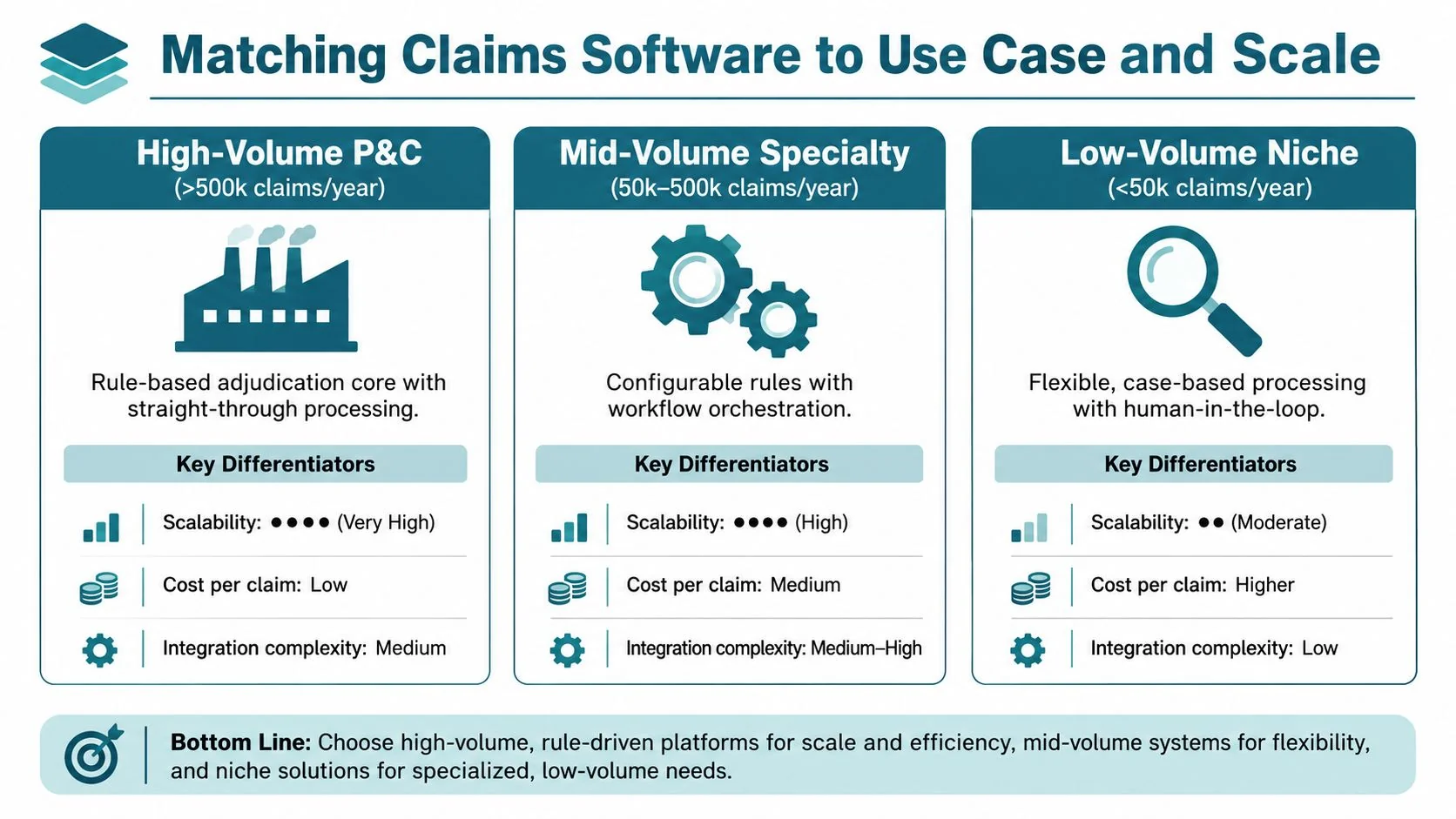
P&C and auto
High-volume P&C carriers should prioritize a durable adjudication core with API-accessible AI services. The core needs stable rules, reserve controls, payment authority, and recovery tracking. AI layers can then handle document intake, triage, image analysis, or correspondence without forcing the insurer to replace every surrounding system.
Mid-market P&C organizations often benefit from configurable cloud suites when their operations need standard workflows but lack the resources to maintain extensive custom infrastructure. The buying test is configurability without uncontrolled customization. If every jurisdiction or product variation requires bespoke code, the apparent simplicity of the suite can disappear during implementation.
Auto-first operations should test telematics ingestion, mobile evidence capture, photo-based assessment, repair-estimate integration, and claimant status updates. These capabilities are valuable only when they connect to adjudication and payment. A separate image tool that leaves adjusters copying decisions into the core has created another queue, not an automated workflow.
Life, annuity, and health
Life and annuity carriers should emphasize policy and beneficiary context, document validation, exception handling, and straight-through processing for structured claims. The platform must make it easy to identify missing evidence and preserve a clear record of why a claim moved to manual review.
Health insurers should put interoperability ahead of impressive automation demonstrations. Claims systems need dependable connections to eligibility, provider, clinical, coding, payment, and prior-authorization data. A model that speeds one document step but cannot reconcile provider or policy context may shift the problem rather than solve it.
Use operational signals to narrow the shortlist:
- Claim volume: Determines whether scale, unit economics, or configurability deserves priority.
- Severity profile: Indicates how much human adjudication and authority control the workflow needs.
- Regulator mix: Shapes reporting, audit, data retention, and jurisdictional configuration.
- Legacy age: Predicts integration effort more reliably than vendor presentation quality.
- Data condition: Determines whether AI can act or must first support data preparation.
The claims processing use-case framework is most useful when applied to these signals, not used as a substitute for them.
Why Implementation Failure Is Rarely About the Software
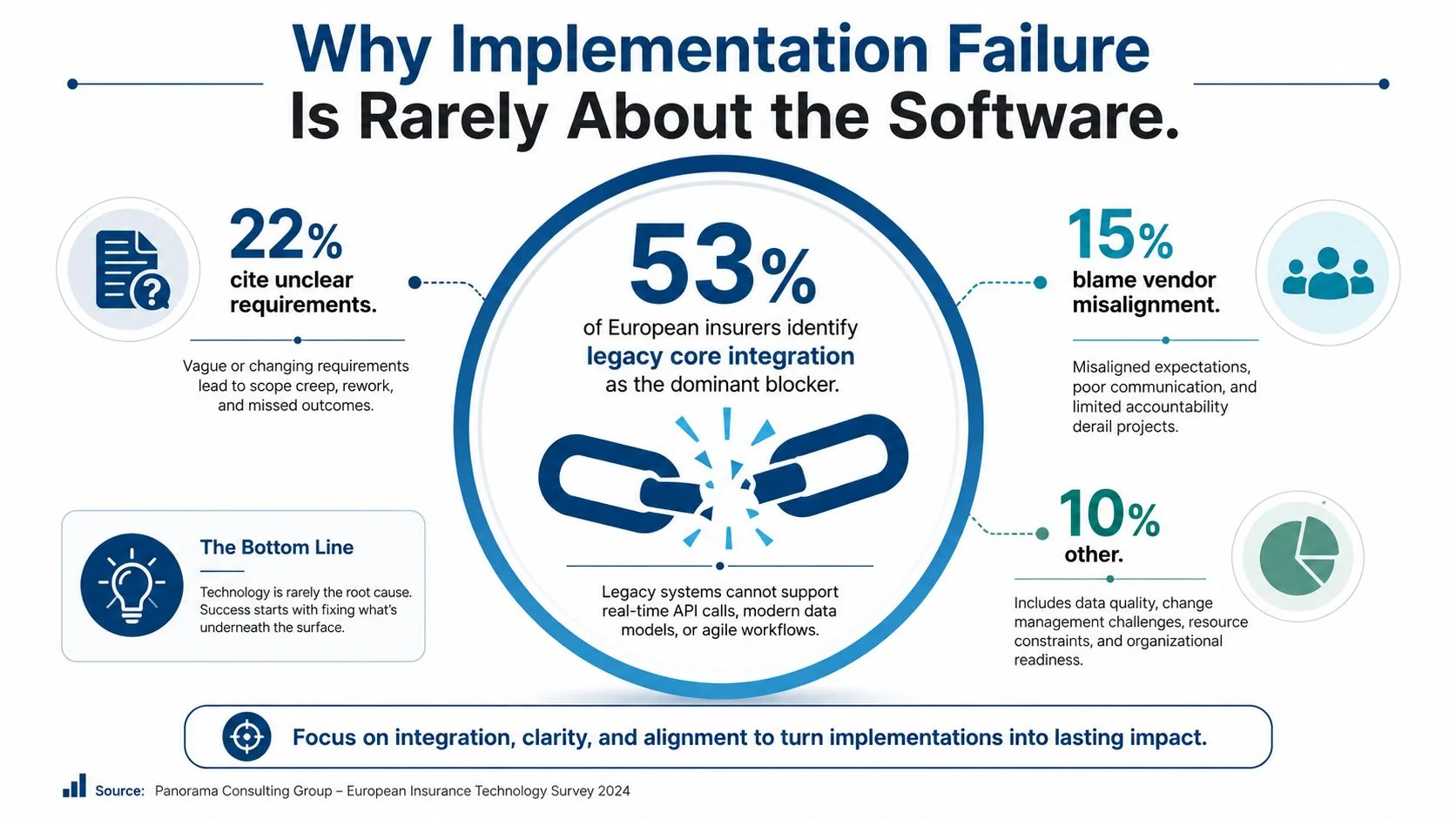
Feature-led procurement assumes deployment success follows from selecting the most capable product. Evidence points elsewhere. In a survey of European insurers, 53% identified legacy IT and integration complexity as their biggest obstacle, while 48% cited high implementation costs or unclear ROI and another 48% cited data-quality and structural issues, according to Precedence Research's claims processing software market coverage.
The hidden dependency chain
A claims platform depends on more than its own rules engine. It relies on policy records, customer identity, coverage history, document classification, payment instructions, adjuster notes, external evidence, and recovery fields. If those sources conflict, the platform can automate the conflict faster without producing a better decision.
Common failure conditions include:
- Inconsistent claim notes: Adjusters use different terminology for the same event, which weakens search, triage, and model training.
- Unstructured archives: Historical documents remain inaccessible to rules and models until classification and extraction standards are defined.
- Missing recovery fields: Subrogation or salvage opportunities disappear when the workflow closes without capturing the required data.
- Fragmented status ownership: Policyholders, agencies, adjusters, and carriers see different versions of the claim state.
Practical rule: A mid-tier platform with dependable middleware can outperform a richer suite if the middleware creates a reliable, shared claim record.
Implementation readiness should be a gating criterion before vendor scoring. Audit the claim taxonomy, map system dependencies, sample documents, observe adjuster workflows, and define who owns each exception. The organization should also decide which decisions require human approval and which can move automatically.
The contrarian conclusion is straightforward. Software capability is a multiplier, not a foundation. If the inputs are incomplete and the operating model is fragmented, adding AI increases the number of automated handoffs without fixing the underlying control problem.
Implementation Roadmap and Pre-Deployment Checklist
A disciplined rollout begins before procurement. The first task isn't a product demonstration. It's an evidence-building exercise that shows how claims enter the organization, where records become inconsistent, and which teams own exceptions.
Phase one focuses on discovery
Use a discovery sprint to audit data quality, legacy integration points, document archives, adjuster workflows, payment controls, and recovery fields. Do this before signing a contract so the business case reflects the migration and remediation burden.
The discovery output should include:
- A claims data map: Identify systems of record, duplicate fields, missing values, and conflicting definitions.
- A document inventory: Separate standard forms from correspondence, images, scanned files, and unclassified historical material.
- A workflow baseline: Record every manual handoff, approval, queue, and exception route.
- An integration register: Document interfaces, batch dependencies, event requirements, and ownership.
Phase two tests one operational slice
Pilot a single high-volume line with representative claim types and exception cases. Measure throughput, manual touchpoints, data-ingestion quality, indemnity variance, payment reconciliation, and claimant status visibility. A pilot that tests only clean claims will produce a misleading result.
Require the vendor to state what happens when extraction confidence is low, a policy record conflicts with a claim submission, or an external service becomes unavailable. Those answers reveal more about production readiness than a smooth demonstration.
Phase three expands only after control holds
Extend the platform to adjacent products only after the pilot meets agreed operational and control thresholds. Expansion should preserve the same data definitions, audit logic, exception ownership, and release governance.
The pre-deployment checklist should confirm:
- Data-quality accountability: The contract defines ingestion accuracy, remediation responsibilities, and escalation rules.
- Human oversight: Review thresholds, approval authority, and override recording are explicit.
- Security and compliance: Access, retention, audit trails, and regulatory reporting are tested.
- Change management: Adjusters, supervisors, compliance teams, and service staff receive workflow-specific training.
- Customer communication: Claim-status events trigger consistent, understandable notifications.
Reserve meaningful project capacity for adoption and workflow redesign. A technically successful deployment can still fail if adjusters don't trust the recommendations or customers can't see what happens after FNOL.
Final Recommendation by Buyer Profile
A regional P&C carrier should usually favor a configurable mid-market SaaS architecture with embedded intake and triage capabilities. The priority is controlled standardization, fast integration with existing policy and payment systems, and enough flexibility for local products. Building a bespoke AI layer is difficult to justify when the carrier lacks the data volume, specialist team, or change capacity to operate it responsibly.
A national multi-line carrier has a different problem. It needs an open core that can support multiple AI and workflow services without turning every innovation into a core replacement. The decision should focus on canonical data, API governance, release control, auditability, and the ability to separate low-complexity straight-through claims from specialist handling.
Life and annuity insurers should select for document completeness, policy context, beneficiary workflows, and controlled exception management. Their claims may not arrive with the same frequency as auto or property claims, but the financial and human consequences of an incorrect decision make traceability essential.
Health insurers should prioritize interoperability across clinical, provider, eligibility, coding, payment, and authorization systems. Straight-through processing is useful only when the underlying records agree and the organization can explain the decision to providers, members, auditors, and regulators.
Auto-first carriers should test the full evidence chain, from mobile FNOL and vehicle imagery through estimating, liability, settlement, payment, and recovery. An impressive image model isn't enough if adjusters still reconcile outputs manually.
Final buying test: Ask whether the platform improves the claimant's next interaction, not only the insurer's next transaction.
The most durable advantage won't come from adding another model to an already fragmented stack. It will come from coordinating first notice, document requests, status communication, adjuster activity, payment, and recovery around one authoritative claim state. A faster adjudication engine can reduce internal work, but customer confidence depends on knowing what has happened, what happens next, and who is responsible.
Before requesting proposals, benchmark your own workflow and publish the constraints vendors must meet. Then use the AI for Insurance database to compare documented implementations by line of business, use case, technology, and measured outcome. Start your shortlist with operational readiness, not feature volume, and require every finalist to prove performance against your real claim records and exception paths.
If your organization is evaluating claims processing software in 2026, build a readiness scorecard before booking vendor demos. Map your data, workflow, integration, human-review, and customer-communication requirements, then use those criteria to request evidence from shortlisted providers.
